

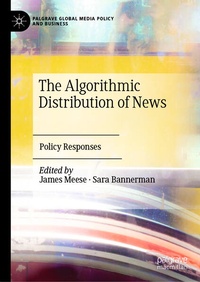
The Algorithmic Distribution of News
Description

This volume explores how governments, policymakers and newsrooms have responded to the algorithmic distribution of the news. Contributors analyse the ongoing battle between platforms and publishers, evaluate recent attempts to manage these tensions through policy reform and consider whether algorithms can be regulated to promote media diversity and stop misinformation and hate speech. Chapter authors also interview journalists and find out how their work is changing due to the growing importance of algorithmic systems. Drawing together an international group of scholars, the book takes a truly global perspective offering case studies from Switzerland, Germany, Kenya, New Zealand, Canada, Australia, and China. The collection also provides a series of critical analyses of recent policy developments in the European Union and Australia, which aim to provide a more secure revenue base for news media organisations. A valuable resource for journalism and policy scholars and students, Governing the Algorithmic Distribution of News is an important guide for anyone hoping to understand the central regulatory issues surrounding the online distribution of news.
More details
Other editions
Additional editions
Persons
James Meese is Senior Lecturer at RMIT University, Australia, and Associate Investigator with the ARC Centre of Excellence for Automated Decision Making and Society.
Sara Bannerman is Associate Professor at McMaster University, Canada, and Canada Research Chair in Communication Policy and Governance.
Content
Chapter 1: Introduction: Governing the Algorithmic Distribution of the News.- Part 1: In the newsroom: algorithms, bots, business models, and privacy.- Chapter 2: Governing the Algorithmic Distribution of News in China: The Case of Jinri Toutiao.- Chapter 3: Algorithms, Platforms, and Policy: The Changing Face of Canadian News Distribution.- Chapter 4: Good Morning, Here's Today's News': Delivering News via the Australian Broadcasting Corporation's Facebook Messenger Chatbot.- Chapter 5: Algorithms and the News Media in Kenya: Emerging Issues in Data Policy and Accountability.- Chapter 6: Advertising, algorithms and audiences: The unchanging economics of online journalism.- Part 2: Current approaches: Copyright or Competition.- Chapter 7: Australian and EU Policy Responses to Algorithmic News Distribution: A Comparative Analysis.- Chapter 8: Private Property vs. Public Policy Vision in Ancillary Copyright Law Reform.- Chapter 9: Big Tech and News: A Critical Approach to DigitalPlatforms, Journalism, and Competition Law.- Part 3: Regulatory Challenges.- Chapter 10: New Zealand: Curbing Hate Speech, But Leaving Platforms to Self-Regulate.- Chapter 11: Diversity, Fake News, and Hate Speech: The German Response to Algorithmic Regulation.- Chapter 12: Switzerland, Algorithms, and the News: A Small Country Looking for Global Solutions.- Part 4: Future horizons: Algorithms and media policy.- Chapter 13:Towards Platform Democracy: Imagining an Open-Source Public Service Social Media Platform.- Chapter 14:Access Diversity Through Online Media and Public Service Algorithms: An Analysis of News Recommendation in Light of Article 10 ECHR.- Chapter 15: The Shortcomings of the Diversity Diet: Public Service Media; Algorithms, and the Multiple Dimensions of Diversity.
