

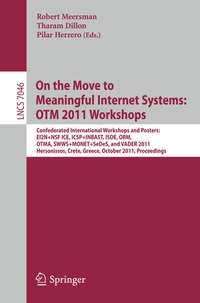
On the Move to Meaningful Internet Systems: OTM 2011 Workshops
Confederated International Workshops and Posters, EI2N+NSF ICE, ICSP+INBAST, ISDE, ORM, OTMA, SWWS+MONET+SeDeS, and VADER 2011, Hersonissos, Crete, Greece, October 17-21, 2011, Proceedings
Published on 30. October 2011
XXXIV, 665 pages
978-3-642-25126-9 (ISBN)
Description

This volume constitutes the refereed proceedings of nine international workshops, EI2N+NSF ICE, ICSP, INBAST, ISDE, MONET, ORM, SeDeS, SWWS, and VADER 2011, held as part of OTM 2011 in Hersonissos on the island of Crete, Greece, in October 2011. The 64 revised full papers presented were carefully reviewed and selected from a total of 104 submissions. The volume also includes three papers from the On the Move Academy (OTMA) 2011 and five ODBASE 2011 poster papers. Topics of the workshop papers are enterprise integration and semantics, information centric engineering, interoperability, industrial and business applications of semantic Web applications, information systems in distributed environments, process management in distributed information system development, distributed information systems: implementation issues and applications, industrial applications of fact-oriented modeling, data warehouse modeling, extensions to fact-oriented modeling, model validation procedures, schema transformations and mapping, semantic Web and Web semantics, ontology development, deployment and interoperability, data access and efficient computation, efficient information processing, exchange and knowledge synthesis algorithms, mobile and networking technologies for social applications, semantic and decision support, variability in software architecture, and dynamic and adaptive architectures.
More details
Other editions
Additional editions
Robert Meersman | Tharam Dillon | Pilar Herrero
On the Move to Meaningful Internet Systems: OTM 2011 Workshops
Confederated International Workshops and Posters, EI2N+NSF ICE, ICSP+INBAST, ISDE, ORM, OTMA, SWWS+MONET+SeDeS, and VADER 2011, Hersonissos, Crete, Greece, October 17-21, 2011, Proceedings
Book
11/2011
1st Edition
Springer
€53.49
Shipment within 7-9 days
Content
- Title
- Volume Editors
- General Co-chairs' Message forOnTheMove 2011
- Organization
- Computing for Human Experience: Semantics Empowered Cyber-Physical, Social and Ubiquitous Computing beyond the Web
- Privacy and the Cloud
- The Social Compute Unit
- GENI - Global Environment for Network Innovations
- Table of Contents
- On the Move Academy (OTMA) 2011
- The 8th OnTheMove Academy Organizers' Message
- A Framework Proposal for Intelligent Management of Unexpected Exceptions in Workflow
- Introduction
- Exception Management
- Exception Classification
- Exception Management
- Related Work
- Research Questions
- Research Methodology
- Theory Elaboration
- Prototype Implementation
- Evaluation
- Conclusion
- References
- Towards Designing Enterprises for Evolvability Based on Fundamental Engineering Concepts
- Introduction: The Challenge of Changing Complexity
- Research Motivation and Objectives
- Related Work
- Normalized Systems Theory
- Extending NS Theory to the Organizational Level
- Research Methodology and Anticipated Research Activities
- Conclusions and Anticipated Contributions
- References
- An Application Framework for Open Application Development and Distribution in Pervasive Display Networks
- Introduction
- Motivation
- Thesis
- Challenges
- Related Work
- Research Design
- Conclusion
- References
- Posters of Ontologies, DataBases, and Applications of Semantics (ODBASE) 2011
- ODBASE 2011 PC Co-chairs' Message
- ODBASE 2011 Posters
- FTMOntology: An Ontology to Fill the Semantic Gap between Music, Mood, Personality, and Human Physiology
- Introduction
- The FTMOntology
- Reference
- Semantics-Preserving Mappings between XML Schemas in P2P Data Integration Systems
- References
- Using Information Extractors with the Neural ElectroMagnetic Ontologies
- Introduction
- Experiments and Results
- Discussion and Conclusion
- References
- SemTrace: Semantic Requirements Tracing Using Explicit Requirement Knowledge
- Embedding User's Requirements in Data Warehouse Repositories
- Introduction
- Proposed Design Method
- Conclusion
- References
- Workshop on Enterprise Integration, Interoperability and Networking with Information Centric Engineering and Cybertechnologies (EI2N+NSF ICE) 2011
- EI2N+NSF ICE 2011 PC Co-chairs' Message
- Enterprise Integration and Semantics
- Towards Semantic Interoperability Service Utilities
- Introduction
- Interoperability, Semantic Interoperability and ISU
- Semantic Interoperability Service Utilities
- Conclusion
- References
- Interoperability Analysis: General Concepts for an Axiomatic Approach
- Introduction
- Axiomatic Approach for Interoperability (Io) Analysis
- Setting the Axioms for Interoperability Analysis
- Implications of the Axiomatic Approach
- Interoperability Analysis: A Show Case
- Scope of Interoperation
- Actors Recognition
- General Features of Interaction
- Modelling Interaction
- Concluding Summary
- References
- Semantic Annotation Model Definition for Systems Interoperability
- Introduction
- What Is Semantic Annotation?
- Semantic Annotation
- Formal Definition of Semantic Annotation
- Why, Where and How to Use Semantic Annotation?
- Step 1: Design or Select Ontology
- Step 2: Design the Semantic Annotation Structure Model
- Step 3: Develop the Application
- A Simple Case Study
- Conclusions
- References
- Information Centric Engineering
- Monitoring Morphisms to Support Sustainable Interoperability of Enterprise Systems
- Introduction
- Model-Based Systems Engineering
- Requirements on Modelling
- Information Models and Data Standards for Interoperability
- Models Morphisms (MoMo)
- Semantic Mismatches
- Knowledge Enriched Tuple for Mappings Representation
- Monitoring Morphims for Sustaining Interoperability in MBSE
- MIRAI Framework and Workflow
- Agents Architecture
- Case Study
- Conclusions and Future Work
- References
- The Role of Coordination Analysis in Software Integration Projects
- Introduction
- The Method
- Coordination Patterns
- Discovering Coordination Patterns
- The Strategy
- A Case-Study in Architectural Analysis
- Conclusions and Future Work
- References
- Information Centric Frameworks for Micro Assembly
- Introduction
- Literature Review
- Cyber Architecture of Proposed Approach
- Architecture of Work Cells 1 and 2
- Working of Work Cell 2
- Using Measurement Services in the Information Centric Framework
- Life Cycle of Micro Devices Assembly
- Conclusion
- References
- Interoperability Case Studies
- Towards Interoperability through Inter-enterprise Collaboration Architectures
- Introduction
- Conceptualization of Enterprise Engineering and Enterprise Architectures
- Enterprise Engineering
- Enterprise Integration
- Enterprise Architecture
- Conceptualization of Enterprise Collaboration
- Definition of Enterprise Collaboration
- Description Collaboration Process
- Relationships between the Fields of Enterprise Architecture and Enterprise Collaboration
- Analysis of Enterprise Architecture Frameworks in the Context of Collaboration
- Analysis of the Methodologies in Enterprise Architectures in the Context of Collaboration
- Analysis of Modeling Languages in Enterprise Architectures in the Context of Collaboration
- Conclusions
- References
- Effective Disaster Management: An Interoperability Perspective
- Introduction
- Current Issues in Disaster Management
- Interoperability Frameworks
- Disaster Management Interoperability
- Enterprise Architecture, Life Cycle and Disaster Management
- Conclusions and Further Work
- References
- Design of Large-Scale Enterprise Interoperable Value Webs
- Introduction
- Business Based on Value Propositions
- Modelling Business Concepts as Ontology
- An Example: Logistics
- Technology Support for Data Sharing and Tools
- Technology Support of Business Concepts
- Management: Interoperability Ontology
- Tools for Specializing the Business Interoperability Ontology
- Conclusions and Further Research
- References
- Workshop on Industrial Case Studies Program and Industrical and Business Applications of Semantic Web Technologies (ICSP+INBAST) 2011
- ICSP 2011 PC Co-chairs' Message
- Realising the Flanders Research Information Space
- Context
- FRIS High Level Engineering Principles
- Two Cases
- Business Vocabulary Definition
- Grounding Business Rules
- Discussion
- Future Work and Conclusion
- References
- Discovering Potential Synergies between Research Projects and Standardisation, the COIN Case
- Introduction
- The Starting Point
- The Methodology
- Construction of the Domain Grid
- Conclusion
- References
- Applications of Ontologies for Assembling Simulation Models of Industrial Systems
- Introduction
- Related Work
- Problem Scope and Research Issues
- Ontology-Based Formalization of Knowledge
- Automatic Ontology-Based Selection of Blocks
- Use-Case: Simplified Electrical Circuit
- Conclusion and Future Work
- References
- Fact-Based Service Modeling in a Service Oriented Architecture
- Introduction
- Related Work
- Related Work on Conceptual Modeling Approaches
- Related Work on Process Modeling
- Related Work on Service-Oriented Architecture
- Related Work on the Modeling of Service-Oriented Enterprise Architectures
- Fact-Based Conceptual Modeling of the SRO
- The SRO UoD: The ABC Company's Carrier Selection Business Process
- Derivation Rules
- Fact-Based Conceptual Modeling of the SDO
- Conclusion
- References
- A Lightweight Data Integration Architecture Based on Semantic Annotated RSS Feeds
- Introduction
- Related Work
- Emergency Management Use-Case
- Semantic GeoRSS Data Integration
- Conclusion and Future Works
- References
- Workshop on Information Systems in Distributed Environments (ISDE) 2011
- ISDE 2011 PC Co-chairs' Message
- Process Management in Distributed Information System Development
- A Model-Driven Approach for Deploying Trading-Based Knowledge Representation Systems
- Introduction
- Description of the MDE-TKR Approach
- Trading-Based Knowledge Representation System Metamodel
- Implementation Repository Metamodel
- System Configuration Metamodel
- System Configuration Language
- Code Generation
- Case Study: SOLERES-KRS
- Conclusions and Future Work
- References
- Software Quality Management Improvement through Mentoring: An Exploratory Study from GSD Projects
- Introduction
- A Review of the Literature on Mentoring
- Study: Impact of Mentoring on SQM in GSD Scenarios
- Research Design
- Sample Description
- Results
- Discussion
- Limitations of the Study
- Conclusions
- Future Work
- References
- Towards a Framework for Work Package Allocation for GSD
- Introduction
- Task Allocation in GSD
- A Framework for Work Package Allocation in GSD
- Framework Construction Process
- Factors: Initial Steps
- Testing Environment
- Conclusions and Future Work
- References
- Distributed Information Systems: Implementation Issues
- Scalable Data Management in Distributed Information Systems
- Introduction
- Scalability Mechanisms
- Scalable Systems
- Key-Value Stores
- Megastore
- Hyder
- SQL Azure
- VoltDB
- Conclusions
- References
- Communications in Global Software Development: An Empirical Study Using GTK+ OSS Repository
- Introduction
- Communications in GNOME GTK+ Project
- Data Mining Process
- Analysis and Results
- The Correlations between Synchronous and Asynchronous Communication
- Exploring Communication Participants
- Email Response Time Delay
- Conclusions
- References
- Distributed Information Systems Applications
- Varying Levels of RFID Tag Ownership in Supply Chains
- Introduction
- The Proposed Authentication Protocol
- The Scenario
- The Event Sequence
- Notations
- The Protocol
- Security Analysis
- Discussion
- References
- Workflow Validation Framework in Distributed Engineering Environments
- Introduction
- Related Work
- Heterogeneous Engineering Environments
- Workflow Validation
- Research Issues
- Solution Approach
- A Power Plant Workflow Management System
- Framework for Integrating and Validating Heterogeneous Workflows
- Prototype Implementation
- Manual Signal Change Management
- Automated Signal Change Management
- Implementation of Workflows into Petri Net Diagram
- Conclusion and Future Work
- References
- Use Cases and Object Modelling Using ArgoUML
- Introduction
- Software Project Development
- Benefits of Using ArgoUML in a Distributed Team
- Conclusion
- References
- Workshop on Fact-Oriented Modeling (ORM) 2011
- ORM 2011 PC Co-chairs' Message
- Industrial Applications of Fact-Oriented Modeling
- ORM and Retirement of Outdated Business System
- Introduction
- BSC Justification for DRSiSCO
- Objectives for DRSiSCO
- Data Quality and Good Models
- Timeline and Team Structure
- Architecture Analysis
- As-Is and To-Be States
- ORM Process
- The ORM Result
- Conclusion: ORM Experiences
- References
- A Metamodel for Orchestrating Service Requirements in an SQL-Environment
- Introduction
- Foundational Principles
- The Simplistic Canonical Collaboration Model
- Collaboration View Canonical Retrieve
- Collaboration View Canonical Retrieve and Canonical Search
- Collaboration View Canonical Create and Canonical Update
- Master Data Hub Based Canonical Collaboration Model
- Master Data Hub Based Collaboration View Canonical Retrieve
- Master Data Hub Based Collaboration View Canonical Retrieve and Search
- Master Data Hub Based Collaboration View Canonical Create and Update
- Metamodel for Orchestrating Service Requirements
- Conclusion
- References
- Enterprise Data Architecture: Development Scenarios Using ORM
- Introduction
- BSC System Development Scenarios
- OTSS Configuration and Customization Overview
- Enterprise Metadata to Address Integration
- OTSS Integration Process
- Detailed Description of OTSS Integration Process
- Future Considerations
- Conclusion
- References
- Data Warehouse Modeling
- An Advanced Generation Model for a Security Data Warehouse
- Current Scenarios and Gaps
- The Basic Process Model for Information Security Management
- Supporting Fact Based Models
- Functional Grouping for P1 ESTABLISH SECURITY
- Functional Grouping for P2 SPECIFY SECURITY
- Functional Grouping for P3 IMPLEMENT SECURITY
- Functional Grouping for P4 & P5 OPERATING SECURITY, MONITOR SECURITY
- Conclusion
- References
- Modeling Slowly Changing Dimensions in ORM
- Introduction
- Dimensional Modeling and History in Dimensions
- ORM Schemas
- Transactions and Rules
- Conclusion
- References
- Extensions to Fact-Oriented Modeling
- Enriched Support for Ring Constraints
- Introduction
- Reflexive and Irreflexive Constraints
- Transitive, Intransitive, and Strongly Intransitive Constraints
- Combining Ring Constraints
- Conclusion
- References
- Value Grouping Transformations in ORM
- Introduction
- Dimensional Modeling
- ORM Schema Transformations
- Value Grouping
- Conclusion
- References
- Model Validation Procedures
- A Derivation Procedure for Set-Comparison Constraints in Fact-Based Modeling
- Introduction
- The Conceptual Schema Design Procedure in Fact Based Modeling
- The Running Example: Tax Collection
- A Formal Derivation Procedure for Set-Comparison Constraints (CSDP Step 6)
- Conclusion
- References
- A Dialogue Game Prototype for FCO-IM
- Introduction
- Theoretical Retrospect: Modeling as a Dialogue Game
- The Prototype: Analysis, Design, Evaluation
- Conclusions and Further Research
- References
- Directly Applied ORM Constraints for Validating and Verifying Semantic Decision Tables
- Introduction
- Background
- Related Work
- ORM/ORM2 Constraints for SDT V&V
- Conclusion and Future Work
- References
- Schema Transformations and Mapping
- Roles in ORM: A Suggested Semantics
- Introduction
- The Need for a Definite Meaning of "Role-Playing" in ORM
- The Need for ORM Reference-Scheme Reduction Transforms
- Our Suggested Semantics for Attribution of "Role-Playing"
- How Using This Semantics Addresses Such Redundancy Issues
- Why This Semantics Is the Best Way to Address Such Issues
- What It Would Take for ORM to Escape Any Taint from These Problems
- What It Would Take to Distinguish Correctly a "Canonical" ORM Subset
- What Would Suffice to Divest Anomalous ORM Structures of Meaning
- Conclusion
- References
- Formal Specification of a Meta Hierarchical Logical Data Model Using Object Role Modeling
- Introduction
- Data Structure Types and Strict Physical Hierarchy
- Identifier Concepts
- Logical Parent-Child Relationship Type Concept
- Conclusions and Further Research
- References
- Workshop on Semantic Web and Web Semantics (SWWS+MONET+SeDeS) 2011
- SWWS 2011, MONET 2011 and SeDeS 2011 PC Co-chairs' Message
- Ontology Development, Deployment and Interoperability (ODDI)
- An Ontology-Driven Search Module for Accessing Chronic Pathology Literature
- Introduction
- Architecture
- Natural Language Processing Tool
- Search
- Ontology/Thesaurus Module
- Ontology Enrichment Tool
- Evaluation
- Conclusions
- References
- KD2R: A Key Discovery Method for Semantic Reference Reconciliation
- Introduction
- Reference Reconciliation Based on Key Constraints
- Ontology and Data Model
- Constraint Integration in Reference Reconciliation
- Key Discovery Problem Statement
- KD2R: Key Discovery Method for Reference Reconciliation
- Keys, Non Keys and Undetermined Keys
- KD2R Algorithm
- First Experiments
- Conclusions and Future work
- References
- A Framework for Change Impact Analysis of Ontology-Driven Content-Based Systems
- Introduction
- Ontology-Driven Content-Based Systems
- Layered Architecture of ODCBSs
- Running Example
- Graph-Based Representation of ODCBS
- Dependency in ODCBSs
- Types of Dependencies
- Dependency within and among Layers
- Impact of Changes in ODCBSs
- Types of Ontology Change Impact
- Severity of Change Impacts
- Discussion and Related Work
- Conclusion and Future Work
- References
- Introducing Layers of Abstraction to Semantic Web Programming
- Introduction
- A Concept Framework for Semantic Web Programming
- Environment
- Our Use of the Term "Concept"
- A DSL for Specifying Concepts
- Framework Implementation
- Application: Reasoning over Business Process Models
- Application Scenario
- Sample Business Processes
- Language Stack and Layers of Abstraction
- Concepts
- Querying and Reasoning
- Evaluation
- Comparison with Semantic Web Technologies
- Related Work
- Conclusions
- References
- Onto-Ann: An Automatic and Semantically Rich Annotation Component for Do-It-Yourself Assemblage
- Introduction
- Background and Related Work
- Onto-Ann
- Discussion, Conclusion and Future Work
- References
- Ontology to Represent Similarity Relations between Public Web Services
- Introduction
- Related Work
- Ontology to Represent Similarity Relations
- Similarity Measures
- Similarity Relations Discovery
- Inference Rules
- Experimental Setup
- Conclusions
- References
- The Role of Class Dependencies in Designing Ontology-Based Databases
- Introduction
- Basic Concepts and Formalization
- Taxonomy of Ontologies
- Dependencies between Ontological Concepts
- A Formal Model for Ontologies
- A Formal Model for Dependency Graph
- Our Proposal
- Different Phases of our Methodology
- Case Study
- Meta-Schema Part Deployment
- Ontology Part Deployment
- Data Part Deployment
- Conclusion
- References
- Data Access and Efficient Computation (DAEC)
- An Access Control Model for Linked Data
- Introduction
- The DataLift Use Case
- Access Control for Linked Data
- Social Semantic SPARQL Security for Access Control Ontology
- The Access Control Policies
- Related Work
- Conclusions
- References
- Efficient RDFS Entailment in External Memory
- Introduction
- Related Work
- RDFS Entailment
- Physical Representations of RDFS Graphs
- Experimental Design
- Test Data
- Test Queries
- Implementation and Execution
- Empirical Results and Analysis
- Concluding Remarks
- References
- Linked Data Indexing Methods: A Survey
- Introduction
- Analysis
- General Issues
- Classification of Approaches
- Approaches
- Local Approaches
- Distributed Approaches
- Global Approaches
- Summary
- Approaches Comparison
- Open Problems
- Conclusion
- References
- Efficient Information Processing, Exchange and Knowledge Synthesis Algorithms (EIPKS)
- Noise Reduction in Essay Datasets for Automated Essay Grading
- Introduction
- Existing AEG Approaches
- Methodology and Approach
- Results
- Discussion
- Conclusion
- References
- CAREY: ClimAtological ContRol of EmergencY Regions
- Introduction
- Motivating Example
- Related Work
- Our Approach
- The CAREY Architecture
- Experimental Study
- Performance and Quality of the CAREY Clustering Techniques
- Quality and Performance of the CAREY Two-Fold Approach
- Conclusions and Future Work
- References
- Reasoning with the Depth-First Iterative Deepening Strategy in the DLog System
- Introduction
- Principles of the DLog Reasoner
- Depth-First Iterative Deepening Search in DLog
- Experimental Results
- Final Remarks
- References
- Model-Driven Approach to XML Schema Evolution
- Introduction
- Motivation
- Language for Designing XML Formats
- Platform-Independent Model (PIM)
- Platform-Specific Model (PSM)
- Operations
- Propagation of Atomic Operations
- Evaluation
- Conclusions
- References
- Mobile and Networking Technologies for Social Applications (MONET)
- Towards a Characterization of Egocentric Networks in Online Social Networks
- Introduction
- Data Acquisition
- Data Analysis
- Socio-demographic Variables
- Relational Variables
- Discussion
- Conclusions
- References
- Privacy Preserving Gate Counting with Collaborative Bluetooth Scanners
- Introduction
- Bluetooth-Based Collaborative Gate Counting
- Objectives
- Probabilistic Counters for Privacy-Enhanced Gate Counting
- Bloom Filters
- Hash Sketches
- Comparative Analysis
- Criteria
- Analysis
- Conclusion
- References
- Touristic Valorisation: A Niche of Interest for Multimodal Information Exploitation
- Background
- Application Scenario
- Aim of the Work
- Methodology
- Proposed Tools and Technical Solutions
- Multimodal Interaction: A Use Case
- Conclusions
- References
- Assessing Feedback for Indirect Shared Interaction with Public Displays
- Introduction
- Related Work
- PuReWidgets
- Usage Scenario
- User Study
- Procedure and Tasks
- Results
- Discussion
- Conclusion
- References
- Toward New Communication Paradigms to Enhance Cognitive and Learning Processes
- Introduction
- The Definition of a New Paradigm
- Emotions
- Aesthetic or Functional Quality
- The Sense of Presence
- The Semantic Communication
- A Gaming Application Scenario
- Conclusion
- References
- Semantic and Decision Support (SeDeS)
- A Decision Support System Based on Metaheuristic Model for Aircrafts Landing Problems
- Introduction
- Problem Formulation
- Linear Objective
- Non-linear Objective
- Basic Particle Swarm Optimization
- PSO Components
- Swarm Size
- Inertia Weight
- Acceleration Coefficients
- Stopping Condition
- Computational Results
- Conclusions and Future Work
- References
- Comparing XML Files with a DOGMA Ontology to Generate O-RIDL Annotations
- Introduction
- Background
- Developing Ontology Guided Methods and Applications
- O-RIDL
- Related Work on Matching Techniques
- Method
- Heuristics
- Experiment
- Conclusions
- References
- On the Relation between Decision Structures, Tables and Processes
- Introduction
- Related Work
- Decision Structures and Modeling
- The Structure of Decision Tables
- The Structure of Decisions
- From Decision Modeling towards Decision Process Modeling
- Decision Execution Strategies
- Evaluating Decision Processes
- Conclusion
- References
- Ontology-Based Approach for Context-Dependent Annotation Templates Recommendations
- Introduction
- Approach Description
- TAS3Knowledge Annotator Use Case
- Related Work
- Conclusions and Future Work
- References
- Maturity Model as Decision Support for Enterprise Interoperability
- Introduction
- Overview of the Maturity Model for Enterprise Interoperability
- Interoperability Diagnosis and Partner's Choice Using MMEI
- Conclusion and Perspectives
- References
- Workshop on Variability, Adaptation and Dynamism in Software Systems and Services (VADER) 2011
- VADER 2011 PC Co-chairs' Message
- Variability in Software Architecture
- A Process for Documenting Variability Design Rationale of Flexible and Adaptive PLAs
- Introduction
- Background
- Flexible-PLA Metamodel
- PLAK Metamodel
- The Process for Documenting PLAs
- Illustrating the Process
- Discussion
- Conclusions and Further Work
- References
- Evolving KobrA to Support SPL for WebGIS Development
- Introduction
- WebGIS Domain
- Related Works
- KobrA in a Nutshell
- Evolved KobrA Containment Tree for Supporting WebGIS Domain Engineering
- Case Study
- Tool Support
- Conclusions and Future Work
- References
- Towards a Development Framework Based on Behavior Recombination
- Introduction
- The Behavioral Recombination Framework
- Behavior Predicates
- Abstracting the Behavior
- Recombining the Behaviors
- Related Work
- Conclusion
- References
- Dynamic and Adaptive Architectures
- Dynamic Adaptation through Event Reconfiguration
- Introduction
- Related Work
- Programming with INI
- Events in INI
- Example
- Events Synchronization and Reconfiguration
- Events Synchronization
- Example Using Synchronization
- Event Reconfiguration
- Conclusion and Future Work
- References
- Towards a Reference Architecture for Mashups
- Introduction
- Mashup Applications and Mashup Development - An Overview
- Architectural Requirements for Mashup Applications
- Deriving Reference Architecture
- Example Implementation
- Conclusions
- References
- Adaptation Patterns in Multi-Agent Architectures: The Gathering Pattern
- Introduction
- Lifecycle of Self-organising Structures
- Adaptation Patterns: The Gathering
- Conclusions and Further Work
- References
- Author Index
