

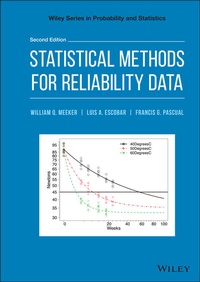
Statistical Methods for Reliability Data
Description

Statistical Methods for Reliability Data, Second Edition (SMRD2) is an essential guide to the most widely used and recently developed statistical methods for reliability data analysis and reliability test planning. Written by three experts in the area, SMRD2 updates and extends the long- established statistical techniques and shows how to apply powerful graphical, numerical, and simulation-based methods to a range of applications in reliability. SMRD2 is a comprehensive resource that describes maximum likelihood and Bayesian methods for solving practical problems that arise in product reliability and similar areas of application. SMRD2 illustrates methods with numerous applications and all the data sets are available on the book's website. Also, SMRD2 contains an extensive collection of exercises that will enhance its use as a course textbook.
The SMRD2's website contains valuable resources, including R packages, Stan model codes, presentation slides, technical notes, information about commercial software for reliability data analysis, and csv files for the 93 data sets used in the book's examples and exercises. The importance of statistical methods in the area of engineering reliability continues to grow and SMRD2 offers an updated guide for, exploring, modeling, and drawing conclusions from reliability data.
SMRD2 features:
* Contains a wealth of information on modern methods and techniques for reliability data analysis
* Offers discussions on the practical problem-solving power of various Bayesian inference methods
* Provides examples of Bayesian data analysis performed using the R interface to the Stan system based on Stan models that are available on the book's website
* Includes helpful technical-problem and data-analysis exercise sets at the end of every chapter
* Presents illustrative computer graphics that highlight data, results of analyses, and technical concepts
Written for engineers and statisticians in industry and academia, Statistical Methods for Reliability Data, Second Edition offers an authoritative guide to this important topic.
More details
Other editions
Additional editions
Persons
William Q. Meeker, PhD, is Professor of Statistics and Distinguished Professor of Liberal Arts and Sciences at Iowa State University. He is a Fellow of the American Association for the Advancement of Science, the American Statistical Association, and the American Society for Quality.
Luis A. Escobar, PhD, is a Professor in the Department of Experimental Statistics at Louisiana State University. He is a Fellow of the American Statistical Association, an elected member of the International Statistics Institute, and an elected Member of the Colombian Academy of Sciences.
Francis G. Pascual, PhD, is an Associate Professor in the Department of Mathematics and Statistics at Washington State University.
Content
Statistical Methods for Reliability Data i
Preface to the Second Edition iii
Preface to First Edition viii
Acknowledgments xii
1 Reliability Concepts and an Introduction to Reliability Data 1
1.1 Introduction 1
1.2 Examples of Reliability Data 3
1.3 General Models for Reliability Data 11
1.4 Models for Time to Event Versus Models for Recurrences in a Sequence of Events 13
1.5 Strategy for Data Collection, Modeling, and Analysis 15
2 Models, Censoring, and Likelihood for Failure-Time Data 19
2.1 Models for Continuous Failure-Time Processes 19
2.2 Models for Discrete Data from a Continuous Process 25
2.3 Censoring 27
2.4 Likelihood 28
3 Nonparametric Estimation for Failure-Time Data 37
3.1 Estimation from Complete Data 38
3.2 Estimation from Singly-Censored Interval Data 38
3.3 Basic Ideas of Statistical Inference 40
3.4 Confidence Intervals from Complete or Singly-Censored Data 41
3.5 Estimation from Multiply-Censored Data 43
3.6 Pointwise Confidence Intervals from Multiply-Censored Data 45
3.7 Estimation from Multiply-Censored Data with Exact Failures 47
3.8 Nonparametric Simultaneous Confidence Bands 49
3.9 Arbitrary Censoring 52
4 Some Parametric Distributions Used in Reliability Applications 60
4.1 Introduction 61
4.2 Quantities of Interest in Reliability Applications 61
4.3 Location-Scale and Log-Location-Scale Distributions 62
4.4 Exponential Distribution 63
4.5 Normal Distribution 64
4.6 Lognormal Distribution 65
4.7 Smallest Extreme Value Distribution 67
4.8 Weibull Distribution 68
4.9 Largest Extreme Value Distribution 70
4.10 Frechet Distribution 71
4.11 Logistic Distribution 73
4.12 Loglogistic Distribution 74
4.13 Generalized Gamma Distribution 75
4.14 Distributions with a Threshold Parameter 76
4.15 Other Methods of Deriving Failure-Time Distributions 78
4.16 Parameters and Parameterization 80
4.17 Generating Pseudorandom Observations from a Specified Distribution 80
5 System Reliability Concepts and Methods 87
5.1 Non-Repairable System Reliability Metrics 88
5.2 Series Systems 88
5.3 Parallel Systems 91
5.4 Series-Parallel Systems 93
5.5 Other System Structures 94
5.6 Multistate System Reliability Models 96
6 Probability Plotting 102
6.1 Introduction 103
6.2 Linearizing Location-Scale-Based Distributions 103
6.3 Graphical Goodness of Fit 105
6.4 Probability Plotting Positions 106
6.5 Notes on the Application of Probability Plotting 111
7 Parametric Likelihood Fitting Concepts: Exponential Distribution 119
7.1 Introduction 120
7.2 Parametric Likelihood 122
7.3 Likelihood Confidence Intervals for ¿ 123
7.4 Wald (Normal-Approximation) Confidence Intervals for ¿ 125
7.5 Confidence Intervals for Functions of ¿ 126
7.6 Comparison of Confidence Interval Procedures 127
7.7 Likelihood for Exact Failure Times 128
7.8 Effect of Sample Size on Confidence Interval Width and the Likelihood Shape 130
7.9 Exponential Distribution Inferences with No Failures 131
8 Maximum Likelihood Estimation for Log-Location-Scale Distributions 138
8.1 Likelihood Definition 139
8.2 Likelihood Confidence Regions and Intervals 142
8.3 Wald Confidence Intervals 146
8.4 The ML Estimate May Not Go Through the Points 151
8.5 Estimation with a Given Shape Parameter 152
9 Parametric Bootstrap and Other Simulation-Based Confidence Interval Methods 164
9.1 Introduction 165
9.2 Methods for Generating Bootstrap Samples and Obtaining Bootstrap Estimates 165
9.3 Bootstrap Confidence Interval Methods 171
9.4 Bootstrap Confidence Intervals Based on Pivotal Quantities 176
9.5 Confidence Intervals Based on Generalized Pivotal Quantities 181
10 An Introduction to Bayesian Statistical Methods for Reliability 189
10.1 Bayesian Inference: Overview 190
10.2 Bayesian Inference: an Illustrative Example 194
10.3 More About Prior Information and Specification of a Prior Distribution 202
10.4 Implementing Bayesian Analyses Using MCMC Simulation 205
10.5 Using Prior Information to Estimate the Service-Life Distribution of a Rocket Motor 210
11 Special Parametric Models 219
11.1 Extending ML Methods 219
11.2 Fitting the Generalized Gamma Distribution 220
11.3 Fitting the Birnbaum-Saunders Distribution 223
11.4 The Limited Failure Population Model 225
11.5 Truncated Data and Truncated Distributions 227
11.6 Fitting Distributions that Have a Threshold Parameter 232
12 Comparing Failure-Time Distributions 243
12.1 Background and Motivation 243
12.2 Nonparametric Comparisons 244
12.3 Parametric Comparison of Two Groups by Fitting Separate Distributions 247
12.4 Parametric Comparison of Two Groups by Fitting Separate Distributions With Equal s values 248
12.5 Parametric Comparison of More than Two Groups 250
13 Planning Life Tests for Estimation 261
13.1 Introduction 261
13.2 Simple Formulas to Determine the Needed Sample Size 263
13.3 Use of Simulation in Test Planning 267
13.4 Approximate Variance of ML Estimators and Computing Variance Factors 274
13.5 Variance Factors for (Log-)Location-Scale Distributions 275
13.6 Some Extensions 278
14 Planning Reliability Demonstration Tests 282
14.1 Introduction to Demonstration Testing 282
14.2 Finding the Required Sample Size n or Test-Length Factor k 284
14.3 Probability of Successful Demonstration 288
15 Prediction of Failure Times and the Number of Future Field Failures 293
15.1 Basic Concepts of Statistical Prediction 294
15.2 Probability Prediction Intervals (_ Known) 295
15.3 Statistical Prediction Intervals (_ Estimated) 296
15.4 Plug-In Prediction and Calibration 297
15.5 Computing and Using Predictive Distributions 301
15.6 Prediction of the Number of Future Failures from a Single Group of Units in the Field 304
15.7 Predicting the Number of Future Failures from Multiple Groups of Units in the Field with Staggered Entry into the Field 307
15.8 Bayesian Prediction Methods 311
15.9 Choosing a Distribution for Making Predictions 313
16 Analysis of Data with More than One Failure Mode 321
16.1 An Introduction to Multiple Failure Modes 321
16.2 Model for Multiple Failure Modes Data 323
16.3 Competing-Risk Estimation 324
16.4 The Effect of Eliminating a Failure Mode 328
16.5 Subdistribution Functions and Prediction for Individual Failure Modes 331
16.6 More About the Non-Identifiability of Dependence Among Failure Modes 332
17 Failure-Time Regression Analysis 340
17.1 Introduction 341
17.2 Simple Linear Regression Models 342
17.3 Standard Errors and Confidence Intervals for Regression Models 345
17.4 Regression Model with Quadratic µ and Nonconstant s 347
17.5 Checking Model Assumptions 351
17.6 Empirical Regression Models and Sensitivity Analysis 354
17.7 Models with Two or More Explanatory Variables 359
18 Analysis of Accelerated Life Test Data 369
18.1 Introduction to Accelerated Life Tests 369
18.2 Overview of ALT Data Analysis Methods 371
18.3 Temperature-Accelerated Life Tests 372
18.4 Bayesian Analysis of a Temperature-Accelerated Life Test 380
18.5 Voltage-Accelerated Life Test 381
19 More Topics on Accelerated Life Testing 396
19.1 ALTs with Interval-Censored Data 396
19.2 ALTs with Two Accelerating Variables 401
19.3 Multifactor Experiments with a Single Accelerating Variable 405
19.4 Practical Suggestions for Drawing Conclusions from ALT Data 409
19.5 Pitfalls of Accelerated Life Testing 410
19.6 Other Kinds of Accelerated Tests 412
20 Degradation Modeling and Destructive Degradation Data Analysis 421
20.1 Degradation Reliability Data and Degradation Path Models: Introduction and Background422
20.2 Description and Mechanistic Motivation for Degradation Path Models 423
20.3 Models Relating Degradation and Failure 427
20.4 DDT Background, Motivating Examples, and Estimation 427
20.5 Failure-Time Distributions Induced from DDT Models and Failure-Time Inferences 431
20.6 ADDT Model Building 433
20.7 Fitting an Acceleration Model to ADDT Data 435
20.8 ADDT Failure-Time Inferences 437
20.9 ADDT Analysis Using an Informative Prior Distribution 438
20.10 An ADDT with an Asymptotic Model 439
21 Repeated-Measures Degradation Modeling and Analysis 448
21.1 RMDT Models and Data 448
21.2 RMDT Parameter Estimation 451
21.3 The Relationship Between Degradation and Failure-Time for RMDT Models 454
21.4 Estimation of a Failure-Time cdf from RMDT Data 457
21.5 Models for ARMDT Data 458
21.6 ARMDT Estimation 459
21.7 ARMDT with Multiple Accelerating Variables 462
22 Analysis of Repairable System and Other Recurrent Events Data 469
22.1 Introduction 469
22.2 Nonparametric Estimation of the MCF 471
22.3 Comparison of Two Samples of Recurrent Events Data 474
22.4 Recurrent Events Data with Multiple Event Types 475
23 Case Studies and Further Applications 481
23.1 Analysis of Hard Drive Field Data 481
23.2 Reliability in the Presence of Stress-Strength Interference 484
23.3 Predicting Field Failures with a Limited Failure Population 487
23.4 Analysis of Accelerated Life Test Data When There is a Batch Effect 494
Epilogue 499
A Notation and Acronyms 503
B Other Useful Distributions and Probability Distribution Computations 509
B.1 Important Characteristics of Distribution Functions 509
B.2 Distributions and R Computations 511
B.3 Continuous Distributions 511
B.4 Discrete Distributions 519
B.4.1 Binomial Distribution 519
C Some Results from Statistical Theory 522
C.1 The cdfs and pdfs of Functions of Random Variables 522
C.2 Statistical Error Propagation-The Delta Method 527
C.3 Likelihood and Fisher Information Matrices 528
C.4 Regularity Conditions 529
C.5 Convergence in Distribution 530
C.6 Convergence in Probability 531
C.7 Outline of General ML Theory 532
C.8 Inference with Zero or Few Failures 534
C.9 The Bonferroni Inequality 536
D Tables 538
References 549
Preface to the Second Edition
The first edition of Statistical Methods for Reliability Data (SMRD1) was published 23 years ago. We believe SMRD1 successfully met its goal of providing a comprehensive overview of statistical methods for reliability data analysis and test planning for practitioners and statisticians and we have received much positive feedback. Despite, and perhaps because of this, there were compelling reasons for a second edition (SRMD2). We (both the profession and the authors) have learned much since 1998. In our experiences consulting on reliability applications and in presenting on the order of one hundred short courses to both statisticians and reliability engineers in industry and government, we have gained a solid appreciation for what are the most important topics in the field of statistical methods for reliability, suggesting a slight change in focus for SMRD2. In teaching our respective university courses, we have discovered some improved methods for presenting some topics. These experiences helped us to develop our plan for SMRD2. For the SMRD2 project, Bill and Luis have been most fortunate to have Jave Pascual join them as a co-author.
Goals for SMRD2
Our goals for the SMRD2 were to:
- Update and improve or expand on various previously presented statistical methods for reliability data, using statistical and computational methods that have been developed or become readily available since SMRD1 was published.
- Improve the organization of the material to make it possible to cover more and the most important topics in a one-semester course.
- Completely rewrite chapters where there have been important developments or changes in what are considered to be best practices in the analysis of reliability data.
- Provide a more extensive treatment of the use and application of Bayesian methods in reliability data analysis.
- Provide, via technical appendices, additional justification and theory underlying the statistical methods presented in this book.
- Provide a webpage that gives up-to-date information about available software for doing reliability data analysis, supplementary information such as presentation slides, additional data sets, and exercises, as well as other important up-to-date information developed or coming to our attention after publication.
What Has Not Changed
In SMRD2, we have paid special care to retain the appealing features of SMRD1. Specifically, the special features of the book, listed in the preface of SMRD1 are still intact.
Important Changes in SMRD2
Important changes in SMRD2 include the following:
- Although SMRD1 has been popular with both engineers and statisticians, in the preparation of SMRD2 there has been a concerted effort to look for ways to improve the presentation and usability of the book. Means for doing this have included additional words of explanation, additional examples using simulation to provide insights, moving some technical details to appendices, and omitting topics that, while of some technical interest, have had little or no value in practical applications.
- We have added a section on the important topic of the distribution of remaining life to the chapter Models, Censoring, and Likelihood for Failure-Time Data (Chapter 2).
- We now include a section describing the important Fréchet distribution in the chapter Some Parametric Distributions Used in Reliability Applications (Chapter 4).
- SMRD1 Chapter 5 (Other Parametric Distributions) has been eliminated, with the important and useful material being moved to either Chapter 4 or the chapter Special Parametric Models (Chapter 11).
- The chapter Parametric Bootstrap and Other Simulation-Based Confidence Interval Methods (Chapter 9), has been completely rewritten to reflect many new developments since SMRD1 was published, including the use of the fractional-random-weight bootstrap and generalized pivotal quantities.
- The chapter An Introduction to Bayesian Statistical Methods for Reliability (Chapter 10) replaces, updates, and expands SMRD1 Chapter 14. The chapter has been completely rewritten with a more modern slant on prior distribution specification and computational methods, with several illustrations of Bayesian applications. Then, in most subsequent chapters, Bayesian methods are integrated into the development and presentation of many statistical analyses where some prior information is available (and ignoring it would be wrong) or where there is other strong motivation to use Bayesian methods.
- SMRD1 Chapter 10 has been completely rewritten to focus on Planning Life Tests for Estimation (now Chapter 13) and to improve clarity and usability of the material.
- The material in the chapter Planning Reliability Demonstration Tests (Chapter 14) is mostly new, where the SMRD1 material (previously in a small part of SMRD1 Chapter 10) has been completely rewritten and generalized to allow planning demonstration tests for any log-location-scale distribution and tests that allow failures to occur (and still pass the test), providing demonstration tests that have much improved probability of successful demonstration (i.e., power).
- The chapter Prediction of Failure Times and the Number of Future Field Failures (Chapter 15) has also been completely rewritten to reflect simpler and more direct methods to obtain prediction intervals in reliability applications. These include the use of predictive distributions for both non-Bayesian and Bayesian prediction. Also, we now put more focus on the important applications of predicting the number of field failures and warranty returns.
- Instead of one combined chapter on system reliability and the analysis of competing risks (SMRD1 Chapter 15), these topics are now covered more extensively in two separate chapters: System Reliability Concepts and Methods (Chapter 5) and Analysis of Data with More than One Failure Mode (Chapter 16), respectively.
- The material on regression analysis of failure-time data and accelerated life testing has been reorganized with many improvements and new examples, now in Chapters 17, 18, and 19.
- We have added a completely new chapter, Degradation Modeling and Destructive Degradation Data Analysis (Chapter 20), to describe and illustrate the use of these important statistical methods.
- To save space and improve organization, the two SMRD1 chapters on degradation modeling and analysis (SMRD1 Chapters 13 and 21) have been combined and completely rewritten to form Repeated-Measures Degradation Modeling and Analysis (Chapter 21). To make inferences from repeated-measures degradation data, we have replaced the previously used maximum likelihood and bootstrap methods for nonlinear mixed-effects models with the more versatile Bayesian hierarchical models and inference methods.
- Almost all of the figures in SMRD2 have been redrawn, both to improve quality and to introduce color (for the electronic versions of SMRD2). We have, however, continued to design our graphics so that having color is not necessary.
- Numerous new references have been added or updated and the Bibliographic Notes and Related Topics sections at the end of each chapter have been expanded and reorganized to make it easier to find references and additional information for particular topics.
- Many new data sets and examples have been added throughout SMRD2. We also have added many new applications to illustrate the use of the methods that we present. As in SMRD1, all of these applications are based on real data. In some of the data sets, however, we have changed the names of the variables and/or the scale of the data to protect sensitive information. The data in Section 23.3 had to be simulated, but they reflect the interesting statistical aspects of the real applications.
- Many new exercises have been added at the end of the chapters.
- Some tables containing small reliability data sets remain in the chapters and in Appendix D. These data sets and all new data sets, used in examples and exercises, are available as csv files from the SRMD2 webpage.
What Was Dropped
Some material from SMRD1 Chapter 5 (Other Parametric Distributions) and Chapter 20 (Planning Accelerated Life Tests) has been dropped. As mentioned earlier, the useful material from Chapter 5 has been integrated into either Chapter 4 or Chapter 11. The important ideas behind planning accelerated life tests are illustrated and briefly described in some of the accelerated testing examples in Chapters 18 and 19 with a summary of the key points in Section 19.4.3. To save space for more important material, we have also dropped a few tables of lengthy data sets. These data sets (and many others) are, however, available on SMRD2's webpage.
Overview and Paths through SMRD2
There are many paths that readers and instructors might take through this book. Chapters 1-8 cover single distribution models without any explanatory variables. This is basic material that will be of interest to almost all readers and should be read in sequence. It is possible to do only a light...
