

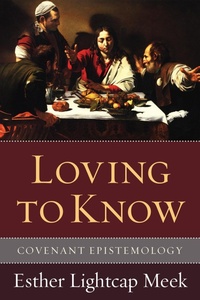
Loving to Know
Covenant Epistemology
Published on 1. June 2011
534 pages
978-1-62189-316-5 (ISBN)
Description

Knowing is less about information and more about transformation; less about comprehension and more about being apprehended.
This radical book develops the notion of covenant epistemology--an innovative, biblically compatible, holistic, embodied, life-shaping epistemological vision in which all knowing takes the shape of interpersonal, covenantal relationship. Rather than knowing in order to love, we love in order to know. Meek argues that all knowing is best understood as transformative encounter.
Creatively blending insights from a diverse range of conversation partners--including Michael Polanyi, Michael D. Williams, Lesslie Newbigin, Parker Palmer, John Macmurray, Martin Buber, and James Loder--Meek offers critically needed "epistemological therapy" in response to the pervasive and damaging presumptions that those in Western culture continue to bring to efforts to know.
The book's innovative approach--an unfolding journey of discovery-through-dialogue--itself subverts standard epistemological presumptions of timeless linearity. While it offers a sustained and sophisticated philosophical argument, Loving to Know's texts and textures interweave loosely to effect therapeutic epistemic transformation in the reader.
This radical book develops the notion of covenant epistemology--an innovative, biblically compatible, holistic, embodied, life-shaping epistemological vision in which all knowing takes the shape of interpersonal, covenantal relationship. Rather than knowing in order to love, we love in order to know. Meek argues that all knowing is best understood as transformative encounter.
Creatively blending insights from a diverse range of conversation partners--including Michael Polanyi, Michael D. Williams, Lesslie Newbigin, Parker Palmer, John Macmurray, Martin Buber, and James Loder--Meek offers critically needed "epistemological therapy" in response to the pervasive and damaging presumptions that those in Western culture continue to bring to efforts to know.
The book's innovative approach--an unfolding journey of discovery-through-dialogue--itself subverts standard epistemological presumptions of timeless linearity. While it offers a sustained and sophisticated philosophical argument, Loving to Know's texts and textures interweave loosely to effect therapeutic epistemic transformation in the reader.
More details
Other editions
Additional editions
Book
06/2011
Wipf & Stock Publishers
€46.60
Shipment within 3-4 weeks
Book
06/2011
Wipf & Stock Publishers
€69.50
Shipment within 15-20 days
Person
Esther Lightcap Meek (BA, Cedarville College; MA, Western Kentucky University; PhD, Temple University) is Professor of Philosophy emerita at Geneva College.
Meek's books include Longing to Know: The Philosophy of Knowledge for Ordinary People (Brazos, 2003); Loving to Know: Introducing Covenant Epistemology (Cascade, 2011); A Little Manual for Knowing (Cascade, 2014); and Contact With Reality: Michael Polanyi's Realism and Why It Matters (Cascade, 2017). Recent books are Doorway to Artistry: Attuning Your Philosophy to Enhance Your Creativity (Cascade, 2023), and with Lisa Cadora, Knowing as Loving: Philosophical Grounding for Charlotte Mason's Expert Educational Insights (Smidgen, 2023). Her newest book is The Mother's Smile: Philosophical Formation in the Welcome of Mothers and Friends (Cascade, 2025).
A professional philosopher, author and speaker, Esther offers her own distinctive, down-to-earth, approach to the philosophical matters that ground and permeate our lives: humanness, meaning, reality, knowing. Her books and talks speak to people in all walks of life, including professionals in art, theology, therapy, business and education. Her books are also used in high schools, colleges and seminaries. Esther also contributes published essays and podcasts, leads workshops and classes, and speaks at churches, universities, schools and conferences.
Esther lives in Steubenville, Ohio.
Content
- Intro
- Loving to Know
- Acknowledgments
- Introduction
- Part One: On the Way
- 1 The Need for "Epistemological Therapy"
- Texture 1: Rekindling the Longing to Know
- 2 Another Kind of Knowing
- 3 What Covenant Epistemology Offers
- Part Two: Transformation
- 4 Knowing as Subsidiary-Focal Integration
- Texture 2: Body Knowledge
- 5 Knowing as Transformation
- Texture 3: Knowing as Transformation, Not Information
- Part Three: Covenant
- 6 Knowing as Stewardship
- Texture 4: Anticipative Knowing and Common Grace
- 7 Knowing as Unfolding Covenant Relationship
- Part Four: Interpersonhood
- 8 Knowing as Interpersonal
- 9 Knowing as I-You
- Texture 5: Friendship and Learning
- 10 Knowing Before the Face of the Holy
- Texture 6: A Sense of Personal Beauty
- 11 Knowing and Healthy Interpersonhood
- 12 Knowing As Dance
- Texture 7: Dance as Metaphysical Therapy
- 13 Reality as Gift
- Texture 8: Stopping Short of Personhood
- Part Five: Covenant Epistemology
- 14 Contours of Covenant Epistemology
- 15 Inviting the Real
- 16 Knowing for Shalom
- Bibliography
- Name Index
- Subject Index
