

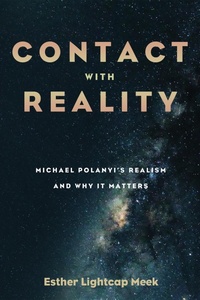
Contact with Reality
Michael Polanyi's Realism and Why It Matters
Published on 5. May 2017
320 pages
978-1-4982-3984-4 (ISBN)
Description

Is knowledge discovered, or just invented? Can we ever get outside ourselves to know how reality is in itself, independent of us? Philosophical realism raises the question whether in our knowing we connect with an independent reality--or only connect with our own mental constructs. Far from being a silly parlor game, the question impacts our lives concretely and deeply. Modern Western culture has been infected with antirealism and the doubt, skepticism, subjectivism, relativism, and atheism that attends it--not to mention distrust and arbitrary (mis)use of reality.
Premier scientist-turned-philosopher Michael Polanyi stepped aside from research to offer an innovative account of knowing that takes its cue from how discovery actually happens. Polanyi defied the antirealism of the twentieth century, sounding a ringing note of hope in his repeated claim that in discovery, we know we have made contact with reality because "we have a sense of the possibility of indeterminate future manifestations." And that sense marks contact with reality, because it is the way reality is: abundant, generous, and fraught with as-yet-unnameable possibilities.
This book examines that distinctive claim, contrasting it to the wider philosophical discussions regarding realism and antirealism in the recent decades. It shows why Polanyi's outlook is superior, and why that matters, not just to scientific discoverers, but to us all.
Premier scientist-turned-philosopher Michael Polanyi stepped aside from research to offer an innovative account of knowing that takes its cue from how discovery actually happens. Polanyi defied the antirealism of the twentieth century, sounding a ringing note of hope in his repeated claim that in discovery, we know we have made contact with reality because "we have a sense of the possibility of indeterminate future manifestations." And that sense marks contact with reality, because it is the way reality is: abundant, generous, and fraught with as-yet-unnameable possibilities.
This book examines that distinctive claim, contrasting it to the wider philosophical discussions regarding realism and antirealism in the recent decades. It shows why Polanyi's outlook is superior, and why that matters, not just to scientific discoverers, but to us all.
More details
Other editions
Additional editions
Book
05/2017
Wipf & Stock Publishers
€59.50
Shipment within 15-20 days
Book
05/2017
Wipf & Stock Publishers
€35.80
Shipment within 15-20 days
Person
Esther Lightcap Meek (BA, Cedarville College; MA, Western Kentucky University; PhD, Temple University) is Professor of Philosophy emerita at Geneva College.
Meek's books include Longing to Know: The Philosophy of Knowledge for Ordinary People (Brazos, 2003); Loving to Know: Introducing Covenant Epistemology (Cascade, 2011); A Little Manual for Knowing (Cascade, 2014); and Contact With Reality: Michael Polanyi's Realism and Why It Matters (Cascade, 2017). Recent books are Doorway to Artistry: Attuning Your Philosophy to Enhance Your Creativity (Cascade, 2023), and with Lisa Cadora, Knowing as Loving: Philosophical Grounding for Charlotte Mason's Expert Educational Insights (Smidgen, 2023). Her newest book is The Mother's Smile: Philosophical Formation in the Welcome of Mothers and Friends (Cascade, 2025).
A professional philosopher, author and speaker, Esther offers her own distinctive, down-to-earth, approach to the philosophical matters that ground and permeate our lives: humanness, meaning, reality, knowing. Her books and talks speak to people in all walks of life, including professionals in art, theology, therapy, business and education. Her books are also used in high schools, colleges and seminaries. Esther also contributes published essays and podcasts, leads workshops and classes, and speaks at churches, universities, schools and conferences.
Esther lives in Steubenville, Ohio.
