

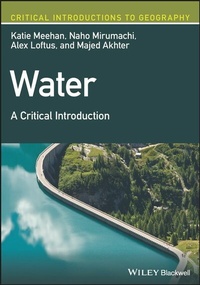
Water
Description

In Water: A Critical Introduction, a team of distinguished researchers delivers an expert examination of our most pressing water-related challenges, arguing that flows of water are shaped by social practices and geometries of power. Combining first-hand research and headline case studies, the authors reveal the hydrosocial relations often hidden in mainstream accounts of water, delving into current issues like water scarcity, floods, global water governance, legal conflicts, human rights, potable water provision, health, the water-food-energy nexus, and much more.
Spanning five centuries, this comprehensive volume reflects on how imperial expansion has shaped hydrosocial relations in and between Europe, Asia, Africa, and the Americas, how water demand has changed over time, and how this change impacted lifestyle.
As the first major text to synthesize critical water research in both local and global perspectives, this book is anchored by clear and compelling arguments -- the "four planks" -- and supported by the authors' original research and up-to-date synthesis of the latest critical research on major water problems. It also includes maps, illustrations, and additional learning materials to be used by educators. Readers will find:
* A lively and thorough introduction that explains why a critical approach is necessary to fully understand our current water challenges, with a focus on the "skeptical superhero"
* A global approach to key debates in water issues, including large dams, privatization, transboundary conflicts, agriculture and irrigation, water and sanitation provision, human rights, governance dilemmas, and the Sustainable Development Goals
* Comprehensive explorations of the roles played by expert knowledge, global capital, climate change, and justice struggles in the hydrosocial cycle
* Critical theoretical perspectives that integrate environmental social sciences, feminist critique, and a broadly defined political economy with the specificities of water resources
* Fulsome treatments of water governance, science, and management, including the origins and implications of neoliberal approaches to the privatization, commodification, and financialization of water
* An accessible text that "invites the reader" on a critical journey
Water: A Critical Introduction is a key text for advanced high school, undergraduate, and graduate students who want a keener understanding of trends in environmental management, political ecology, and water governance, science, and engineering. Written with an interdisciplinary audience in mind, this book will benefit students taking courses in environmental studies, environmental law, geopolitics, international studies, human geography, hydrology, engineering, environmental economics, and related disciplines.
More details
Other editions
Additional editions
Persons
Katie Meehan is Reader in Environment and Society at King's College London, where she is Co-Director of King's Water Centre. She is an Editor (Nature and Society) of the Annals of the American Association of Geographers and has authored over three dozen publications on the politics of water infrastructure, development, and household water insecurity.
Naho Mirumachi is Professor of Environmental Politics at the Department of Geography at King's College London and Co-Director of King's Water Centre. Her research focuses on the governance of water resources and climate security, including water diplomacy, water-climate security, water resilience and socio-political barriers to water sustainability. She has written reports for UN Environment, European Parliament and contributed to the IPCC Sixth Assessment Report.
Alex Loftus is Professor of Political Ecology at King's College London. His research is focused on the political ecology of water and the environment, with a particular interest in the right to water and emerging processes of financialization. He co-edited Water Politics: Governance, Justice, and the Right to Water (2020, with F. Sultana) and is author of Everyday Environmentalism (2012).
Majed Akhter is Senior Lecturer in Environment and Society at King's College London. His research interests sit at the intersection of geopolitics, environment, and natural resources, with a focus on decolonization in South and Southeast Asia. He was named a BBC/AHRC New Generation Thinker in 2019.
Content
List of Figures vii
List of Tables ix
List of Boxes x
Acknowledgments xi
Part 1 Foundations 1
1 The Hydrosocial Cycle 3
2 Water and Empire 27
3 Legal Waters 48
4 The Business of Water 74
Part 2 Big Waters 95
5 Eating Water 97
6 Dam Fever 122
7 Shared Waters 147
Part 3 Water is Life 169
8 Intimate Waters 171
9 The Right to Water 196
10 Future Waters 217
Bibliography 237
Index 279
