

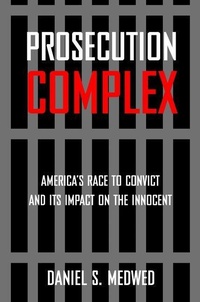
Prosecution Complex
America's Race to Convict and Its Impact on the Innocent
1st Edition
Published on 5. March 2012
277 pages
978-0-8147-6435-0 (ISBN)
Description

American prosecutors are asked to play two roles within the criminal justice system: they are supposed to be ministers of justice whose only goals are to ensure fair trials-and they are also advocates of the government whose success rates are measured by how many convictions they get. Because of this second role, sometimes prosecutors suppress evidence in order to establish a defendant's guilt and safeguard that conviction over time.
In Prosecution Complex, Daniel S. Medwed shows how prosecutors are told to lock up criminals and protect the rights of defendants. This double role creates an institutional "prosecution complex" that animates how district attorneys' offices treat potentially innocent defendants at all stages of the process-and that can cause prosecutors to aid in the conviction of the innocent. Ultimately, Prosecution Complex shows how, while most prosecutors aim to do justice, only some hit that target consistently.
In Prosecution Complex, Daniel S. Medwed shows how prosecutors are told to lock up criminals and protect the rights of defendants. This double role creates an institutional "prosecution complex" that animates how district attorneys' offices treat potentially innocent defendants at all stages of the process-and that can cause prosecutors to aid in the conviction of the innocent. Ultimately, Prosecution Complex shows how, while most prosecutors aim to do justice, only some hit that target consistently.
Reviews / Votes
"Prosecution Complexchallenges us all to work towards changes that can be more likely to result in genuine justice, rather than the comfortable feeling that comes simply from putting somebody behind bars." - Scott Renshaw (City Weekly) "Prosecution Complexis an enlightening book that tackles an issue many tend to shy away from." - Shelby Scoffield (Desert News) "The book should be required reading by all prosecutors, and by all law students who would seek to practice criminal law." - Maurice Possley (Los Angeles Daily Journal) "Wrongful convictions will continue until prosecutors are one day held accountable for their deliberate misconduct. Prosecution Complex examines their misbehavior and the tragic consequences. It also shows us how to fix the problems." - John Grisham,New York Times best-selling author of The Litigators "Professor Daniel Medwed has written a compelling book entitled Prosecution Complex. The book offers inside knowledge based on his experience as a litigator and serious scholar of miscarriages of justice in the criminal justice system. Anybody concerned with fairness and examining the role of prosecutors at every stage of our criminal justice process will find this book absorbing, sobering, and informative. I strongly recommend it to anyone who is looking at our American legal system and seeking reforms. This is a must read!" - Charles J. Ogletree,Founding and Executive Director of the Charles Hamilton Houston Institute for Race and Justice ""Daniel Medwed provides a fascinating ethical, legal, and psychological perspective on the work of prosecutors, the power-players in our criminal justice system.With gripping accounts from real criminal cases gone wrong, he shows how the best-intentioned prosecutors can convict the innocent while racing to convict the guilty. Prosecutors can fall prey to cognitive biases that we all share in our everyday lives, but with nearly-absolute discretion, they lack adequate checks and safeguards to correct for such bias. This book simply must be read by all who care about the past and the future of criminal justice." - Brandon L. Garrett,Roy L. and Rosamund Woodruff Morgan Professor of Law, University of Virginia "One value of Medwed's book is his even-handed, clear-headed explication of all the ways prosecutors can contribute to the conviction of innocent defendants. There is also value in his suggested reforms." (Rutgers) "Highly recommended for general readers, upper-division undergraduate students and above." (CHOICE) "Daniel S. Medwed has put together a book that appeals to both academics and anyone interested in gaining knowledge about many of the intricate details of prosecution." (Criminal Justice Review) "Medweds discussion of particularly horrific cases of injustice and particularly groundbreaking reforms is illuminating . . . [The author] reminds his readers that the goal of doing justice and achieving accurate outcomes is not hopelessly naive, nor is it necessarily an issue about which the defense and the prosecution should disagree. For better or worse, he also seems to suggest that much of the potential for reforming prosecutorial practices lies with prosecutors own commitment to doing honorable work." (Appeal and Habeas blog) "Medwed engages in a scholarly conversation with those who, like him, work or have worked in the criminal justice system and understand how seemingly small legal changes can seriously affect how cases are tried, won, and lost" (Boston Review)More details
Language
English
Place of publication
New York
United States
Target group
Professional and scholarly
File size
10,26 MB
ISBN-13
978-0-8147-6435-0 (9780814764350)
Copyright in bibliographic data and cover images is held by Nielsen Book Services Limited or by the publishers or by their respective licensors: all rights reserved.
Schweitzer Classification
Other editions
Additional editions
Book
11/2013
New York University Press
€36.50
Shipment within 10-20 days
Book
03/2012
New York University Press
€88.50
Shipment within 15-20 days
Person
Daniel S. Medwed is Professor of Law at Northeastern University School of Law and the 2013 recipient of the Robert D. Klein University Lectureship.
Content
- Cover
- Contents
- Acknowledgments
- Introduction
- PART I. Fair Play? Prosecutorial Behavior Prior to Trial
- 1 Charging Ahead
- 2 In the Interest of Full Disclosure: Discovery in Criminal Cases
- 3 Plea Bargaining Pitfalls
- PART II. Beyond a Reasonable Doubt? Reasons to Doubt Prosecutorial Conduct during Trial
- 4 Preparation and Examination of Witnesses
- 5 Test Tubes on Trial: Prosecutors and Forensic Evidence
- 6 Closing the Door on Innocence: Improper Summations by Prosecutors
- PART III. The Fallacy of Finality: Prosecutors and Post-Conviction Claims of Innocence
- 7 Prosecutorial Resistance to Post-Conviction Claims of Innocence
- 8 A Closer Look: Prosecutors and Post-Conviction DNA Testing
- 9 In Denial: Prosecutors' Refusal to Accept Proof of an Inmate's Innocence
- Conclusion
- Notes
- Index
- A
- B
- C
- D
- E
- F
- G
- H
- I
- J
- K
- L
- M
- N
- O
- P
- R
- S
- T
- U
- V
- W
- Z
- About the Author
