

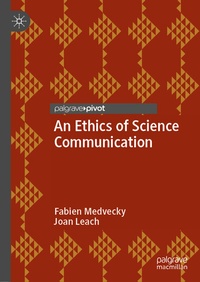
An Ethics of Science Communication
Description

This book presents the first comprehensive set of principles for an ethics of science communication. We all want to communicate science ethically, but how do we do so? What does being ethical when communicating science even mean? The authors argue that ethical reasoning is essential training for science communicators. The book provides an overview of the relationship between values, science, and communication. Ethical problems are examined to consider how to create an ethics of science communication. These issues range from the timing of communication, narratives, accuracy and persuasion, to funding and the client-public tension. The book offers a tailor-made ethics of science communication based on principlism. Case studies are used to demonstrate how this tailor-made ethics can be applied in practice.
More details
Other editions
Additional editions
Persons
Dr. Fabien Medvecky is a science communication academic at the Centre for Science Communication, University of Otago, New Zealand. He holds a PhD in Philosophy and works at the intersection between values, science, and society.
Professor Joan Leach is the Director of the Australian National Centre for the Public Awareness of Science at the Australian National University. She wants science communication to be oriented toward the public good and thinks discussions of ethics are a good place to start.
Content
Chapter 1: Introduction: what's so good about science communication?.- Chapter 2: Ethics, values and science.- Chapter 3: The Multiple Ethics of Science.- Chapter 4: (Science) Communication as ethics.- Chapter 5: Kairos.- Chapter 6: Knowing and ignoring: the utility of information.- Chapter 7: Storytelling and selling science.- Chapter 8: Show me the money.- Chapter 9: What are the guiding ethical principles of science communication?.- Chapter 10: Ethical science communication in practice.- Chapter 11: is science communication ethical? a question of justice.- Chapter 12: Conclusion.
