

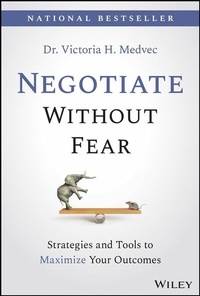
Negotiate Without Fear
Description

With Negotiate Without Fear: Strategies and Tools to Maximize Your Outcomes, master negotiator, Kellogg professor, and accomplished CEO Victoria Medvec delivers an authoritative and practical resource for eliminating the fear that impedes success in negotiation. In this book, readers will discover unique and proprietary negotiation strategies honed over decades advising Fortune 500 clients on high-stakes, complex negotiations.
Negotiate Without Fear provides readers at all levels of negotiation skill the ability to increase their negotiating confidence and maximize their negotiation success. You'll learn how to:
* Put the right issues on the table by defining your objectives for the negotiation
* Analyze the issues being negotiated with an Issue Matrix to ensure you have the right issues to secure what you want
* Establish ambitious goals using a proprietary tool to identify the weaknesses in the other side's best outside alternative (BATNA)
* Leverage a unique architecture for creating and delivering Multiple Equivalent Simultaneous Offers (MESOs)
Negotiate Without Fear belongs on the bookshelves of executives and all the dealmakers who work for them. Additionally, specific advice is provided in every chapter for individuals who are negotiating for themselves and in the everyday world. This book is an invaluable guide for anyone who hopes to sharpen their negotiating skills and achieve success in any arena.
More details
Other editions
Additional editions
Person
Content
Chapter 2: Put the Right Issues on the Table
Chapter 3: Build Your BATNA
Chapter 4: Define Your Reservation Point
Chapter 5: Establish an Ambitious Goal
Chapter 6: Make the First Offer, and Craft a Compelling Message
Chapter 7: Reinforce Your Message with a Multiple Offer
Chapter 8: Say It, Don't Send It
Chapter 9: Leave Yourself Room to Concede to Close the Deal
Chapter 10: The Five F's to Ensure You Are a Fearless Negotiator
Acknowledgments
About the Author
Index
1
Take the Fear Out of Negotiation
Fear impedes people's ability to negotiate. Fear is not just a factor for amateurs who negotiate infrequently. Fear affects people who negotiate every day. For the past 20 years, I have advised clients on many high-stakes negotiations. I have consulted on mergers, acquisitions, large customer contracts, commercial real estate deals, partnership agreements, and supplier contracts. I have also taught negotiation strategies to thousands of executives around the world-from CEOs, to senior vice presidents of business development, to sales executives. I have taught those who negotiate every day, such as investment bankers, private equity partners, and commercial real estate investors, as well as those who are intimidated by the negotiation process. Google, McDonald's, IBM, McKesson, Cisco, and many other Fortune 500 companies are my clients, along with many smaller, growth-oriented businesses.
I frequently ask the senior executives that I am advising if they feel that fear impedes their own negotiations and the negotiations that their teams complete. They resoundingly agree that fear is a significant factor in these negotiations. Likewise, when I am teaching a negotiation course for a company, I often ask the participants if fear plays a role in their negotiations, and more than 80% of the attendees will raise their hands to say that fear limits their success.
What do people fear the most in negotiations? My extensive conversations with executives reveal that the biggest sources of apprehension are a fear of losing the deal and a fear of damaging the relationship. Other fears also include leaving money on the table, having a contentious discussion, experiencing conflict, allowing the other side to take advantage of you, and securing a poor outcome for yourself.
All of these concerns are reasonable, but the right strategies and tools can maximize your outcomes and take the fear out of negotiation. This book is designed to teach you these strategies and provide explicit tools that will allow you to Negotiate Without Fear and maximize your success.
The timing for this book could not be better. The COVID-19 pandemic has created an environment where many companies are faced with challenging negotiations with customers, suppliers, partners, and sources of financial support. Likewise, many individuals need to negotiate to save their small businesses, protect their homes, and secure essential resources. Many individuals' jobs have been threatened by the economic crisis that has accompanied the pandemic and have an urgent need to negotiate for themselves. This book will help with all of these situations, whether you are a large industrial company negotiating to secure the equipment needed to operate your plants, a sales executive negotiating with new customers who need your technology services to help them excel in the new virtual world, a small business negotiating with your landlord for rent abatement, or an individual negotiating to secure a new role. The negotiation strategies presented in the book will also help you excel in the many negotiations you will encounter in the future, both at work and in your personal life. In addition, these strategies will enable you to effectively negotiate for yourself across the rest of your career.
People are often very afraid to negotiate for themselves. Research reveals that women are less likely than men to negotiate for themselves. In a famous study of graduating MBA students at Carnegie Mellon University, 93% of women did not attempt to negotiate higher salaries for themselves, while 43% of the men did not attempt to negotiate either (Babcock & Laschever, 2007). Even expert negotiators, who fiercely negotiate on behalf of their organizations, often fear negotiating for themselves. Because of this, in each chapter of the book, there is a special section included on applying the tactics to help you negotiate effectively for yourself and reduce your fear.
Each chapter will present specific strategies and proprietary tools to help you to take the fear out of every negotiation that you face. The book will include many real-world examples to highlight how to use the tactics being discussed. Some of the examples will relate to negotiating in the everyday world, such as buying a car or purchasing a house. Others will focus on high-stakes negotiations with customers, suppliers, and business partners. Still others will focus on negotiating for yourself. The strategies and tools we will discuss will give you an advantage in all these situations.
Chapter 2 will highlight how you can eliminate fear by putting the right issues on the table. Purposefully including issues in the negotiation that are important to the other side and easy for you to offer will allow you to focus the rationale on the other side and get more of what you want. Chapter 2 will also discuss common objectives that should drive the issues that you include in a negotiation; it also presents a unique Issue Matrix that can be used to assess the issues you are putting on the table before you open your mouth. Having the right issues on the table eliminates the fear of having an emotionally charged, contentious, single-issue discussion and ensures that you negotiate the right deal.
People are also afraid to negotiate because they fear that the other side will walk away and they will lose the deal. This is particularly concerning when a negotiator does not have strong outside options. Chapter 3 discusses the importance of building your options. This chapter highlights that your Best Alternative to Negotiated Agreement (BATNA) is your biggest source of power in any negotiation. Because increasing your power will reduce your fear, building your BATNA is essential.
Your BATNA is your biggest source of power, and it is also the most significant determinant of your bottom line; that is, your Reservation Point. Chapter 4 highlights the importance of knowing your Reservation Point and discusses building a Scoring Tool to assess your Reservation Point. A Scoring Tool helps to ensure that you do not become fixated on a single quantified issue and that you pay attention to the entire package of issues, establishing your Reservation Point across the bundle of issues. Knowing your bottom line provides clarity and reduces the fear that you will take a deal that is worse for you than walking away would be.
While you need to know your bottom line, you need to focus on your goal. Establishing an ambitious goal will help to reduce the fear that you will leave money on the table with a poor outcome for yourself. In Chapter 5, you will learn that your goal should be based on the weakness of the other side's options; that is, the weakness of their BATNA. The more you know about the fragility of the other party's BATNA, the more accurately you can estimate their reservation point. This chapter discusses a proprietary BATNA Analysis Tool to assess the weakness of the other side's BATNA and establish an appropriate goal. The BATNA Analysis Tool will also help you identify issues that you should add to the table to educate the other side on what is lacking in their alternatives. In addition, this tool will help you to uncover the best opportunities to reduce the other side's BATNA over time. Companies lose millions of dollars a year because their negotiators do not establish ambitious goals. The material in Chapter 5 will help to mitigate this risk and decrease your fear of leaving money on the table.
Once you have the right issues on the table and have completed an analysis of your goal, your BATNA, your Reservation Point and the other side's BATNA and Reservation Point, you are ready to begin the negotiation. Chapter 6 discusses the importance of making the first offer and connecting your offer to a compelling message that highlights how your differentiators address the other side's pressing needs and challenges. People are often afraid to lead in the negotiation and prefer to let the other side go first; however, this chapter presents extensive evidence that making the first offer allows you to anchor the starting point, frame the discussion, put the right issues on the table, and secure the relationship-enhancing position. Leading with the first offer provides you with advantages that set the stage for better outcomes, and it allows you to build a rationale that focuses on the other side to build the relationship at the same time. The strategies presented in Chapter 6 will take the fear out of making the first offer.
Chapter 7 highlights how your fear of making the first offer and your fear that the other side will walk away can be mitigated by making multiple offers simultaneously rather than providing a single offer. There are many advantages to delivering multiple equivalent simultaneous offers (MESOs) rather than single offers. MESOs pull the other side into a discussion and change the frame of the conversation from "whether we will work together" to "how we can work together." This reframing jettisons a sense of conflict and replaces this with a feeling of problem solving. MESOs also allow you to anchor an attractive starting point more effectively than a single offer does. In addition, a multiple offer makes your first offer seem more reasonable, decreasing the chances that an ambitious MESO will lead to an aggressive counteroffer or the other side walking away. Moreover, a MESO allows you to uncover more information from the other side and surface deeper levels of intelligence revealing not just what the other side wants but what it...
