

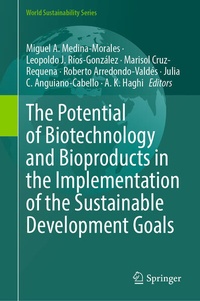
The Potential of Biotechnology and Bioproducts in the Implementation of the Sustainable Development Goals
Description

This book will provide recent information regarding biotechnological processes and/or advances in agriculture, medicine and engineering. As many research field, constant update is required to stay in the vanguard of scientific achievements and advances of relevance with the ultimate goal of improving humanity's quality of life. In this regard, the contributions that will be available in this book will comprise certain areas of the United Nations Sustainability Goals, which, in some ways, will provide information on the developments being made for efforts for the benefit of the people in the planet. Our contributions range between the effect of natural bioactive molecules and their activity against cancer cellular lines, biomolecules affecting biofilm formation by pathogen bacteria, innocuos film for increasing food shelf life, second generation biofuel production, among many other subjects. The information provided by this publication will interest the reader about the types of projects being done to advance in knowledge generation. The impacts on UN Sustainability Goals will include Good Health and Well-being, Life on Land, Climate Action, No Poverty, Affordable and Clean Energy and Responsible Production and Production.
More details
Other editions
Additional editions
Persons
Dr. Miguel A. Medina Morales is a full-time professor at the School of Chemistry, Autonomous University of Coahuila, in the area Environmental Biotechnology since 2019. In 2017 he was part of a research team that were recipients of the Tritio Award given by the Autonomous University of Coahuila. He has over 45 papers in scientific journals in the JCR and published book chapters in 2006 and 2023. He graduated as Biologist Chemist (2008) at the Autonomous University of Coahuila (UAdeC). He obtained a MSc Degree in Food Science and Technology (2009) by the same institution. In 2012 he obtained his PhD in Food Science and Technology held in the Autonomous University of Coahuila. He had a two years postdoctoral stay in the Antonio Narro Agrarian Autonomous University from 2015 to 2017. He has been granted funding projects from the National Council of Humanities, Sciences and Technologies and is the principal advisor of several masters and PhD projects. His lines of research cover bioprocessing plant materials to recover high added-value bioactive compounds, solid state fermentation, biorefinery concept and biofuels production. He is a member of National Researchers System (SNII) since 2017 and recently has been promoted to level II.
Content
1. Applied biotechnology in agriculture: from single microbe-inoculants to microbial consortia and their challenges in production and efficient use for Zero Hunger UN sustainability goal.- 2. Harnessing biomaterials for enhanced secondary metabolite production from agro-industrial wastes: The role of omics sciences in biofactory innovation.- 3. Nanotechnology and Biotechnology: A Pair of Weapons for UN Zero Hunger Sustainability Goal to Improve the Fight Against Phytopathogens.- 4. Microalgae in agriculture, driving compliance with sustainable development goals.- 5. Microalgae as enriched biofertilizers: Potential substitute for chemical fertilizers (Zero Hunger).
