

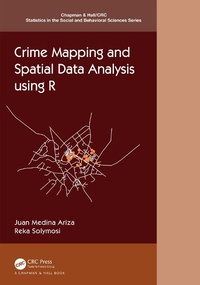
Crime Mapping and Spatial Data Analysis using R
1st Edition
Published on 27. April 2023
450 pages
978-1-000-85079-6 (ISBN)
Description

Crime mapping and analysis sit at the intersection of geocomputation, data visualisation and cartography, spatial statistics, environmental criminology, and crime analysis. This book brings together relevant knowledge from these fields into a practical, hands-on guide, providing a useful introduction and reference material for topics in crime mapping, the geography of crime, environmental criminology, and crime analysis. It can be used by students, practitioners, and academics alike, whether to develop a university course, to support further training and development, or to hone skills in self-teaching R and crime mapping and spatial data analysis. It is not an advanced statistics textbook, but rather an applied guide and later useful reference books, intended to be read and for readers to practice the learnings from each chapter in sequence.
In the first part of this volume we introduce key concepts for geographic analysis and representation and provide the reader with the foundations needed to visualise spatial crime data. We then introduce a series of tools to study spatial homogeneity and dependence. A key focus in this section is how to visualise and detect local clusters of crime and repeat victimisation. The final chapters introduce the use of basic spatial models, which account for the distribution of crime across space. In terms of spatial data analysis the focus of the book is on spatial point pattern analysis and lattice or area data analysis.
In the first part of this volume we introduce key concepts for geographic analysis and representation and provide the reader with the foundations needed to visualise spatial crime data. We then introduce a series of tools to study spatial homogeneity and dependence. A key focus in this section is how to visualise and detect local clusters of crime and repeat victimisation. The final chapters introduce the use of basic spatial models, which account for the distribution of crime across space. In terms of spatial data analysis the focus of the book is on spatial point pattern analysis and lattice or area data analysis.
Reviews / Votes
"I think overall the book is pitched perfectly and the step by step approach with code will act as an excellent training resources as well as reference guide."-Ruth Weir, City, University of London
"Overall, this is a great book! It is written in an accessible style, is up to date and covers the foundational material one would want a student to understand. As an experienced R user, I was delighted to learn something. Staying abreast of the fast-developing packages is nearly a full-time job, so I see this book as highly useful to many readers. The authors do a great job illustrating the main concepts of import but also pointing readers to places to follow up for more detailed treatments."
-Michael Townsley, Professor of Criminology and Criminal Justice, Griffith University
More details
Series
Edition
1. Auflage
Language
English
Place of publication
London
United Kingdom
Publishing group
Taylor & Francis Ltd
Target group
Professional and scholarly
Product notice
Reflowable
Illustrations
4 Tables, black and white; 131 Line drawings, color; 65 Line drawings, black and white; 26 Halftones, color; 157 Illustrations, color; 65 Illustrations, black and white
File size
32,29 MB
ISBN-13
978-1-000-85079-6 (9781000850796)
Copyright in bibliographic data and cover images is held by Nielsen Book Services Limited or by the publishers or by their respective licensors: all rights reserved.
Schweitzer Classification
Other editions
Additional editions
Juan Medina Ariza | Reka Solymosi
Crime Mapping and Spatial Data Analysis using R
Book
04/2023
1st Edition
Chapman & Hall/CRC
€144.00
Shipment within 15-20 days
Persons
This book is based on teaching materials developed by the authors. Professor Juanjo Medina is Senior Distinguished Researcher at the Department of Criminal Law and Crime Sciences at the University of Seville. Previously he was Professor of Quantitative Criminology at the University of Manchester where he taught data analysis and crime mapping for 20 years. Dr Reka Solymosi is a Senior Lecturer in Quantitative Methods at the University of Manchester where she has been teaching data analysis and crime mapping since 2016.
Content
1. Producing your First Crime Map 2. Basic Geospatial Operations in R 3. Mapping Rates and Counts 4. Variations of Thematic Mapping 5. Basics of Cartographic Design: Elements of a Map 6. Time Matters 7. Spatial Point Patterns of Crime Events 8. Crime Along Spatial Networks 9. Spatial Dependence and Autocorrelation 10. Detecting Hot Spots and Repeats 11. Spatial Regression Models 12. Spatial Heterogeneity and Regression 13. Appendix: A Quick Intro to R and RStudio 14. Appendix B: Regression Analysis (A Refresher) 15. Appendix C: Sourcing Geographical Data for Crime Analysis
