

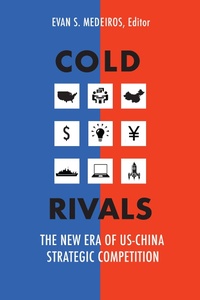
Cold Rivals
Description

Leading authorities analyze growing tensions in US-China relations and what this means for the future
The US-China relationship is now defined by "strategic competition." In Cold Rivals, a distinguished group of scholars from the United States and China examine the reasons for this deterioration and its implications for world politics.
The two countries are now competitors locked in a long-term rivalry, but how volatile this rivalry will become is still to be determined. The book explores not only the historical roots and contemporary foreign policy aspects of this era, but also looks at the economic, military, and technological arenas of US-China strategic competition. In doing so, this volume highlights important differences in US and Chinese perspectives. A final section of the volume explores future scenarios for this relationship from a variety of perspectives, all coming to a sobering conclusion.
This policy-relevant book provides a comprehensive overview of US-China strategic competition and reinvigorates thinking about how to avoid reaching a crisis point.
More details
Other editions
Additional editions
Person
Evan S. Medeiros is the inaugural Penner Family Chair in Asian Studies at Georgetown University's Walsh School of Foreign Service and the Cling Family Distinguished Fellow in US-China Studies. During the Obama Administration, he held senior positions on the National Security Council including Special Assistant to the President and Senior Director for Asia. He has published seven books including China's International Behavior: Activism, Opportunism, and Diversification.
Content
List of Illustrations
Acknowledgments
Introduction: A New Strategic Reality
Evan. S. Medeiros
Part I
1. Explaining and Understanding Competition in U.S.-China Relations
Evan S. Medeiros
2. Old Cold War and New
Richard K. Betts
3. The U.S. and China: From Partners to Competitors in America's Eyes
Harry Harding
4. From Reluctant Cooperation to Assertive Competition: China's Reaction to U.S. Strategic Pressure 1979-2022
Wang Jisi
Part II
5. China's Management of Strategic Competition with the United States
Wu Xinbo
6. The Evolution of America's China Policy: Rethink, Reset, Recalibrate
Elizabeth Economy
7. The Economic Origins of U.S.-China Strategic Competition
Arthur R. Kroeber
Part III
8. The Military Factor in U.S.-China Strategic Competition
Phillip C. Saunders
9. National Security and Strategic Competition between China and the United States
Li Chen
10. Non-Traditional Security Competition: the Espionage Realm
James Mulvenon
Part IV
11. China's Rise as a Technology Power and U.S.-China Technology Competition: Assessing Beijing's Response
Paul Triolo
12. From Backwater to Near-Peer: Changing U.S. Approaches Towards China as a Technological Competitor
Helen Toner
Part V
13. Time Horizons and The Future of Sino-American Relations
David M. Edelstein
14. Parsing and Managing U.S.-China Competition
David Shambaugh
15. Forecasting the Future of U.S.-China Relations
Evan S. Medeiros
List of Contributors
Index
