

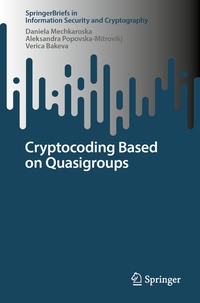
Cryptocoding Based on Quasigroups
Description

This book presents the concept of cryptcoding which arises from the need to obtain secure and accurate transmission. Therefore, it is necessary to improve constantly existing and develop new algorithms that will ensure accurate and secure data transfer. This leads to the intensive development of coding theory and cryptography as scientific fields which solve these problems. To ensure efficient and secure data transmission at the same time, the concept of cryptcoding is developed such that the coding and encryption processes are merged into one process. Cryptcodes provide correction of a certain number of errors in the transmitted message and data confidentiality, using only one algorithm. The main research in this field is to define new algorithms for coding that detects and corrects errors, random codes, stream ciphers, block ciphers, pseudo-random generators, hash functions, etc. This monograph examines an application of quasigroups for designing error-correcting cryptcodes, called Random Codes Based on Quasigroups (RCBQ ). These codes are a combination of cryptographic algorithms and error-correcting codes and depend on several parameters. Some modifications (new coding/decoding algorithms) of RCBQ for improving their performances for transmission ordinary messages, images, and audio files trough a binary-symmetric channel, Gaussian channel, and burst channels are considered. Also, authors propose and analyze filter for visually enhance of the decoded images and improving the quality of decoded audio files.
More details
Other editions
Additional editions
Persons
Aleksandra Popovska-Mitrovikj received the B.S. and M.S. degrees in computer science from the Faculty of Natural Sciences and Mathematics, Ss. Cyril and Methodius University in Skopje, in 2003 and 2009 respectively. The Ph.D. degree in computer science from the Faculty of Computer Science and Engineering, Ss. Cyril and Methodius University in Skopje, she received in 2014 with a doctoral dissertation in the field of Coding Theory and Cryptography.From 2002 to 2011 she has been working as a teaching/research assistant at the Faculty of Natural Sciences and Mathematics, Ss. Cyril and Methodius University in Skopje. Since 2011, she has been working at the Faculty of Computer Science and Engineering, Ss. Cyril and Methodius University in Skopje and currently she is an associate professor at this faculty. She participated in several international and national scientific research projects, many international scientific conferences, workshops and schools. She is an author and co-author of one book, more than 40 scientific research papers published in journals and proceedings of international conferences. Her research interests include coding theory, cryptography, application of ML and NLP in security, cryptography and coding, and blockchain technology. Dr. Aleksandra Popovska-Mitrovikj received an award from the Ss. Cyril and Methodius University in Skopje for graduation with the highest average grade at the Faculty of Natural Sciences and Mathematics in the academic year 2002/03.
Verica Bakeva received the B.S. and M.S. degrees in mathematics and informatics and the Ph.D. degree in informatics from the Faculty of Natural Sciences and Mathematics, Ss. Cyril and Methodius University in Skopje, in 1992, 1998 and 2003, respectively. Her Ph.D. thesis is in the field of applications of probabilistic models in Queueing Systems, Cryptography and Coding Theory. From 1993 to 2003 she worked as a teaching/research assistant at the Faculty of Natural Sciences and Mathematics, Ss. Cyril and Methodius University in Skopje. After the defense of her Ph.D. thesis, in 2003 she was promoted to assistant professor and in 2008 - to associate professor at the same faculty. Since 2011, she works at the Faculty of Computer Science and Engineering, Ss. Cyril and Methodius University in Skopje where she was promoted to full professor in 2013. She participated in several international and national scientific research projects, many international scientific conferences, workshops, and schools. She is an author of two university textbooks, co-author of 5 high school textbooks, and co-author of one monography. She is an author/co-authorof more than 60 scientific research papers published in journals and proceedings of international conferences. Her research interest includes probabilistic models and their applications, especially in coding theory and cryptography.
Content
Quasigroups and quasigroups string transformation.- Cryptcodes based on quasigroup.- Experimental results for cryptcodes based on quasigroups for transmission through a binary-symmetric channel.- Experimental results for cryptcodes based on quasigroups for transmission through a Gaussian channel.- Fast algorithms for cryptcodes based on quasigroups.- Cryptcodes based on quasigroups for burst channels.
