

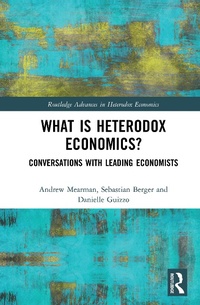
What is Heterodox Economics?
Conversations with Leading Economists
1st Edition
Published on 17. April 2019
326 pages
978-1-351-74401-0 (ISBN)
Description

Since the Global Financial Crisis, economics has been under greater public scrutiny, revealing a crisis in the discipline. This represented a potential turning point on how economics should be thought and taught. Heterodox economics has played a prominent role in these discussions revolving around new economics thinking and pluralism in economics. Yet, its identity, aspirations, and pedagogy remain underexplored, contested, and somewhat opaque.
This volume brings together sixteen interviews with leading economists to understand what heterodox economics is. How and why does an economist become heterodox? In which way do heterodox economists see themselves as 'different' from mainstream economics? The interviews shed light on what problems heterodox economists perceive in the mainstream; elucidate the different contexts under which they operate in higher education; and provide insights on their ontology and methodology. The reader will also find answers to the following questions about the nature and state of heterodox economics: Do heterodox economists have particular intellectual journeys, motives and aspirations? Is this reflected in their teaching practices and strategies to achieve social change? What is the relation between heterodox economics and the humanities and arts?
Appealing to a diverse audience, including philosophers, sociologists and historians of economic thought, the book will be of great interest to anyone keen to find out more about the internal discussions in the economics discipline.
This volume brings together sixteen interviews with leading economists to understand what heterodox economics is. How and why does an economist become heterodox? In which way do heterodox economists see themselves as 'different' from mainstream economics? The interviews shed light on what problems heterodox economists perceive in the mainstream; elucidate the different contexts under which they operate in higher education; and provide insights on their ontology and methodology. The reader will also find answers to the following questions about the nature and state of heterodox economics: Do heterodox economists have particular intellectual journeys, motives and aspirations? Is this reflected in their teaching practices and strategies to achieve social change? What is the relation between heterodox economics and the humanities and arts?
Appealing to a diverse audience, including philosophers, sociologists and historians of economic thought, the book will be of great interest to anyone keen to find out more about the internal discussions in the economics discipline.
Reviews / Votes
"What is Heterodox Economics? is a terrific book. If you are a heterodox economist, an aspiring heterodox economist, or an engaged student of heterodox economics, I expect that you will appreciate this book very much. I also expect that many scholars trained in social sciences other than economics will appreciate this book and learn a lot from it. If you are a mainstream economist, I hope very much that you will read this book. It could make you a better economist, and it might be a small step toward making the discipline of economics a more richly rewarding space for economists of all stripes - and for our students. I'll cross my fingers, but I won't hold my breath."Timothy Koechlin, Review of Political Economy
"The goal of the book, expressed in the title, is to convey the essence of heterodoxy to a readership perplexed by the folk rites of the economics profession...What emerges here is a set of intellectual life stories. They tell of how the interviewees entered economics, of their professional trajectories, of what they read and with whom they studied when they were young, of how they teach"
James K. Galbraith, Oeconomia
More details
Series
Edition
1. Auflage
Language
English
Place of publication
London
United Kingdom
Publishing group
Taylor & Francis Ltd
Target group
College/higher education
Illustrations
1 Line drawings, black and white; 1 Illustrations, black and white
File size
14,47 MB
ISBN-13
978-1-351-74401-0 (9781351744010)
Copyright in bibliographic data and cover images is held by Nielsen Book Services Limited or by the publishers or by their respective licensors: all rights reserved.
Schweitzer Classification
Other editions
Additional editions
Andrew Mearman | Sebastian Berger | Danielle Guizzo
What is Heterodox Economics?
Conversations with Leading Economists
Book
12/2020
1st Edition
Routledge
€58.26
Shipment within 15-20 days
Andrew Mearman | Sebastian Berger | Danielle Guizzo
What is Heterodox Economics?
Conversations with Leading Economists
Book
05/2019
1st Edition
Routledge
€208.20
Shipment within 10-20 days
Persons
Andrew Mearman is Associate Professor of Economics at the University of Leeds, UK. He has previously taught at the University of the West of England (UWE Bristol), UK; Wagner College, New York, USA; and the University of Lincoln, UK. He has published extensively on economics education, the philosophy and methodology of economics, and heterodox economics and pluralism.
Sebastian Berger is Senior Lecturer in Economics at the University of the West of England (UWE Bristol), UK. He is recipient of the Helen Potter Award from the Association for Social Economics and trustee of the Kapp Foundation for the Humanization and Integration of the Social Sciences.
Danielle Guizzo is Senior Lecturer in Economics at the University of the West of England (UWE Bristol), UK. She has published articles on the history of economic thought, philosophy of economics and teaching of economics.
Sebastian Berger is Senior Lecturer in Economics at the University of the West of England (UWE Bristol), UK. He is recipient of the Helen Potter Award from the Association for Social Economics and trustee of the Kapp Foundation for the Humanization and Integration of the Social Sciences.
Danielle Guizzo is Senior Lecturer in Economics at the University of the West of England (UWE Bristol), UK. She has published articles on the history of economic thought, philosophy of economics and teaching of economics.
Content
Preface. Acknowledgements. 1. Introduction. 2. Sheila Dow. 3. Fernando Cardim de Carvalho. 4. William Darity. 5. S. Charusheela. 6. Karma Ura. 7. Rolf Steppacher. 8. Julie Nelson. 9. Tony Lawson. 10. Joan Martinez-Alier. 11. Esther-Mirjam Sent. 12. Gary Mongiovi. 13. Anwar Shaikh. 14. Victoria Chick. 15. Edward Fullbrook. 16. David Dequech. 17. Ulrich Witt. 18. Concluding Thoughts. Bibliography
