

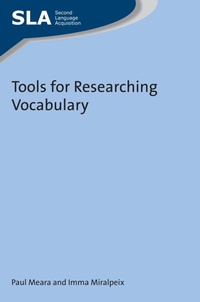
Tools for Researching Vocabulary
Published on 1. November 2016
259 pages
978-1-78309-648-0 (ISBN)
Description

This book introduces an innovative collection of easy-to-use computer programs that have been developed to measure and model vocabulary knowledge. The book aims to help researchers discover new instruments for lexical analysis, and provides a theoretical framework in which studies with such tools could be conducted. Each of the programs comes with a short manual explaining how to use the program, an example of a published paper that uses the program and a set of questions that readers can develop into proper projects. The programs can be used in real research projects and have the potential to break new ground for research in L2 vocabulary acquisition. The book will be of great use to final year undergraduates and masters students in applied linguistics, second language acquisition, psycholinguistics and language testing and to PhD students doing research methods courses.
Reviews / Votes
This is a book that is of great value to researchers interested in vocabulary. The programs described in the book are highly innovative and imaginative. The questions that the programs are designed to answer lie at the heart of language learning and assessment, and the programs strikingly represent the designers thinking outside the box. -- Paul Nation, Victoria University of Wellington, New Zealand Meara and Miralpeix provide a rich collection of clearly explained, user-friendly, web-based applications for students and investigators interested in L2 vocabulary research. The reprinted articles, historical commentaries and accompanying reflections offer novel and stimulating ideas that many researchers will want to build on. I highly recommend this valuable resource. -- Norman Segalowitz, Concordia University, Montreal, Canada Tools for Researching Vocabulary', has successfully provided a timely contribution to the area of L2 vocabulary acquisition. There is no doubt that this book is a valuable reference for final year undergraduates and master students in Applied Linguistics, second language acquisition, psycholinguistics, and testing. This book is also useful for PhD students who have little background knowledge of the tools for researching vocabulary but would like to work in this field. -- Thi Ngoc Yen Dang, Victoria University of Wellington, New Zealand * LINGUIST List 28.3263 * This book provides an invaluable resource for researchers who are interested in the field of vocabulary research. It is extremely user-friendly and introduces the objectives of eleven such programs, along with clear instructions on how toimplement them. -- Michael James Davies, Ritsumeikan University, Japan * System 66 (2017) * In sum, this book more than lives up to its promise. It provides young researchers with a range of ideas and the tools to start exploring them. At the same time it is a thorough introduction to the issues involved in vocabulary research, and takes a critical look at both issues and tools. And although I probably no longer qualify as a novice researcher - age forbids - I still find that it opens up a wealth of new perspectives and ideas for research. -- Paul Pauwels, University of Leuven, Belgium * BAAL News, Issue 111, Summer 2017 *
More details
Series
Language
English
Place of publication
Bristol
United Kingdom
Publishing group
Channel View Publications Ltd
Target group
College/higher education
Professional and scholarly
Product notice
Reflowable
ISBN-13
978-1-78309-648-0 (9781783096480)
Copyright in bibliographic data and cover images is held by Nielsen Book Services Limited or by the publishers or by their respective licensors: all rights reserved.
Schweitzer Classification
Other editions
Additional editions
Paul Meara | Imma Miralpeix
Tools for Researching Vocabulary
Book
11/2016
Multilingual Matters
€48.50
Shipment within 10-20 days
Persons
Paul Meara is Emeritus Professor, Swansea University, UK and a leading scholar in the field of vocabulary acquisition. He has published extensively in this area and has held many positions of responsibility including Chair of the British Association for Applied Linguistics. He was awarded an Honorary Fellowship of Chartered Institute of Linguists in 2010 and was elected to the UK Academy of Social Sciences in 2011.
Imma Miralpeix obtained her PhD from the University of Barcelona, Spain where she is Lecturer and Researcher. Her main research interests include second language vocabulary acquisition, especially lexical development and assessment, and multilingualism. She is the author of several publications in these areas and has taken part in different funded projects on second language learning and teaching.
Imma Miralpeix obtained her PhD from the University of Barcelona, Spain where she is Lecturer and Researcher. Her main research interests include second language vocabulary acquisition, especially lexical development and assessment, and multilingualism. She is the author of several publications in these areas and has taken part in different funded projects on second language learning and teaching.
Content
Acknowledgements
Introduction
Section 1: Processing Vocabulary Data
Chapter 1. V_Words and V_Lists
Section 2: Measuring Lexical Variation, Sophistication and Originality
Chapter 2. D_Tools
Chapter 3. P_Lex
Chapter 4. Lexical Signatures
Chapter 5. V_Unique
Section 3: Estimating Vocabulary Size
Chapter 6. V_YesNo
Chapter 7. V_Size
Chapter 8. V_Capture
Section 4: Measuring Lexical Access
Chapter 9. Q_Lex
Section 5: Assessing Aptitude for L2 Vocabulary Learning
Chapter 10. LLAMA_B
Section 6: Modelling Vocabulary Growth
Chapter 11. Mezzofanti
Envoi
Index
Introduction
Section 1: Processing Vocabulary Data
Chapter 1. V_Words and V_Lists
Section 2: Measuring Lexical Variation, Sophistication and Originality
Chapter 2. D_Tools
Chapter 3. P_Lex
Chapter 4. Lexical Signatures
Chapter 5. V_Unique
Section 3: Estimating Vocabulary Size
Chapter 6. V_YesNo
Chapter 7. V_Size
Chapter 8. V_Capture
Section 4: Measuring Lexical Access
Chapter 9. Q_Lex
Section 5: Assessing Aptitude for L2 Vocabulary Learning
Chapter 10. LLAMA_B
Section 6: Modelling Vocabulary Growth
Chapter 11. Mezzofanti
Envoi
Index
