

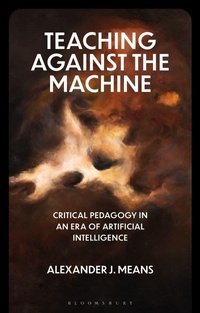
Teaching Against the Machine
Critical Pedagogy in an Era of Artificial Intelligence
Will be published approx. on 23. July 2026
224 pages
978-1-350-50682-4 (ISBN)
Description

This book examines the entanglement of capitalism, technological acceleration and AI, and warns that they are eroding education as a means of collective intelligence.
Alexander J. Means shows how our desires, dreams, emotions, and psychic life have become the target of optimizing drives and algorithmic manipulation aimed at extracting value from thought and time. He argues that this is leading to a disintegration of meaning, knowledge, and culture, allowing Fascism, fraud, racism, ecocide, and war to thrive in an environment of systemic nihilism and the collapse of memory into computation. He examines how education has become a brand word and how education is being reduced to training in compliance and suggests ways to stop this trend. Means draws on a range of theorists book including Franco Berardi, Alain Badiou, Byung-Hul Chan, Fredric Jameson and Achille Mbembe. The book represents a warning against a life of fundamentalism, money, consumption, and power and argues that education should, in contradiction to the current trends, be equipping young people and adults with the tools to live a life filled with meaning and purpose.
Alexander J. Means shows how our desires, dreams, emotions, and psychic life have become the target of optimizing drives and algorithmic manipulation aimed at extracting value from thought and time. He argues that this is leading to a disintegration of meaning, knowledge, and culture, allowing Fascism, fraud, racism, ecocide, and war to thrive in an environment of systemic nihilism and the collapse of memory into computation. He examines how education has become a brand word and how education is being reduced to training in compliance and suggests ways to stop this trend. Means draws on a range of theorists book including Franco Berardi, Alain Badiou, Byung-Hul Chan, Fredric Jameson and Achille Mbembe. The book represents a warning against a life of fundamentalism, money, consumption, and power and argues that education should, in contradiction to the current trends, be equipping young people and adults with the tools to live a life filled with meaning and purpose.
More details
Series
Language
English
Place of publication
London
United Kingdom
Publishing group
Bloomsbury Publishing PLC
Target group
College/higher education
File size
91,36 MB
ISBN-13
978-1-350-50682-4 (9781350506824)
Copyright in bibliographic data and cover images is held by Nielsen Book Services Limited or by the publishers or by their respective licensors: all rights reserved.
Schweitzer Classification
Other editions
Additional editions
Alexander J. Means
Teaching Against the Machine
Critical Pedagogy in an Era of Artificial Intelligence
Book
approx. 08/2026
Critical Directions in Education, Technology, and Politics
€31.50
Not yet published
Person
Alexander J. Means is Assistant Professor and Chair of the Department of Educational Foundations at the University of Hawai'i, USA.
Content
Series Editor's Introduction
Introduction: End of Education
1. Optimized Nihilism and the Disfiguration of Thought
2. Capitalist Catastrophism and the Politics of Knowledge
3. Mind Factory in Ruins: From Cognitive to AI Capital
4. Platform Learning, Cities, and Silicon Illusions
5. Digital Squalor: Scams, War, and Mindlessness
6. Corrupting the Xanax Generation
7. Futurability: Seizing the Means of Cognition for Postcapitalism
Conclusion
References
Index
Introduction: End of Education
1. Optimized Nihilism and the Disfiguration of Thought
2. Capitalist Catastrophism and the Politics of Knowledge
3. Mind Factory in Ruins: From Cognitive to AI Capital
4. Platform Learning, Cities, and Silicon Illusions
5. Digital Squalor: Scams, War, and Mindlessness
6. Corrupting the Xanax Generation
7. Futurability: Seizing the Means of Cognition for Postcapitalism
Conclusion
References
Index
