

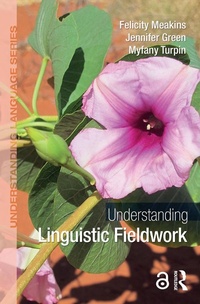
Understanding Linguistic Fieldwork
Published on 19. March 2018
348 pages
978-1-351-33010-7 (ISBN)
Description

Understanding Linguistic Fieldwork offers a diverse and practical introduction to research methods used in field linguistics. Designed to teach students how to collect quality linguistic data in an ethical and responsible manner, the key features include:
A focus on fieldwork in countries and continents that have undergone colonial expansion, including Australia, the United States of America, Canada, South America and Africa
A description of specialist methods used to conduct research on phonological, grammatical and lexical description, but also including methods for research on gesture and sign, language acquisition, language contact and the verbal arts
Examples of resources that have resulted from collaborations with language communities and which both advance linguistic understanding and support language revitalisation work
Annotated guidance on sources for further reading
This book is essential reading for students studying modules relating to linguistic fieldwork or those looking to embark upon field research.
A focus on fieldwork in countries and continents that have undergone colonial expansion, including Australia, the United States of America, Canada, South America and Africa
A description of specialist methods used to conduct research on phonological, grammatical and lexical description, but also including methods for research on gesture and sign, language acquisition, language contact and the verbal arts
Examples of resources that have resulted from collaborations with language communities and which both advance linguistic understanding and support language revitalisation work
Annotated guidance on sources for further reading
This book is essential reading for students studying modules relating to linguistic fieldwork or those looking to embark upon field research.
Reviews / Votes
"This book aims to be a one-stop introduction to fieldwork as it is currently conceived, covering not only the expected topics, but also a variety of areas that are not standardly found in the fieldwork literature, including sign language, child language acquisition, contact languages, and verbal arts, all areas that figure prominently in language documentation today. It will be an invaluable resource for the novice fieldworker, with much of value for the experienced one as well."Keren Rice, University of Toronto, Canada
"The authors take exquisite account of the community contexts in which linguistic documentation and discovery unfold, which they work into a humanistically and scientifically rich, holistic introduction to the subject."
Anthony C. Woodbury, The University of Texas at Austin, USA
More details
Series
Language
English
Place of publication
London
United Kingdom
Publishing group
Taylor & Francis Ltd
Target group
College/higher education
Product notice
Reflowable
Illustrations
45 s/w Abbildungen, 16 s/w Tabellen, 22 s/w Photographien bzw. Rasterbilder, 23 s/w Zeichnungen
16 Tables, black and white; 23 Line drawings, black and white; 22 Halftones, black and white; 45 Illustrations, black and white
File size
5,79 MB
ISBN-13
978-1-351-33010-7 (9781351330107)
Copyright in bibliographic data and cover images is held by Nielsen Book Services Limited or by the publishers or by their respective licensors: all rights reserved.
Schweitzer Classification
Other editions
Additional editions
Felicity Meakins | Jennifer Green | Myfany Turpin
Understanding Linguistic Fieldwork
Book
03/2018
1st Edition
Routledge
€207.10
Shipment within 15-20 days
Felicity Meakins | Jennifer Green | Myfany Turpin
Understanding Linguistic Fieldwork
Book
03/2018
1st Edition
Routledge
€60.80
Shipment within 15-20 days
Persons
Felicity Meakins is a Senior Lecturer at the University of Queensland. She specialises in the documentation of Australian languages in the Victoria River District in northern Australia and the effect of English on Indigenous languages.
Jennifer Green is a Research Fellow at the University of Melbourne. Her main research interests are descriptive linguistics, lexicography, multimodality in narrative practices and sign language.
Myfany Turpin is a Research Fellow at the University of Sydney. Her research is in descriptive linguistics, poetry, song, ethnobiology and language revitalization.
Jennifer Green is a Research Fellow at the University of Melbourne. Her main research interests are descriptive linguistics, lexicography, multimodality in narrative practices and sign language.
Myfany Turpin is a Research Fellow at the University of Sydney. Her research is in descriptive linguistics, poetry, song, ethnobiology and language revitalization.
Content
List of Figures
List of Tables
Acknowledgements
Abbreviations
1. Introduction
2. Planning for fieldwork
3. Equipment and recording
4. Data management, annotation and archiving
5. Phonetics and Phonology
6. Morpho-syntax
7. Semantic fieldwork and lexicography
8. Sign and gesture
9. Child language acquisition
10. Contact Languages
11. Verbal art
12. A final word
Appendices
Map of major languages referred to in this book
Answers to Exercises
Glossary and Abbreviations
Index
List of Tables
Acknowledgements
Abbreviations
1. Introduction
2. Planning for fieldwork
3. Equipment and recording
4. Data management, annotation and archiving
5. Phonetics and Phonology
6. Morpho-syntax
7. Semantic fieldwork and lexicography
8. Sign and gesture
9. Child language acquisition
10. Contact Languages
11. Verbal art
12. A final word
Appendices
Map of major languages referred to in this book
Answers to Exercises
Glossary and Abbreviations
Index
