

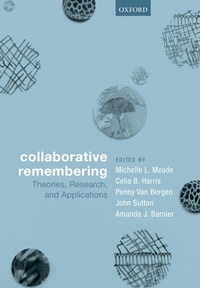
Collaborative Remembering
Theories, Research, and Applications
1st Edition
Published on 1. December 2017
496 pages
978-0-19-105778-6 (ISBN)
Description

We remember in social contexts. We reminisce about the past together, collaborate to remember shared experiences, and, even when we are alone, we remember in the context of our communities and cultures.
Taking an interdisciplinary approach throughout, this text comprehensively covers collaborative remembering across the fields of developmental psychology, cognitive psychology, social psychology, discourse processing, philosophy, neuropsychology, design, and media studies. It highlights points of overlap and contrast across the many disciplinary perspectives and, with its sections on 'Approaches of Collaborative Remembering' and 'Applications of Collaborative Remembering', also connects basic and applied research.
Written with late-stage undergraduates and early-stage graduates in mind, the book is also a valuable tool for memory specialists and academics in the fields of psychology, cognitive science and philosophy who are interested in collaborative memory research.
More details
Other editions
Additional editions
Michelle L. Meade | Celia B. Harris | Penny van Bergen
Collaborative Remembering
Theories, Research, and Applications
Book
12/2017
Oxford University Press
€141.50
Shipment within 15-20 days
Persons
Michelle L. Meade is an Associate Professor of Psychology at Montana State University, USA. Michelle received her BA from Grinnell College, her MA and PhD from Washington University in St. Louis, and she completed a Beckman Postdoctoral Fellowship at the University of Illinois. Her research focuses on memory errors and how memory is influenced in both individual and social contexts.
Celia B. Harris is an Australian Research Council Discovery Early Career Research Fellow in the Department of Cognitive Science at Macquarie University, Australia. She completed her PhD at Macquarie University, in 2010, before taking up a postdoctoral position at the Center of Autobiographical Memory Research at Aarhus University, Denmark. In 2012, Celia returned to Macquarie University as a Macquarie University Research Fellow. Her research focuses on memory sharing in groups, ways of triggering memories, and the functions that memory serves.
Penny Van Bergen is a Senior Lecturer in Educational Psychology in the Department of Educational Studies, Macquarie University, Australia. Penny received her BA in psychology and her PhD in developmental psychology from the University of New South Wales, Australia. Her research and teaching now focuses on children's development of memory and emotion skills, memory in educational contexts, and memory across the lifespan. She is particularly interested in how parents, teachers, and peers support and scaffold children's memory in everyday contexts.
John Sutton is Professor of Cognitive Science at Macquarie University, Australia, where he was previously Head of Philosophy. He received his BA from the University of Oxford and his PhD from the University of Sydney. He is author of Philosophy and Memory Traces: Descartes to connectionism, and co-editor of the journal Memory Studies. John's current research addresses autobiographical and collaborative remembering, embodied skills, and cognitive history. He is a Fellow of the Australian Academy of the Humanities.
Amanda J. Barnier is Professor of Cognitive Science and a Chief Investigator of the Australian Research Council (ARC) Centre of Excellence in Cognition and its Disorders at Macquarie University, Australia. She received her BA(Hons) from Macquarie University and her PhD from the University of New South Wales, both in Psychology. Supported by 20 years of continuous funding from the ARC, including four prestigious Fellowships, Amanda's research has focused on remembering versus forgetting our personal past, and the costs and benefits of remembering alone versus together. She is a Fellow of the Academy of the Social Sciences in Australia.
Content
- I Introduction
- 1: Michelle L. Meade, Celia B. Harris, Penny Van Bergen, John Sutton, and Amanda J. Barnier: Collaborative Remembering: Background and Approaches
- II Approaches to Studying Collaborative Remembering
- 2: Catherine A. Haden, Maria Marcus, and Erin Jan: Socializing Early Skills for Remembering Through Parent-Child Conversations During and After Events
- 3: Robyn Fivush, Widaad Zaman, and Natalie Merrill: Developing Social Functions of Autobiographical Memory within Family Storytelling
- 4: Suparna Rajaram: Collaborative Inhibition in Group Recall: Cognitive Principles and Implications
- 5: William Hirst and Jeremy Yamashiro: Social Aspects of Forgetting
- 6: Fiona Gabbert and Rebecca Wheeler: Memory Conformity Following Collaborative Remembering
- 7: Gerald Echterhoff and René Kopietz: The Socially Shared Nature of Memory: From Joint Encoding to Communication
- 8: Linda A. Henkel and Alison Kris: Collaborative Remembering and Reminiscence in Older Adults
- 9: Nicole Müller and Zaneta Mok: Memories and Identities in Conversation with Dementia
- 10: Lucas M. Bietti and Michael J. Baker: Multimodal Processes of Joint Remembering in Complex Collaborative Activities
- 11: Steven D. Brown and Paula Reavey: Contextualizing Autobiographical Remembering: An Expanded View of Memory
- 12: Chris McVittie and Andy McKinlay: Collaborative Processes in Neuropsychological Interviews
- 13: Kourken Michaelian and Santiago Arango-Muñoz: Collaborative Memory Knowledge: A Distributed Reliabilist Perspective
- 14: Robert A. Wilson: Group-level Cognizing, Collaborative Remembering, and Individuals
- 15: M. Pasupathi and C. Wainryb: Remembering Good and Bad Times Together: Functions of Collaborative Remembering
- 16: Magdalena Abel, Sharda Umanath, James V. Wertsch, and Henry L. Roediger, III: Collective Memory: How Groups Remember Their Past
- 17: Qi Wang: Culture in Collaborative Remembering
- III Applications of Collborative Memory
- 18: Elaine Reese: Encouraging Collaborative Remembering Between Young Children and Their Caregivers
- 19: Karen Salmon: Parent-Child Construction of Personal Memories via Reminiscing Conversations: Implications for the Development and Treatment of Childhood Psychopathology
- 20: Helen Paterson and Lauren Monds: Forensic Applications of Social Memory Research
- 21: Andrew Hoskins: Digital Media and the Precarity of Memory
- 22: Elise van den Hoven, Mendel Broekhuijsen, and Ine Mols: Design Applications for Social Remembering
- 23: Rupa Gupta Gordon, Melissa C. Duff, and Neal J. Cohen: Applications of Collaborative Memory: Patterns of Success and Failure in Individuals with Hippocampal Amnesia
- 24: Helena Blumen: Collaborative Memory Interventions for Age-Related and Alzheimer s Disease- Related Memory Decline
- 25: Lars-Christer Hydén and Mattias Forsblad: Collaborative Remembering in Dementia: A Focus on Joint Activities
- IV Conclusion
- 26: Michelle L. Meade, Celia B. Harris, Penny Van Bergen, John Sutton, and Amanda J. Barnier: Concluding Remarks: Common Themes and Future Directions
