

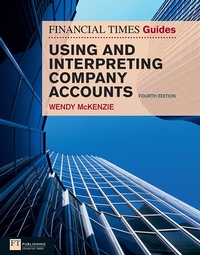
Financial Times Guide to Using and Interpreting Company Accounts, The
Description

The Financial Times Guide to Using and Interpreting Company Accounts is designed for the non-accountant manager, investor or entrepreneur who is expected to have financial knowledge but may not have accounting training.
Wendy McKenzie approaches the project via three key points: What information will I find in these accounts?; How do I analyse the accounts?; How can I use my analysis?
Using publicly available actual accounts, the book begins by covering the 'numbers' from company accounts then moves on to information such as the financial review and then explains the logic of the accounts. To help with the interpreting of the numbers Wendy shows the reader how to understand issues such as cash flow, what this will tell you about a company, how to consider a competitor's accounts and how to perform ratio calculations to help with company analysis.
More details
Other editions
Additional editions
Person
Wendy McKenzie is the founder and manager of McKenzie Training Associates. She's worked both in the City and in a range of other companies and financial organisations.
Content
Table of Contents
Preface PART 1 WHAT INFORMATION WILL I FIND IN THE ACCOUNTS?
1 An introduction to the accounts 2 The profit and loss account 3 The balance sheet 4 The cash flow statement 5 The statement of total recognised gains and losses 6 The note of historical cost profits and losses 7 Other information found in the accounts 8 International conventions - local GAPP, IFRS, emerging nations
PART 2 HOW DO I ANALYSE THE ACCOUNTS? 9 How do I analyse the accounts? 10 Solvency 11 Profitability 12 Cash management 13 The investor's perspective 14 Johnson Matthey
PART 3 HOW CAN I USE MY ANALYSIS?
15 How can I use my analysis? 16 Suppliers' accounts 17 Customers' accounts 18 Competitors' accounts 19 Identifying a company's acquisition potential 20 The availability of accounts
Weblinks
Index
