

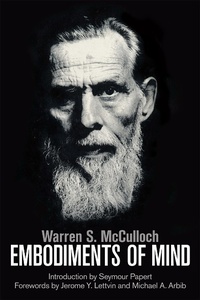
Embodiments of Mind
Description

Warren S. McCulloch was an original thinker, in many respects far ahead of his time. McCulloch, who was a psychiatrist, a philosopher, a teacher, a mathematician, and a poet, termed his work "experimental epistemology.” He said, "There is one answer, only one, toward which I've groped for thirty years: to find out how brains work.” Embodiments of Mind, first published more than fifty years ago, teems with intriguing concepts about the mind/brain that are highly relevant to recent developments in neuroscience and neural networks. It includes two classic papers coauthored with Walter Pitts, one of which applies Boolean algebra to neurons considered as gates, and the other of which shows the kind of nervous circuitry that could be used in perceiving universals. These first models are part of the basis of artificial intelligence.
Chapters range from "What Is a Number, that a Man May Know It, and a Man, that He May Know a Number,” and "Why the Mind Is in the Head,” to "What the Frog's Eye Tells the Frog's Brain” (with Jerome Lettvin, Humberto Maturana, and Walter Pitts), "Machines that Think and Want,” and "A Logical Calculus of the Ideas Immanent in Nervous Activity” (with Walter Pitts). Embodiments of Mind concludes with a selection of McCulloch's poems and sonnets. This reissued edition offers a new foreword and a biographical essay by McCulloch's one-time research assistant, the neuroscientist and computer scientist Michael Arbib.
More details
Other editions
Additional editions

Person
Michael Arbib has played a leading role at the interface of neuroscience and computer science ever since his first book, Brains, Machines, and Mathematics. From Neuron to Cognition provides a worthy pedagogical sequel to his widely acclaimed Handbook of Brain Theory and Neural Networks. After thirty years at University of Southern California he is now pursuing interests in ?how the brain got language? and ?neuroscience for architecture? in San Diego.
The late Seymour A. Papert was a Professor in MIT's AI Lab (1960?1980s) and MIT's Media Lab (1985?2000) and the author of Mindstorms: Children, Computers, and Powerful Ideas.
Content
- Intro
- Title page
- Copyright page
- Table of Contents
- Foreword to the 2016 Reissue
- Foreword to the 1988 Reissue
- Preface
- Acknowledgments
- Introduction
- 1 What Is a Number, That a Man May Know It, and a Man, That He May Know a Number?
- 2 A Logical Calculus of the Ideas Immanent in Nervous Activity
- 3 A Heterarchy of Values Determined by the Topology of Nervous Nets
- 4 How We Know Universals: The Perception of Auditory and Visual Forms
- 5 Modes of Functional Organization of the Cerebral Cortex*
- 6 Why the Mind Is in the Head
- 7 Through the Den of the Metaphysician
- 8 Mysterium Iniquitatis of Sinful Man Aspiring into the Place of God
- 9 Effects of Strychnine with Special Reference to Spinal Afferent Fibres*
- 10 Reflex Inhibition by Dorsal Root Interaction*
- 11 Toward Some Circuitry of Ethical Robots or an Observational Science of the Genesis of Social Evaluation in the Mind-Like Behavior of Artifacts*
- 12 Agathe Tyche: Of Nervous Nets-the Lucky Reckoners
- 13 Where Is Fancy Bred?
- 14 What the Frog's Eye Tells the Frog's Brain*
- 15 Finality and Form in Nervous Activity
- 16 The Past of a Delusion
- 17 Machines That Think and Want
- 18 The Natural Fit
- 19 A Historical Introduction to the Postulational Foundations of Experimental Epistemology*
- 20 Physiological Processes Underlying Psychoneuroses
- 21 "What's in the Brain That Ink May Character?"*
- Afterword: Warren McCulloch's Search for the Logic of the Nervous System
- Index
