

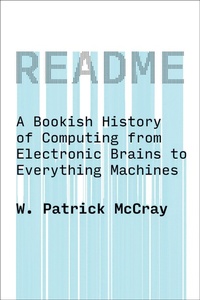
README
A Bookish History of Computing from Electronic Brains to Everything Machines
Published on 2. December 2025
376 pages
978-0-262-38484-1 (ISBN)
Description

The essential role that the oldest literary technology-books-played in making computers popular and pervasive.
In README, historian Patrick McCray argues that in order for computers to become ubiquitous, people first had to become interested in them, learn about them, and take the machines seriously. A powerful catalyst for this transformation was, ironically, one of the oldest information technologies we have: books. The author uses a carefully chosen selection of books, some iconic and others obscure, to describe this technological revolution as it unfolded in the half century after 1945. The book begins with a fundamental question: How does a new technology become well-known and widespread? McCray answers this by using books as a window into significant moments in the history of computing, books, publishing, and American culture.
README offers a literary history of computers and, more broadly, information technologies between World War II and the dot.com crash of the early twenty-first century. From the electronic brains and cybernetics craze of the 1940s to the birth of AI, the rise of the personal computer, and the Internet-driven financial frenzy of the 1990s, books have proven a durable and essential way for people to learn how to use and think about computers. By offering a readable half-century of bookish history, README explains how computers became popular and pervasive.
In README, historian Patrick McCray argues that in order for computers to become ubiquitous, people first had to become interested in them, learn about them, and take the machines seriously. A powerful catalyst for this transformation was, ironically, one of the oldest information technologies we have: books. The author uses a carefully chosen selection of books, some iconic and others obscure, to describe this technological revolution as it unfolded in the half century after 1945. The book begins with a fundamental question: How does a new technology become well-known and widespread? McCray answers this by using books as a window into significant moments in the history of computing, books, publishing, and American culture.
README offers a literary history of computers and, more broadly, information technologies between World War II and the dot.com crash of the early twenty-first century. From the electronic brains and cybernetics craze of the 1940s to the birth of AI, the rise of the personal computer, and the Internet-driven financial frenzy of the 1990s, books have proven a durable and essential way for people to learn how to use and think about computers. By offering a readable half-century of bookish history, README explains how computers became popular and pervasive.
More details
Other editions
Additional editions
W. Patrick Mccray
README
A Bookish History of Computing from Electronic Brains to Everything Machines
Book
approx. 12/2025
MIT Press
€41.00
Not yet published
Person
W. Patrick McCray is Professor of History at the University of California, Santa Barbara. Originally trained as a scientist, he is the author or editor of eight books. He is an elected Fellow of the American Association for the Advancement of Science (AAAS) and the American Physical Society (APS).
