

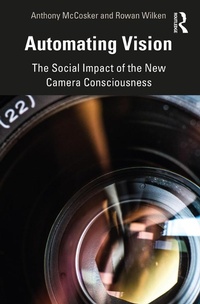
Automating Vision
The Social Impact of the New Camera Consciousness
1st Edition
Published on 26. March 2020
162 pages
978-1-000-06098-0 (ISBN)
Description

Automating Vision explores the rise of seeing machines through four case studies: facial recognition, drone vision, mobile and locative media and driverless cars. Proposing a conceptual lens of camera consciousness, which is drawn from the early visual anthropology of Gregory Bateson and Margaret Mead, Automating Vision accounts for the growing power and value of camera technologies and digital image processing.
Behind the smart camera devices examined throughout the book lies a set of increasingly integrated and automated technologies underpinned by artificial intelligence, machine learning and image processing. Seeing machines are now implicated in growing visual data markets and are supported by emerging layers of infrastructure that they coproduce. In this book, Anthony McCosker and Rowan Wilken address the social impacts, the disruptions and reconfigurations to existing digital media ecosystems, to urban environments and to mobility and social relations that result from the increasing automation of vision and explore how it might be possible to ensure a safe and equitable future as we learn to see with and negotiate the interventions of seeing machines.
This book will appeal to students and scholars in media, communication, cultural studies, sociology of media and science and technology studies.
More resources for the book can be found at https://www.anthonymccosker.com/automating-vision.
Behind the smart camera devices examined throughout the book lies a set of increasingly integrated and automated technologies underpinned by artificial intelligence, machine learning and image processing. Seeing machines are now implicated in growing visual data markets and are supported by emerging layers of infrastructure that they coproduce. In this book, Anthony McCosker and Rowan Wilken address the social impacts, the disruptions and reconfigurations to existing digital media ecosystems, to urban environments and to mobility and social relations that result from the increasing automation of vision and explore how it might be possible to ensure a safe and equitable future as we learn to see with and negotiate the interventions of seeing machines.
This book will appeal to students and scholars in media, communication, cultural studies, sociology of media and science and technology studies.
More resources for the book can be found at https://www.anthonymccosker.com/automating-vision.
Reviews / Votes
"The authors provide an invaluable guidebook to an emerging and at times uncanny technological landscape whose unblinking, opaque, and distributed gaze stares back at us from a growing array of devices that promise to sort, recognize, and evaluate us. Automating Vision is a crucial contribution to the new forms of visual literacy we must cultivate if we are to reap the benefits of the burgeoning field of machine vision while evading its pitfalls. It is an elegantly written, theoretically sophisticated book that is destined to become a touchstone work for our times."Mark Andrejevic, Monash University. Author of Automated Media.
"Snapshots are automated, vision becomes machinic, cars sense more than the driver, and seeing is more like data analysis; it's in this field of transformations of media that Automating Vision offers an excellent analysis of the social aspects of artificial intelligence. Warmly recommended across the multiple contemporary disciplines that have to make sense of this situation but also to develop a fresh approach to media literacy."
Professor Jussi Parikka, University of Southampton and FAMU, Prague
"This timely volume offers a rich discussion of the social impact of smart cameras across a range of domains, ranging from surveillance and facial recognition to drones and self-driving cars. The central term "camera consciousness" grounds the productive analysis of the social interactions around and with new visual technologies. This book will be a key reference for scholars interested in the social aspects of algorithmic visual technologies."
Jill Walker Rettberg, Author, Professor and Leader of the Digital Culture Research Group at the University of Bergen, Norway "The authors provide an invaluable guidebook to an emerging and at times uncanny technological landscape whose unblinking, opaque, and distributed gaze stares back at us from a growing array of devices that promise to sort, recognize, and evaluate us. Automating Vision is a crucial contribution to the new forms of visual literacy we must cultivate if we are to reap the benefits of the burgeoning field of machine vision while evading its pitfalls. It is an elegantly written, theoretically sophisticated book that is destined to become a touchstone work for our times."
Mark Andrejevic, Monash University, Australia. Author of Automated Media.
"Snapshots are automated, vision becomes machinic, cars sense more than the driver, and seeing is more like data analysis; it's in this field of transformations of media that Automating Vision offers an excellent analysis of the social aspects of artificial intelligence. Warmly recommended across the multiple contemporary disciplines that have to make sense of this situation but also to develop a fresh approach to media literacy."
Professor Jussi Parikka, University of Southampton, UK, and FAMU, Prague, Czech Republic
"This timely volume offers a rich discussion of the social impact of smart cameras across a range of domains, ranging from surveillance and facial recognition to drones and self-driving cars. The central term 'camera consciousness' grounds the productive analysis of the social interactions around and with new visual technologies. This book will be a key reference for scholars interested in the social aspects of algorithmic visual technologies."
Jill Walker Rettberg, Author, Professor and Leader of the Digital Culture Research Group at the University of Bergen, Norway
More details
Edition
1. Auflage
Language
English
Place of publication
London
United Kingdom
Publishing group
Taylor & Francis Ltd
Target group
College/higher education
Illustrations
9 Halftones, black and white; 9 Illustrations, black and white
ISBN-13
978-1-000-06098-0 (9781000060980)
Copyright in bibliographic data and cover images is held by Nielsen Book Services Limited or by the publishers or by their respective licensors: all rights reserved.
Schweitzer Classification
Other editions
Additional editions
Book
05/2020
1st Edition
Routledge
€60.70
Shipment within 15-20 days
Book
05/2020
1st Edition
Routledge
€191.89
Shipment within 15-20 days
Persons
Anthony McCosker is an Associate Professor in Media and Communication and Deputy Director of the Social Innovation Research Institute, Swinburne University of Technology, Melbourne, Australia.
Rowan Wilken is an Associate Professor in Media and Communication and Principal Research Fellow in the Digital Ethnography Research Centre (DERC), RMIT University, Melbourne, Australia.
Rowan Wilken is an Associate Professor in Media and Communication and Principal Research Fellow in the Digital Ethnography Research Centre (DERC), RMIT University, Melbourne, Australia.
Content
Interrogating seeing machines
Camera consciousness
Face value
Automating and augmenting mobile vision
Drone vision
How does a car learn to see?
Training visual literacies
Camera consciousness
Face value
Automating and augmenting mobile vision
Drone vision
How does a car learn to see?
Training visual literacies
