

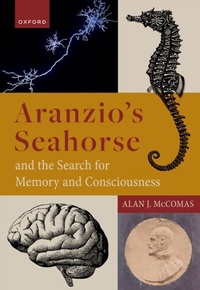
Aranzio's Seahorse and the Search for Memory and Consciousness
The Search for Memory and Consciousness
1st Edition
Published on 15. September 2022
328 pages
978-0-19-269435-5 (ISBN)
Description

In the final volume of his historical neuroscience trilogy, prize-winning author Alan J. McComas recounts the research that led to recognition of the hippocampus, a structure deep within the brain, as being primarily responsible for memory. This intriguing and exciting account includes observations on patients with memory loss as well as insights from ingenious laboratory experiments. Using several arguments in support, McComas suggests that it is the electrical impulse activity of neurons in the hippocampus that creates consciousness and that the latter is, in fact, the ever-changing sequence of short-term memories. He show us how a deeper knowledge of the hippocampus can help us develop a fuller understanding of Alzheimer's disease and other disorders of memory and behaviour, including 'long COVID.
Lavishly illustrated, Aranzio's Seahorse will be of value not only to neuroscientists, psychologists, and philosophers but to all those interested in the workings of the brain and in the history of its exploration.
More details
Other editions
Additional editions
Alan J. Mccomas
Aranzio's Seahorse and the Search for Memory and Consciousness
The Search for Memory and Consciousness
Book
09/2022
Oxford University Press
€68.00
Shipment within 15-20 days
Person
Born in Western Australia, Alan J. McComas received his medical and neurological training in Newcastle upon Tyne (UK), with postdoctoral studies at University College London and the National Hospital for Nervous Diseases, Queen Square, London. He was later appointed Head of Neurology and then of Biomedical Sciences at McMaster University, Canada. Initially specializing in neuromuscular disorders, McComas is best known for having pioneered a method for estimating numbers of motor nerve cells (motoneurons) in the spinal cords and brain stems of living human subjects. Later interests included reflex mechanisms and muscle fatigue, and he (with colleague Adrian Upton) pioneered the use of transcranial magnetic stimulation for the treatment of migraine. As a medical historian, McComas wrote the award-winning Galvani's Spark. The Story of the Nerve Impulse.
He is now Emeritus Professor of Medicine (Neurology) at McMaster University.
Content
- Part I: Memory
- 1: The undisturbed seahorse. (Europe, 16th-20th centuries).
- 2: A portentous crossing. (Montreal, 1944-1948: Donald Hebb, Peter and Brenda Milner).
- 3: Graduate studies at MNI. (Montreal, 1948-1954: Peter and Brenda Milner, James Olds, Wilder Penfield, Herbert Jasper).
- 4: Bold surgeon and compliant patient. (Hartford (Connecticut), 1953: William Scoville, Brenda Milner, Henry Molaison).
- 5: Triumph and an unprovoked attack. (Montreal, London, 1957; Wilder Penfield, Francis Walshe).
- 6: The path to psychiatry. (New York, 1957: Eric Kandel).
- 7: A trip to Australia. (Oslo, Canberra, 1961: Per Andersen, John Eccles).
- 8: Taking stock. (Montreal, 1960: Brenda Milner).
- 9: Visual focus. (Cambridge (Massachusetts), 1962, Stephen Kuffler, David Hubel, Torsten Wiesel).
- 10: Enter the giant sea slug. (Paris, 1962: Eric Kandel, Ladislav Tauc).
- 11: Human neurons--success and disappointment. (Paris, Uppsala, 1960s: Denise Albe-Fessard, Karl-Erik Hagbarth).
- 12: Human neurons--success and disappointment. (Paris, Uppsala, 1960s: Denise Albe-Fessard, Karl-Erik Hagbarth).
- 13: Return of the slug. (New York, 1965: Eric Kandel).
- 14: Polish insights. (Warsaw, 1968: Jerzy Konorski).
- 15: Continuing excitation in Norway. (Oslo, 1968: Terje Lømo, Timothy Bliss).
- 16: Revelation on Gower Street. (London, 1971: Patrick Wall, John O'Keefe).
- 17: Mathematics and the hippocampus. (Cambridge (UK), 1971: David Marr).
- 18: 1980: departures.
- 19: Hidden faces. (Oxford, New York: Edmund Rolls, Eric Kandel).
- 20: More than a headache. (London, 1985: Clive and Deborah Wearing).
- 21: Unexpectedly, a grid. (London, Oslo, 1996: Edvard and May-Britt Moser).
- 22: A telephone call. (Stockholm, New York, Cambridge (Massachusetts), 2000: Eric Kandel).
- 23: Death and disorder. (Bickford (Connecticut), San Diego, 2008: Henry Molaison, Suzanne Corkin, Jacopo Annese).
- 24: Jennifer Aniston discovered. (Los Angeles, 2005. Itzhak Fried, Christof Koch, Rodrigo Quian Quiroga).
- 25: New cells or not? (1983--present, New York, Boston, Princeton, New Haven, La Jolla: Fernando Nottebohn, Joseph Altman, Michael Kaplan, Elizabeth Gould, Pasko Rakic, Fred Gage).
- 26: Neurons that glow. (Toronto, Cambridge (Massachusetts), 2020: Sheena Josselyn, Susuma Tonegawa).
- 27: Summary.
- Part II: The Evolution of Consciousness
- 28: Preamble.
- 29: Definition of consciousness.
- 30: Theories of consciousness.
- 31: Recognition of limbic system within brain.
- 32: Recognition of limbic system within brain.
- 33: Clinical evidence of hippocampal (limbic) involvement in consciousness
- 34: Animal evidence consistent with consciousness generation in limbic system (rather than cortex).
- 35: Animal evidence consistent with consciousness generation in limbic system (rather than cortex).
- 36: The evolutionary argument.
- 37: The minimum time argument.
- 38: Clive Wearing and Henry Molaison reconsidered.
- 39: Role of the amygdala.
- 40: Role of the non-hippocampal cortex.
- 41: Back to the hippocampus.
- 42: The numbers game
- 43: Speculations on spatial maps and other issues.
- 44: Final note: the multi-tasking hippocampus.
- 45: Recapitulation and synthesis
- 46: Epilogue
