

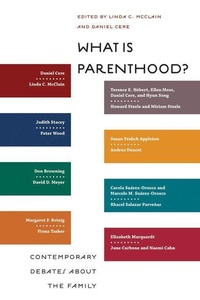
What Is Parenthood?
Contemporary Debates About the Family
1st Edition
Published on 14. January 2013
277 pages
978-0-8147-2448-4 (ISBN)
Description

Extraordinary changes in patterns of family life-and family law-have dramatically altered the boundaries of parenthood and opened up numerous questions and debates. What is parenthood and why does it matter? How should society define, regulate, and support it? Is parenthood separable from marriage-or couplehood-when society seeks to foster children's well-being? What is the better model of parenthood from the perspective of child outcomes?
Intense disagreements over the definition and future of marriage often rest upon conflicting convictions about parenthood. What Is Parenthood? asks bold and direct questions about parenthood in contemporary society, and it brings together a stellar interdisciplinary group of scholars with widely varying perspectives to investigate them. Editors Linda C. McClain and Daniel Cere facilitate a dynamic conversation between scholars from several disciplines about competing models of parenthood and a sweeping array of topics, including single parenthood, adoption, donor-created families, gay and lesbian parents, transnational parenthood, parent-child attachment, and gender difference and parenthood.
Intense disagreements over the definition and future of marriage often rest upon conflicting convictions about parenthood. What Is Parenthood? asks bold and direct questions about parenthood in contemporary society, and it brings together a stellar interdisciplinary group of scholars with widely varying perspectives to investigate them. Editors Linda C. McClain and Daniel Cere facilitate a dynamic conversation between scholars from several disciplines about competing models of parenthood and a sweeping array of topics, including single parenthood, adoption, donor-created families, gay and lesbian parents, transnational parenthood, parent-child attachment, and gender difference and parenthood.
Reviews / Votes
"What is Parenthood? is an invaluable resource for anyone who wishes to think critically about modern parenthood and what the government can and should do to improve families. In bringing together eminent figures from different disciplines and from different political or cultural views about the family, it maintains an important dialogue about the best way forward." - Brian Bix,Frederick W. Thomas Professor, University of Minnesota "I highly recommend this thought provoking and compelling book. It examines parenthood at a time when the concept of the family is radically changing, most notably stemming from the rise of single-parent households and divorced and blended families. And it proposes a number of intelligent and important solutions. After all, the long-term health of our representative democracy is dependent on our ability, as parents, to prepare our children for the future." - Leah Ward Sears,former Chief Justice, Georgia Supreme Court "This book is a much needed model for how to bring civility and reason into the culture wars. It is a frank but non-polemical exploration of the science, ethics, and politics that affect our views about when and how we should regulate parenthoodone that opens up rather than shuts down the conversation." - Katharine Bartlett,A. Kenneth Pye Professor of Law, Duke Law School "This book is a valuable contribution to a critically important, current societal debate on childrens rights with respect to who their parents are and the family structure in which they are reared. It should be read by all involved in that debate, and especially those who will decide on the law and social and public policy that will determine the future of the family and the family of the future." - Margaret Somerville (International Journal of Jurisprudence of the Family) "Well-balanced consideration of two different views of parenthood as a social institution." (Choice)More details
Series
Language
English
Place of publication
New York
United States
Target group
Professional and scholarly
File size
3,62 MB
ISBN-13
978-0-8147-2448-4 (9780814724484)
Copyright in bibliographic data and cover images is held by Nielsen Book Services Limited or by the publishers or by their respective licensors: all rights reserved.
Schweitzer Classification
Other editions
Additional editions
Book
01/2013
New York University Press
€93.00
Shipment within 15-20 days
Book
01/2013
New York University Press
€39.50
Shipment within 15-20 days
Persons
Linda C. McClain is Professor of Law and Paul M. Siskind Research Scholar at Boston University School of Law. She is the author of The Place of Families: Fostering Capacity, Equality, and Responsibility, co-author of Ordered Liberty: Rights, Responsibilities, and Virtues (with James E. Fleming), and co-editor of Gender Equality: Dimensions of Women's Equal Citizenship (with Joanna L. Grossman).
Daniel Cere is Associate Professor of Religion, Ethics and Public Policy in the Faculty of Religious Studies, McGill University and the Director of the Institute for the Study of Marriage, Law & Culture. His publications include Divorcing Marriage and The Future of Family Law.
Daniel Cere is Associate Professor of Religion, Ethics and Public Policy in the Faculty of Religious Studies, McGill University and the Director of the Institute for the Study of Marriage, Law & Culture. His publications include Divorcing Marriage and The Future of Family Law.
Content
- Cover
- Contents
- Acknowledgments
- Introduction
- Part I: What Is Parenthood? Proposing Two Models
- 1. Toward an Integrative Account of Parenthood
- 2. A Diversity Approach to Parenthood in Family Life and Family Law
- Part II: Institutions: Is Parenthood Separable from Marriage (or Couplehood) When It Comes to Fostering Child Well-Being?
- 3. Uncoupling Marriage and Parenting
- 4. The Anthropological Case for the Integrative Model
- Part III: Rights: What Rights Are at Stake? How Should the Rights of Adults and Children Shape the Law of Parenthood?
- 5. Legal Parenthood, Natural and Legal Rights, and the Best Interests of the Child: An Integrative View
- 6. Family Diversity and the Rights of Parenthood
- Part IV: Child Outcomes and Forms of Parenthood: Does One Model Produce, on Average, Better Outcomes for Children? For Society?
- 7. A Case for Integrated Parenthood
- 8. Developmental Outcomes for Children Raised by Lesbian and Gay Parents
- Part V: Attachment: (How Much) Does Biology Matter?
- 9. Biological and Psychological Dimensions of Integrative Attachments
- 10. Parenting Matters: An Attachment Perspective
- Part VI: Gender Equality, Gender Difference, and Parenthood: Are There Gender Differences in Parenting? Should Difference Make a Difference?
- 11. Gender and Parentage: Family Law's Equality Project in Our Empirical Age
- 12. Can Parenting Be Equal? Rethinking Equality and Gender Differences in Parenting
- Part VII: Globalization and Parenthood: How Do Family Immigration and Transnational Parenting Shape Parenthood? How Should They Inform Debates over Parenthood?
- 13. Transnationalism of the Heart: Familyhood across Borders
- 14. Transnational Mothering and Models of Parenthood: Ideological and Intergenerational Challenges in Filipina Migrant Families
- Part VIII: Now What? Given Current Indicators, Can the "Toothpaste Go Back in the Tube"? Should It?
- 15. Of Human Bonding: Integrating the Needs and Desires of Women, Men, and the Children Their Unions Produce
- 16. The Other Side of the Demographic Revolution: Social Policy and Responsible Parenthood
- Epilogue
- About the Contributors
- Index
- A
- B
- C
- D
- E
- F
- G
- H
- I
- J
- K
- L
- M
- N
- O
- P
- R
- S
- T
- U
- V
- W
- Z
