

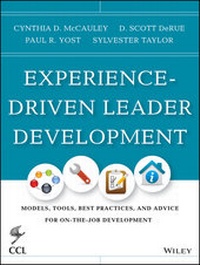
Experience-Driven Leader Development
Description

Reviews / Votes
Praise for Experience-Driven Leader Development "In my twenty-six years in human resources, I've learned firsthand that our best leaders develop through on-the-job experience. This book provides a valuable framework for leadership thinking and talent development--immensely helpful for all of us who work with aspiring leaders." --Jeff Brodsky, Chief Human Resources Officer, Morgan Stanley "How to best leverage on-the-job experiences for leader development is a challenge for organizations, but clearly one that talent management professionals have tackled in intentional and innovative ways. This book performs the real service of broadly sharing best practices--both proven and cutting-edge--so that we all can do a better job of using experience to develop leadership talent." --Martha Soehren, Chief Talent Development Officer, Comcast "Having experienced the power of on-the-job leadership development in my own career, I'm delighted to see the world's best thinking on experiential learning collected in one place. The well-researched and practical wisdom in this book makes it essential for executives and line managers who want to unleash the full potential of their talent pipelines." --O. P. (Om) Bhatt, Chairman (retired), State Bank of India "As we develop the next generation of leaders, the 'e' in e-Learning must shift to mean 'experience.' This book is a must-read for learning leaders driven to make development sustainable!" --Elliott Masie, Learning CONSORTIUM, The Masie Center "This compendium on leadership development through experience is comprehensive, practical, and useful. The anthology embodies the latest thinking and practice in building leaders and will help thoughtful scholars and practitioners make more informed choices about leadership development." --Dave Ulrich, Professor, Ross School of Business and Partner, The RBL Group "If you believe you become an employer of choice by building leaders of choice, this book serves as a field guide rich with thought leadership and practical solutions to help enable your success!" --Nina M. Ramsey, Chief Human Resources Officer, Kelly Services, Inc. "A collection of A to Z best practices in leader development: selection to job experiences to courses to learning strategies and how they all must work together. This will be the definitive source for leader development for decades to come." --Michael M. Lombardo, Founder, Lominger Limited, Inc., and author, FYI: For Your Improvement and Lessons of ExperienceMore details
Other editions
Additional editions
Persons
Content
List of Exhibits, Figures, and Tables xiii
Foreword xix
Acknowledgments xxiii
Introduction xxv
Section 1. Developmental Experiences: More Intentional for More People 1
Section Introduction 3
Equipping Employees to Pursue Developmental Experiences 7
1 Intensity and Stretch: The Drivers of On-the-Job Development 7 Mark Kizilos (Experience-Based Development Associates, LLC)
2 A Leadership Experience Framework 15 Paul Van Katwyk, Joy Hazucha, and Maynard Goff (Korn/Ferry International)
3 Identifying Development-in-Place Opportunities 21 Cynthia McCauley (Center for Creative Leadership)
4 Leadership Maps: Identifying Developmental Experiences in Any Organization 25 Paul Yost (Seattle Pacific University) and Joy Hereford (Yost & Associates, Inc.)
5 Building Organization-Specific Knowledge About Key Developmental Experiences 37 Paul R. Bly (Thomson Reuters) and Mark Kizilos (Experience-Based Development Associates, LLC)
6 Expression of Interest: Making Sought-After Roles Visible 45 Tanya Boyd (Payless Holdings, Inc.)
7 Designing Part-Time Cross-Functional Experiences 49 Nisha Advani (Genentech, a member of the Roche Group)
8 Creating Project Marketplaces 55 Cynthia McCauley (Center for Creative Leadership)
Leveraging Existing Experiences for Learning 57
9 Leveraging the Developmental Power of Core Organizational Work 57 Patricia M.G. O'Connor (Wesfarmers)
10 Learning Transferable Skills Through Event Planning 65 Kenna Cottrill and Kim Hayashi (Leadership Inspirations)
11 Pinpointing: Matching Job Assignments to Employees 69 Jeffrey J. McHenry (Rainier Leadership Solutions)
12 Learning from Personal Life Experiences 77 Marian N. Ruderman and Patricia J. Ohlott (Center for Creative Leadership)
Creating New Developmental Experience 81
13 Strategic Corporate Assignments to Develop Emerging Market Leaders 81 Anita Bhasin (Sage Ways, Inc.), Lori Homer (Microsoft), and Eric Rait (Honeycomb Development)
14 Full-Time Strategic Projects for High Potentials 87 Paul Orleman (SAP)
15 A Personalized Rotation Program to Develop Future Leaders 93 Bela Tisoczki and Laurie Bevier (General Electric)
16 Corporate Volunteerism as an Avenue for Leader Development 99 Shannon M. Wallis (Arrow Leadership Strategies) and Jeffrey J. McHenry (Rainier Leadership Solutions)
17 Developing Socially Responsible Global Leaders Through Service Projects 107 Mathian Osicki and Caroline Smee (IBM)
18 Stretch Assignments to Develop First-Time Supervisors 113 Sally A. Allison and Marsha Green (Duke University) 19 Executive Shadowing 119 Ritesh Daryani (Expedia, Inc.)
20 Leadership Fitness Challenge: Daily Exercise of the Leadership Muscle 123 Laura Ann Preston-Dayne (Kelly Services, Inc.)
21 Using a Video-Case-Based Collaborative Approach in Leader Development 129 Nate Allen (U.S. Army, National Defense University)
22 Cross-Company Consortiums: Tackling Business Challenges and Developing Leaders Together 133 Yury Boshyk (The Global Executive Learning Network)
Section 2. Leaders: Better Equipped to Learn from Experience 141
Section Introduction 143
Organizing Frameworks 145
23 Mindful Engagement: Learning to Learn from Experience 145 D. Scott DeRue and Susan J. Ashford (University of Michigan)
24 PARR: A Learning Model for Managers 151 Laura Ann Preston-Dayne (Kelly Services, Inc.)
25 GPS.R: A Tool for Assessing Learning Readiness 157 Paul Yost, Hillary Roche, and Jillian McLellan (Seattle Pacific University)
Learning Strategies and Tactics 165
26 Asking Questions to Foster Learning from Experience 165 Sally Beddor Nowak (Agilent Technology)
27 Using the Classroom to Create a Learning Orientation 169 Lori Homer (Microsoft) and Anita Bhasin (Sage Ways, Inc.)
28 Establishing a Learning Mindset 177 Kelly A. Bunker (Making Experience Matter)
29 Tactics for Learning from Experience 181 Maxine Dalton
30 Narrating Emotions to Enhance Learning 187 Shirli Kopelman (University of Michigan) and Ilan Gewurz (Proment Corporation)
31 Proactive Feedback Seeking: The Power of Seeing Yourself as Others See You 195 Susan J. Ashford (University of Michigan)
32 Feedback: Who, When, and How to Ask 203 Sylvester Taylor (Center for Creative Leadership)
33 Micro-Feedback: A Tool for Real-Time Learning 207 Tanya Boyd (Payless Holdings, Inc.)
Reflection and Retention 213
34 Leadership Journeys: Intentional Reflection Experiences 213 Nicole L. Dubbs, Andrew K. Mandel, Kristin Ohnstad, and Scott Taylor (Teach For America)
35 After-Event Reviews: How to Structure Reflection Conversations 221 D. Scott DeRue (University of Michigan)
36 Scaffolding Reflection: What, So What, Now What? 229 Claudia Hill (Korn/Ferry International)
37 Life Journeys: Developing for the Future by Looking at the Past 235 Kerry A. Bunker (Making Experience Matter)
38 Strategies for Facilitating Learning from Experience 239 Claudia Hill (Korn/Ferry International)
39 Teachable Point of View: Learning to Lead by Teaching Others 243 Scott McGhee (U.S. Cellular)
40 Implementation Intention: A Refinement to Leadership Development Goal Setting 249 Luke Novelli, Jr. (Leadership Development Resources Global)
41 Twelve Questions for More Strategic Work and Learning 255 Kelly McGill (Expedia, Inc.)
Learning Communities and Support 259
42 Building a Board of Learning Advisors 259 Marisa Bossen and Paul Yost (Seattle Pacific University)
43 Building a Learning Community Through Reflection and Experimentation 265 Jennifer Jaramillo (Accenture) and Kristen Schultz (University of Michigan)
44 Using Communities of Practice to Cultivate Leaders of Integrity 273 John R. Terrill (Seattle Pacific University)
45 Company Command: A Peer-to-Peer Learning Forum 279 Nate Allen (U.S. Army, National Defense University)
46 Virtual Roundtables: Using Technology to Build Learning Communities 287 Jonathan Winter (The Career Innovation Group)
Section 3. Human Resource Systems: Designed for Experience-Driven Development 293
Section Introduction 295
47 Integrated Talent Management and Experience-Based Development 299 Norm Tonina (Grameen Foundation)
Selection and On-Boarding 309 48 Identifying and Assessing for Learning Ability 309 Paul Yost and Jillian McLellan (Seattle Pacific University)
49 On-the-Job Development That Starts on Day One 317 Brad Borland (Kelly Services, Inc.)
50 New Leader Assimilation 321 Tanya Boyd (Payless Holdings, Inc.)
51 Virtual On-Boarding 327 Ritesh Daryani (Expedia, Inc.)
Managers as Developers 333
52 Leaders Coaching Leaders: Cascading Leadership Development Through the Organization 333 Robert J. Thomas, Claudy Jules, and Joshua Bellin (Accenture)
53 An Exercise for Managers: Developing Talent Through Assignments 341 Cynthia McCauley (Center for Creative Leadership)
54 Performance and Development Through Conversation 347 Jonathan Winter (The Career Innovation Group)
Performance Management 355
55 Performance Management and Leadership Development: Paradox or Potential? 355 Robert McKenna and Robleh Kirce (Seattle Pacific University)
56 Performance Management Catalysts for Experience-Driven Development 363 Paul Yost (Seattle Pacific University)
Training, Development, and Beyond 371 57 Training and Experience-Driven Development 371 Paul Yost (Seattle Pacific University)
58 Bringing the Real World into the Classroom 375 Elaine Biech (ebb associates inc)
59 Cultivating Learning Agility: Lessons from the Microfinance Sector 381 Lyndon Rego (Center for Creative Leadership), Vandana Viswanathan (CoCoon), and Peg Ross (PCI)
60 HoTspots (HubsoTraining): A Blended Group Learning Solution to Extend Traditional Training 389 Eric Berg (LINGOs)
61 Building Experience into Simulations 397 James Chisholm, Greg Warman, and Andrew Webster (ExperiencePoint)
62 Mentoring: Building Leaders in Powerful Developmental Relationships 405 Dana Kendall (Seattle Pacific University)
Action Learning 413 63 Business Driven Action Learning 413 Yury Boshyk (The Global Executive Learning Network)
64 Action Learning with Community-Based Nonprofits 423 Lynn Fick-Cooper and Shera Clark (Center for Creative Leadership)
65 Better Together: Building Learning Communities Across Organizations 433 Jan Wilmott (Royal Bank of Canada)
66 Communities of Practice: Building and Sustaining Global Learning Communities 441 Yury Boshyk (The Global Executive Learning Network)
Succession Management 445
67 Succession Planning: Developing General Managers Through Experience 445 Mary M. Plunkett
68 Building Breadth and Depth Through Experience 451 Jennifer Kennedy Marchi (Sonos, Inc.)
69 Profiles for Success: Building a Framework for Internal Transitions 459 Tanya Boyd (Payless Holding, Inc.)
70 Hot Jobs-Hot People: Sharing Leadership Talent Across Organizations 463 Jeffrey J. McHenry (Rainier Leadership Solutions)
71 Multicultural Women in the Pipeline: Finding Hidden Treasure 473 Ella L.J. Edmondson Bell (Tuck School of Business and ASCENT-Leading Multicultural Women to the Top)
Section 4. The Organization: Enabler of Experience-Driven Development 479
Section Introduction 481
Frameworks for Assessing Organizations 483
72 Organizational Climate for Development 483 Cynthia McCauley (Center for Creative Leadership)
73 Creating the "and" Organization: Seeing Leadership Development as a Key Strategic Issue 487 Stephen R. Mercer (SRM Consulting, Ltd.)
Designing Tools for Widespread Use 493 74 Leading from Where You Are 493 Paul Yost and Emily Pelosi (Seattle Pacific University)
75 My Needs, Their Needs: Designing High-Value Development Tools 501 Rob McKenna (Seattle Pacific University), Mary M. Plunkett, and Kayode Adeuja (Heineken International)
76 Built to Last: Sustainable On-the-Job Development Interventions for the Entire Organization 509 Paul Yost and Emily Pelosi (Seattle Pacific University), and Sierra Snyder (Slalom Consulting)
Influencing Organizational Leaders 515 77 Building Support for Experience-Based Development 515 Brad Borland (Kelly Services, Inc.)
78 The Power of Stories in Leadership Development 519 Paul Yost and Jillian McLellan (Seattle Pacific University)
79 Assessing Learning's Impact on Careers 523 Richard A. Guzzo and Haig R. Nalbantian (Mercer)
80 Teaching Senior Leaders the Dynamics of Derailment 529 Cynthia McCauley and Sylvester Taylor (Center for Creative Leadership)
Solutions to Specific Obstacles 535
81 Strengthening Executive Mobility 535 Nora Gardner and Cameron Kennedy (McKinsey & Company)
82 Talent Ecosystems: Building Talent Through Strategic Partnerships 541 D. Scott DeRue (University of Michigan)
Conclusion 545
Contributing Authors 551
About the Center for Creative Leadership 563
Index 565
Introduction
INDIVIDUALS BROADEN AND deepen their leadership capabilities as they do leadership work. In fact, there are good reasons to believe that learning from experience is the number one way that leader development happens.
As a leader development practitioner you know this. You know it from the research-based professional knowledge you consume and from your own observations and experiences in organizations. Yet the field continues to focus considerable time, money, and resources on the other two major sources of growth and development for leaders: (1) education and training, and (2) relationships for learning. U.S. companies spend an estimated $13.6 billion annually on formal leader development (O'Leonard & Loew, 2012). The vast majority of this investment goes toward education and training. On average, another 20 percent or so of an organization's leader development solutions are relationship-based (for example, formal coaching or peer networks). In contrast, the average percent of experience-driven leader development solutions range from 9 percent for first-level supervisors to 14 percent for senior managers (O'Leonard & Loew). The number one driver of leader development gets the least attention in leader development systems.
How can organizations rectify this imbalance and better harness the power of experiences for leader development? In our search for answers to this question, we connected with practitioners who had taken up the challenge of enhancing experience-driven development in organizations and communities—in many different ways and with a wide variety of audiences. We did not discover a formula or a step-by-step process, but rather an array of tools, techniques, interventions, initiatives, and models. We invited these individuals to share their work. The result is a compendium of resources that you can use to jump-start, guide, and stimulate your own efforts to use experience more intentionally to develop leaders.
Let's first return to the imbalance and understand why it happens. A number of forces draw your attention and energy away from experience-driven development and toward coursework and relationship-based development:
- The field is part of a larger society that takes for granted that learning is something that happens in the classroom, yielding knowledge and skills that are put to use later in one's career or back on the job or in some other aspect of one's life. This cultural mindset is pervasive. Classroom language is even used when describing learning outside of that realm (for example, “the school of hard knocks” or “leaders teaching leaders”). Putting experience-based development ahead of formal education and training is countercultural—not just for leader development professionals but for their customers, too.
- Practitioners have developed a wealth of knowledge and expertise about how to design and deliver effective programs, coaching initiatives, and formal mentoring processes. Done well, these practices do make a difference—they impact the development of leaders in important ways. It is no surprise that people focus on what they know how to do well, particularly when they can point to the positive impact of their work. There is much less knowledge in the field about how to best use experiences to develop leaders.
- Experience-driven development is messy. Programs have a beginning and an end, specific objectives, and design elements that support those objectives. They can be managed, evaluated, and continuously improved. On-the-job experiences are unfolding and unscripted. Teasing out the impact of a particular experience on a leader is tricky. When training or coaching, the practitioner is right there guiding and encouraging the learner. Give a leader a stretch assignment, and he or she is in charge of any learning that happens.
- Experience-driven development is less visible. It is hard to quantify and, when done really well, is a natural part of business and organizational processes. The closer you come to embedding leader development into the ongoing work of the organization, the less visibility you have for your work. In fact, a real success means that leaders themselves will own and take credit for the development of leaders in the organization.
But it's not as if the field has been devoid of experience-driven development practices. Job rotation programs are common at entry levels in organizations. Organizations often move high potential managers through a series of assignments to broaden their knowledge and skills in preparation for higher-level leadership responsibilities. Apprenticeship models of learning and development are standard in numerous professions. Action learning is in the toolkit of many practitioners.
Yet we sense a shift in the field. Not a shift away from coursework and relationships as important modes of learning, but rather a move to make learning from experience a more central part of the practice. What's the evidence for this shift?
- Increased visibility for the concept of experience-driven development. You can find more publications on the topic. The topic shows up more in conferences and practitioner forums. More research—some of it published in top academic journals—is available. In human resource circles there is even a catchphrase, “70–20–10,” to describe leader development that puts more emphasis on job experiences (the 70) than relationships and training (the 20 and 10). Popularized by one consulting firm (Lombardo & Eichinger, 1996), the phrase is now used regularly in the field.
- More sophistication in established experience-based practices. For example, action learning projects that are part of leadership development programs increasingly engage participants in demanding work with real consequences for the organization (rather than safer study-and-recommend projects that might simply end up on a shelf somewhere). Take expatriate assignments as another example. Organizations are now more likely to carefully select candidates, prepare them prior to the assignment, coach them during the assignment, and capitalize on the expatriates' gained insights, connections, and skills in their next assignment.
- Ongoing experimentation with new practices. As awareness and understanding of experience-driven development has grown, practitioners have been at the forefront in designing new ways to make it happen and to support it throughout the organization. If you are like us, as you read about the models, tools, and practices in this book, you'll be excited—and sometimes surprised—about innovation in the field.
- Practices that link and integrate experiences, relationships, and coursework for learning. One of the criticisms of the 70–20–10 concept is the implication that these three ways of learning represent separate paths. However, what we see in practice is the integration of these three approaches within the same initiative or practice to get the biggest boost for the investment.
This book is about how individuals in the field are making this shift happen. Before you jump in to learn directly from these individuals, we want to accomplish two things in this Introduction: (1) provide you with a brief overview of the stream of research that helped fuel the shift and (2) orient you to the content of this book.
The Research Catalyst
A significant stimulus for the shift toward more focus on experience-driven leadership development happened in 1988 with the publication of The Lessons of Experience: How Successful Executives Develop on the Job, authored by Morgan W. McCall, Jr., Michael M. Lombardo, and Ann M. Morrison. The book became a catalyst, moving the focus away from what distinguishes effective leaders to how leaders are developed. As a result, experience-driven development emerged as a new focus for organizations and leader development professionals.
The book was based on qualitative data from 191 executives who were asked to reflect on their career and identify three key experiences that had led to a lasting change in the way they managed. The executives described their experiences in detail, including the skills and perspectives they gleaned from these experiences. The analysis of the executives' stories yielded five categories of key developmental experiences:
- Challenging Assignments: A job or a task within a job that stretched the executive because it was new, complex, or demanding. Examples include being responsible for turning around an operation in trouble and moving from a line to a staff position.
- Other People: Positive and negative role models—primarily bosses and others higher in the organization—who strongly influenced the executive's approach to management.
- Hardships: Setbacks and failures that generated a sense of loss and aloneness. Examples include business mistakes, demotions and missed promotions, and personal life traumas.
- Coursework: Formal training and academic programs.
- Personal Life Experiences: Experiences that occurred in the family, in school, or in the community, and that varied in nature from difficult situations to inspirational ones.
A majority of the experiences (56 percent) were challenging assignments, and for the most part, the other people and hardship experiences were also happening on the job.
That people learn a great deal from their experiences was certainly not a new discovery. Learning from cycles of action and reflection is a familiar concept in the field...
