

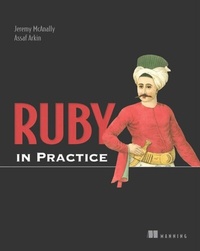
Ruby in Practice
1st Edition
Published on 28. February 2009
360 pages
978-1-63835-481-9 (ISBN)
Description

Ruby in Practice increases your productivity by showing you specific Ruby techniques you can use in your projects. The book offers detailed strategies for using Ruby in a large-scale environment. You'll see concrete examples of integration, messaging, web development, and databases, all presented in a clear Problem/Solution format. This book won't help you push your deadline back, but it will help you get the job done in less time.
Above all, Ruby in Practice is a practical book for developers who want an in depth understanding of the Ruby language and its toolset. The book is divided into three major parts.
The first part concentrates on issues that developers face both from within their organizations and from their peers. The authors weigh the costs and benefits of using Ruby in enterprise development projects, the over-riding theme being that every developer should always aim to use the right tool for any particular job. The authors then examine the pros and cons of developing with Ruby, and where appropriate, compare Ruby to other languages, both conceptually and in code.
The second part discusses techniques for communication and integration of systems. The authors describe how libraries and techniques are used to facilitate messaging, web development and communication automation. They also focus on how the strategies in the first section can be used with these libraries to make development more flexible and efficient.
The last part shows how to manage data and integrate with existing data using Ruby. The authors describe techniques for using existing Ruby libraries that either replace popular Java libraries or can interface with existing data in a different way. They go on to show you how strategies covered in the first section can be used to enable Ruby to interact with existing assets or to build new data systems.
Purchase of the print book comes with an offer of a free PDF, ePub, and Kindle eBook from Manning. Also available is all code from the book.
Above all, Ruby in Practice is a practical book for developers who want an in depth understanding of the Ruby language and its toolset. The book is divided into three major parts.
The first part concentrates on issues that developers face both from within their organizations and from their peers. The authors weigh the costs and benefits of using Ruby in enterprise development projects, the over-riding theme being that every developer should always aim to use the right tool for any particular job. The authors then examine the pros and cons of developing with Ruby, and where appropriate, compare Ruby to other languages, both conceptually and in code.
The second part discusses techniques for communication and integration of systems. The authors describe how libraries and techniques are used to facilitate messaging, web development and communication automation. They also focus on how the strategies in the first section can be used with these libraries to make development more flexible and efficient.
The last part shows how to manage data and integrate with existing data using Ruby. The authors describe techniques for using existing Ruby libraries that either replace popular Java libraries or can interface with existing data in a different way. They go on to show you how strategies covered in the first section can be used to enable Ruby to interact with existing assets or to build new data systems.
Purchase of the print book comes with an offer of a free PDF, ePub, and Kindle eBook from Manning. Also available is all code from the book.
More details
Other editions
Additional editions
Jeremy Mcanally | Asaaf Arkin
Ruby in Practice
Book
03/2009
Manning Publications
€55.89
Article not available at the moment
Persons
Jeremy McAnally has been programming for about eight years and doing graphic design for four years. He is curerntly a freelance Ruby and Rails developer, consultant, and author. He has over three years' experience with Ruby and two years' with Rails; in that time has has developed a number of small, localized intranet systems and mediumt- large-scale systems in Ruby.
Content
- Intro
- Copyright
- Dedication
- Brief Table of Contents
- Table of Contents
- List of Figures
- List of Tables
- List of Listings
- Preface
- Acknowledgments
- About this Book
- Part 1. Ruby techniques
- Chapter 1. Ruby under the microscope
- Chapter 2. Testing Ruby
- Chapter 3. Scripting with Ruby
- Part 2. Integration and communication
- Chapter 4. Ruby on Rails techniques
- Chapter 5. Web services
- Chapter 6. Automating communication
- Chapter 7. Asynchronous messaging
- Chapter 8. Deployment
- Part 3. Data and document techniques
- Chapter 9. Database facilities and techniques
- Chapter 10. Structured documents
- Chapter 11. Identity and authentication
- Chapter 12. Searching and indexing
- Chapter 13. Document processing and reporting
- Appendix A. Installing Ruby
- Appendix B. JRuby
- Appendix C. Deploying web apps
- Index
