

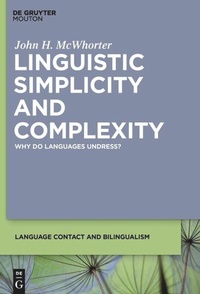
Linguistic Simplicity and Complexity
Description

In John McWhorter's Defining Creole anthology of 2005, his collected articles conveyed the following theme: His hypothesis that creole languages are definable not just in the sociohistorical sense, but in the grammatical sense. His publications since the 1990s have argued that all languages of the world that lack a certain three traits together are creoles (i.e. born as pidgins a few hundred years ago and fleshed out into real languages). He also argued that in light of their pidgin birth, such languages are less grammatically complex than others, as the result of their recent birth as pidgins. These two claims have been highly controversial among creolists as well as other linguists.
In this volume, Linguistic Simplicity and Complexity , McWhorter gathers articles he has written since then, in the wake of responses from a wide range of creolists and linguists. These articles represent a considerable divergence in direction from his earlier work.
More details
Other editions
Additional editions
Person
Content
2 - Abbreviations [Seite 10]
3 - Introduction: The creole litmus test and the NCSL challenge [Seite 12]
4 - I Creole exceptionalism [Seite 30]
4.1 - Introduction to Section I [Seite 30]
4.2 - 1 The creole prototype revisited and revised. [Seite 40]
4.3 - 2 Comparative complexity: What the creolist learns from Cantonese and Kabardian [Seite 74]
4.4 - 3 Reconstructing creole: Has "Creole Exceptionalism" been seriously engaged? [Seite 114]
5 - II Creole complexity [Seite 132]
5.1 - Introduction to Section II. [Seite 132]
5.2 - 4 Oh, ncc!: emergent pragmatic marking from a bewilderingly multifunctional word [Seite 136]
5.3 - 5 Hither and thither in Saramaccan Creole [Seite 160]
5.4 - 6 Complexity hotspot: The copula in Saramaccan [Seite 194]
6 - III Exceptional language change elsewhere [Seite 214]
6.1 - Introduction to Section III [Seite 214]
6.2 - 7 Why does a language undress? The Riau Indonesian problem [Seite 218]
6.3 - 8 Affixless in Austronesian: Why Flores is a puzzle and what to do about it [Seite 234]
6.4 - 9 A brief for the Celtic Hypothesis: English in Box 5? [Seite 272]
7 - References [Seite 308]
8 - Index [Seite 330]
