

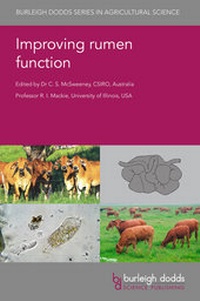
Improving rumen function
Published on 23. June 2020
862 pages
978-1-78676-334-1 (ISBN)
Description

Major advances in analytical techniques and genomics have transformed our understanding of rumen microbiology. This understanding is of critical importance to livestock production since rumen function affects nutritional efficiency, emissions from ruminants (such as methane and nitrous oxide) as well as animal health. This collection reviews what we know about rumen microbiota and the role of nutritional strategies in optimising their function for more sustainable livestock production.
Part 1 summarises advances in methods for analysing the rumen microbiome. Part 2 reviews recent research on the role of different types of rumen microbiota such as bacteria, archaea, anaerobic fungi, viruses and the rumen wall microbial community. Part 3 discusses the way the rumen processes nutrients such as fibre and protein as well as outputs such as energy, lipids and methane emissions. Part 4 explores nutritional strategies to optimise rumen function, including the role of pasture, silage, cereal feed, plant secondary compounds and probiotics.
Part 1 summarises advances in methods for analysing the rumen microbiome. Part 2 reviews recent research on the role of different types of rumen microbiota such as bacteria, archaea, anaerobic fungi, viruses and the rumen wall microbial community. Part 3 discusses the way the rumen processes nutrients such as fibre and protein as well as outputs such as energy, lipids and methane emissions. Part 4 explores nutritional strategies to optimise rumen function, including the role of pasture, silage, cereal feed, plant secondary compounds and probiotics.
More details
Series
Language
English
Place of publication
Cambridge
United Kingdom
Publishing group
Burleigh Dodds
Target group
University researchers in ruminant nutrition, government and other agencies seeking to make livestock production more sustainable, commercial animal feed companies and farmers interested in the latest science on improving the nutrition of beef and dairy cattle in particular.
Illustrations
Color tables, photos and figures
ISBN-13
978-1-78676-334-1 (9781786763341)
DOI
10.19103/AS.2020.0067
Schweitzer Classification
Other editions
Additional editions
Chris McSweeney | Roderick I. Mackie
Improving Rumen Function
Book
06/2020
Burleigh Dodds Science Publishing Limited
€225.50
Shipment within 3-4 weeks
Persons
Editor
DrCSIRO
Dr Chris McSweeney is Chief Research Scientist at CSIRO, Australia, and is internationally-renowned for his research in ruminant gut microbiology and its implications for nutrition and livestock emissions.
Dr Chris McSweeney is Chief Research Scientist at CSIRO, Australia, and is internationally-renowned for his research in ruminant gut microbiology and its implications for nutrition and livestock emissions.
University of Illinois
Dr Rod Mackie is Professor of Microbiology at the University of Illinois at Urbana-Champaign, USA. Professor Mackie is a leading expert on microbial ecology in the ruminant gut and its impact on nutrition and health, as well as the use of bacteria in bioenergy applications.
Dr Rod Mackie is Professor of Microbiology at the University of Illinois at Urbana-Champaign, USA. Professor Mackie is a leading expert on microbial ecology in the ruminant gut and its impact on nutrition and health, as well as the use of bacteria in bioenergy applications.
Contributions
INRAE (France)
INRAE (France)
Estación Experimental del Zaidín, CSIC (Spain)
INRAE (France)
Microba Life Sciences and Mater Research Institute - The University of Queensland (Australia)
Teagasc Moorepark Food Research (Ireland)
Devenish (United Kingdom)
Wageningen University and Research (Netherlands)
Wageningen University and Research (Netherlands)
Wageningen University and Research (Netherlands)
Wageningen University and Research (Netherlands)
Institute of Biological, Environmental and Rural Science (IBERS), Aberystwyth University (United Kingdom)
Institute of Global Food Security (IGFS), Queen's University Belfast (United Kingdom)
Institute of Global Food Security (IGFS), Queen's University Belfast (United Kingdom)
Institute of Biological, Environmental and Rural Science (IBERS), Aberystwyth University (United Kingdom)
Institute of Global Food Security (IGFS), Queen's University Belfast (United Kingdom)
Institute of Global Food Security (IGFS), Queen's University Belfast (United Kingdom)
Christopher Creevey is Professor of Computational Biology at the School of Biological Sciences and the Institute of Global Food Security (IGFS), Queen's University, Belfast (QUB). He is an authority in systems-level analyses of biological function in both model and non-model organisms having worked previously in the European Molecular Biology Laboratory in Heidelberg and as a Science Foundation Ireland Stokes Lecturer in Teagasc and a Reader in Rumen Systems Biology at IBERS, Aberystwyth University.
Christopher Creevey is Professor of Computational Biology at the School of Biological Sciences and the Institute of Global Food Security (IGFS), Queen's University, Belfast (QUB). He is an authority in systems-level analyses of biological function in both model and non-model organisms having worked previously in the European Molecular Biology Laboratory in Heidelberg and as a Science Foundation Ireland Stokes Lecturer in Teagasc and a Reader in Rumen Systems Biology at IBERS, Aberystwyth University.
New Zealand Greenhouse Gas Research Centre (New Zealand)
AgResearch Ltd (New Zealand)
Donvis Ltd (New Zealand)
Queen's University Belfast (United Kingdom)
Aberystwyth University
Robert Gordon University (United Kingdom)
University of California, Davis
Czech Academy of Sciences, Institute of Animal Physiology and Genetics (Czech Republic)
Indian Council of Agricultural Research, Directorate of Poultry Research (India)
Indian Council of Agricultural Research, National Dairy Research Institute (India)
Department of Agriculture and Fisheries, Queensland Government (Australia)
Department of Agriculture and Fisheries, Queensland Government (Australia)
University of Alberta
Nanjing Agricultural University
University of Alberta
Norwegian University of Life Sciences
Norwegian University of Life Sciences
The Ohio State University (United States)
University of Illinois
Dr Rod Mackie is Professor of Microbiology at the University of Illinois at Urbana-Champaign, USA. Professor Mackie is a leading expert on microbial ecology in the ruminant gut and its impact on nutrition and health, as well as the use of bacteria in bioenergy applications.
Dr Rod Mackie is Professor of Microbiology at the University of Illinois at Urbana-Champaign, USA. Professor Mackie is a leading expert on microbial ecology in the ruminant gut and its impact on nutrition and health, as well as the use of bacteria in bioenergy applications.
Instituto de Investigaciones Agropecuarias (INIA) (Chile)
University California-Davis
Ghent University
Ghent University
Ghent University
Agriculture and Agri-Food Canada
Agriculture and Agri-Food Canada
Agriculture and Agri-Food Canada
Lethbridge Research and Development Centre, Agriculture and Agri-Food Canada (Canada)
Ben Gurion University of the Negev
Brawijaya University (Indonesia)
University of Veterinary Medicine Vienna (Austria)
University of Veterinary Medicine Vienna (Austria)
Teagasc Animal and Bioscience Research Department (Ireland)
Teagasc Animal and Bioscience Research Department (Ireland)
Teagasc Animal and Bioscience Research Department (Ireland)
University of Helsinki
University of Helsinki
US Meat Animal Research Center - USDA-ARS (United States)
University of Georgia
University of Georgia
University of Georgia
University of Georgia
University of Georgia
US Meat Animal Research Center - USDA-ARS (United States)
University of Georgia
ResearcherUniversity of Zaragoza
Lallemand Animal Nutrition and Université Clermont Auvergne, INRAE, UMR 454 MEDIS (France)
Lallemand Animal Nutrition and Université Clermont Auvergne, INRAE, UMR 454 MEDIS (France)
Content
1.Colonization and establishment of the rumen microbiota - opportunities to influence productivity and methane emissions: Diego P. Morgavi and Milka Popova, INRAE, France; David Yañez-Ruiz, CSIC, Spain; and Evelyne Forano, INRAE, France;
Part 1 Tools to understand the ruminal microbiome
2.A question of culture: bringing the gut microbiome to life in the -omics era: Páraic Ó Cuív, Microba Life Sciences and Mater Research Institute - The University of Queensland, Australia;
3.Rumen metabolomics - a powerful tool for discovery and understanding of rumen functionality and health: Tom F. O'Callaghan, Teagasc Moorepark Food Research, Ireland; and Eva Lewis, Devenish, UK;
4.A conceptual approach to the mathematical modelling of microbial functionality in the rumen: André Bannink, Soumya Kar, Dirkjan Schokker and Jan Dijkstra, Wageningen University and Research, The Netherlands;
Part 2 The rumen microbiota
5.Genome sequencing and the rumen microbiome: Jessica C. A. Friedersdorff and Benjamin J. Thomas, Institute of Biological, Environmental and Rural Science (IBERS), Aberystwyth University and Institute of Global Food Security (IGFS), Queen's University Belfast, UK; Sara E. Pidcock, Institute of Global Food Security (IGFS), Queen's University Belfast, UK; Elizabeth H. Hart, Institute of Biological, Environmental and Rural Science (IBERS), Aberystwyth University, UK; Francesco Rubino and Christopher J. Creevey, Institute of Global Food Security (IGFS), Queen's University Belfast, UK;
6.The Rumen Archaea: Graeme T. Attwood and Sinead C. Leahy, AgResearch Ltd and New Zealand Greenhouse Gas Research Centre, New Zealand; and William J. Kelly, Donvis Ltd, New Zealand;
7.Ruminal-ciliated protozoa: Sharon A. Huws, Queen's University Belfast, UK; Cate L. Williams, Aberystwyth University, UK; and Neil R. McEwan, Robert Gordon University, UK;
8.The anaerobic rumen fungi: Matthias Hess, University of California-Davis, USA; Katerina Fliegerová, Czech Academy of Sciences, Institute of Animal Physiology and Genetics, Czech Republic; Shyam Paul, Indian Council of Agricultural Research, Directorate of Poultry Research,
India; and Anil Kumar Puniya, Indian Council of Agricultural Research, National Dairy Research Institute, India;
9.Ruminal viruses and extrachromosomal genetic elements: Rosalind Ann Gilbert and Diane Ouwerkerk, Department of Agriculture and Fisheries, Queensland Government and Queensland Alliance for Agriculture and Food Innovation, The University of Queensland, Australia;
10.The rumen wall microbiota community: Mi Zhou, University of Alberta, Canada; Junhua Liu, Nanjing Agricultural University, China; and Le Luo Guan, University of Alberta, Canada;
Part 3 Nutrient processing in the rumen and host interactions
11.Ruminal fibre digestion: Adrian E. Naas and Phillip B. Pope, Norwegian University of Life Sciences, Norway;
12.Ruminal protein breakdown and ammonia assimilation: Jeffrey L. Firkins, The Ohio State University, USA; and Roderick I. Mackie, University of Illinois, USA;
13.Factors influencing the efficiency of rumen energy metabolism: Emilio M. Ungerfeld, Instituto de Investigaciones Agropecuarias (INIA), Chile; and Timothy J. Hackmann, University of California-Davis, USA;
14.Understanding rumen lipid metabolism to optimize dairy products for enhanced human health and to monitor animal health: Veerle Fievez, Nympha De Neve and Lore Dewanckele, Ghent University, Belgium;
15.Nutritional factors affecting greenhouse gas production from ruminants: implications for enteric and manure emissions: Stephanie A. Terry, Agriculture and Agri-Food Canada, Canada and University of Sydney, Australia; Carlos M. Romero, Agriculture and Agri-Food Canada and University of Lethbridge, Canada; and Alex V. Chaves and Tim A. McAllister, Agriculture and Agri-Food Canada, Canada;
16.Host-rumen microbiome interactions and influences on feed conversion efficiency (FCE), methane production and other productivity traits: Elie Jami, Agricultural Research Organization - Volcani Center, Israel; and Itzhak Mizrahi, Ben-Gurion University of the Negev, Israel;
17.The rumen as a modulator of immune function in cattle: S. Aditya, University of Veterinary Medicine Vienna, Austria and Brawijaya University, Indonesia; and E. Humer and Q. Zebeli, University of Veterinary Medicine Vienna, Austria;
Part 4 Nutritional strategies to optimise ruminal function
18.Role of the rumen microbiome in pasture-fed ruminant production systems: Sinéad M. Waters, David A. Kenny, Teagasc Animal and Bioscience Research Department, Ireland; and Paul E. Smith, Teagasc Animal and Bioscience Research Department and
UCD College of Health and Agricultural Sciences, University College Dublin, Ireland;
19.Optimising ruminal function: the role of silage and concentrate in dairy cow nutrition to improve feed efficiency and reduce methane and nitrogen emissions: Aila Vanhatalo and Anni Halmemies-Beauchet-Filleau, University of Helsinki, Finland;
20.The use of feedlot/cereal grains in improving feed efficiency and
reducing by-products such as methane in ruminants: Kristin Hales, US Meat Animal Research Center - USDA-ARS, USA; Jeferson Lourenco, Darren S. Seidel, Osman Yasir Koyun, Dylan Davis and Christina Welch, University of Georgia, USA; James E. Wells, US Meat Animal Research Center - USDA-ARS, USA; and Todd R. Callaway, University of Georgia, USA;
21.Plant secondary compounds: beneficial roles in sustainable
ruminant nutrition and productivity: David R. Yáñez-Ruiz and Alejandro Belanche, Estación Experimental del Zaidín, CSIC, Spain;
22.The use of probiotics as supplements for ruminants: Frédérique Chaucheyras-Durand and Lysiane Dunière, Lallemand Animal Nutrition and Université Clermont Auvergne, INRAE, UMR 454 MEDIS, France;
Part 1 Tools to understand the ruminal microbiome
2.A question of culture: bringing the gut microbiome to life in the -omics era: Páraic Ó Cuív, Microba Life Sciences and Mater Research Institute - The University of Queensland, Australia;
3.Rumen metabolomics - a powerful tool for discovery and understanding of rumen functionality and health: Tom F. O'Callaghan, Teagasc Moorepark Food Research, Ireland; and Eva Lewis, Devenish, UK;
4.A conceptual approach to the mathematical modelling of microbial functionality in the rumen: André Bannink, Soumya Kar, Dirkjan Schokker and Jan Dijkstra, Wageningen University and Research, The Netherlands;
Part 2 The rumen microbiota
5.Genome sequencing and the rumen microbiome: Jessica C. A. Friedersdorff and Benjamin J. Thomas, Institute of Biological, Environmental and Rural Science (IBERS), Aberystwyth University and Institute of Global Food Security (IGFS), Queen's University Belfast, UK; Sara E. Pidcock, Institute of Global Food Security (IGFS), Queen's University Belfast, UK; Elizabeth H. Hart, Institute of Biological, Environmental and Rural Science (IBERS), Aberystwyth University, UK; Francesco Rubino and Christopher J. Creevey, Institute of Global Food Security (IGFS), Queen's University Belfast, UK;
6.The Rumen Archaea: Graeme T. Attwood and Sinead C. Leahy, AgResearch Ltd and New Zealand Greenhouse Gas Research Centre, New Zealand; and William J. Kelly, Donvis Ltd, New Zealand;
7.Ruminal-ciliated protozoa: Sharon A. Huws, Queen's University Belfast, UK; Cate L. Williams, Aberystwyth University, UK; and Neil R. McEwan, Robert Gordon University, UK;
8.The anaerobic rumen fungi: Matthias Hess, University of California-Davis, USA; Katerina Fliegerová, Czech Academy of Sciences, Institute of Animal Physiology and Genetics, Czech Republic; Shyam Paul, Indian Council of Agricultural Research, Directorate of Poultry Research,
India; and Anil Kumar Puniya, Indian Council of Agricultural Research, National Dairy Research Institute, India;
9.Ruminal viruses and extrachromosomal genetic elements: Rosalind Ann Gilbert and Diane Ouwerkerk, Department of Agriculture and Fisheries, Queensland Government and Queensland Alliance for Agriculture and Food Innovation, The University of Queensland, Australia;
10.The rumen wall microbiota community: Mi Zhou, University of Alberta, Canada; Junhua Liu, Nanjing Agricultural University, China; and Le Luo Guan, University of Alberta, Canada;
Part 3 Nutrient processing in the rumen and host interactions
11.Ruminal fibre digestion: Adrian E. Naas and Phillip B. Pope, Norwegian University of Life Sciences, Norway;
12.Ruminal protein breakdown and ammonia assimilation: Jeffrey L. Firkins, The Ohio State University, USA; and Roderick I. Mackie, University of Illinois, USA;
13.Factors influencing the efficiency of rumen energy metabolism: Emilio M. Ungerfeld, Instituto de Investigaciones Agropecuarias (INIA), Chile; and Timothy J. Hackmann, University of California-Davis, USA;
14.Understanding rumen lipid metabolism to optimize dairy products for enhanced human health and to monitor animal health: Veerle Fievez, Nympha De Neve and Lore Dewanckele, Ghent University, Belgium;
15.Nutritional factors affecting greenhouse gas production from ruminants: implications for enteric and manure emissions: Stephanie A. Terry, Agriculture and Agri-Food Canada, Canada and University of Sydney, Australia; Carlos M. Romero, Agriculture and Agri-Food Canada and University of Lethbridge, Canada; and Alex V. Chaves and Tim A. McAllister, Agriculture and Agri-Food Canada, Canada;
16.Host-rumen microbiome interactions and influences on feed conversion efficiency (FCE), methane production and other productivity traits: Elie Jami, Agricultural Research Organization - Volcani Center, Israel; and Itzhak Mizrahi, Ben-Gurion University of the Negev, Israel;
17.The rumen as a modulator of immune function in cattle: S. Aditya, University of Veterinary Medicine Vienna, Austria and Brawijaya University, Indonesia; and E. Humer and Q. Zebeli, University of Veterinary Medicine Vienna, Austria;
Part 4 Nutritional strategies to optimise ruminal function
18.Role of the rumen microbiome in pasture-fed ruminant production systems: Sinéad M. Waters, David A. Kenny, Teagasc Animal and Bioscience Research Department, Ireland; and Paul E. Smith, Teagasc Animal and Bioscience Research Department and
UCD College of Health and Agricultural Sciences, University College Dublin, Ireland;
19.Optimising ruminal function: the role of silage and concentrate in dairy cow nutrition to improve feed efficiency and reduce methane and nitrogen emissions: Aila Vanhatalo and Anni Halmemies-Beauchet-Filleau, University of Helsinki, Finland;
20.The use of feedlot/cereal grains in improving feed efficiency and
reducing by-products such as methane in ruminants: Kristin Hales, US Meat Animal Research Center - USDA-ARS, USA; Jeferson Lourenco, Darren S. Seidel, Osman Yasir Koyun, Dylan Davis and Christina Welch, University of Georgia, USA; James E. Wells, US Meat Animal Research Center - USDA-ARS, USA; and Todd R. Callaway, University of Georgia, USA;
21.Plant secondary compounds: beneficial roles in sustainable
ruminant nutrition and productivity: David R. Yáñez-Ruiz and Alejandro Belanche, Estación Experimental del Zaidín, CSIC, Spain;
22.The use of probiotics as supplements for ruminants: Frédérique Chaucheyras-Durand and Lysiane Dunière, Lallemand Animal Nutrition and Université Clermont Auvergne, INRAE, UMR 454 MEDIS, France;
