

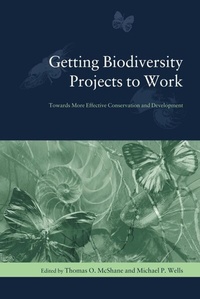
Getting Biodiversity Projects to Work
Towards More Effective Conservation and Development
1st Edition
Published on 28. July 2004
464 pages
978-0-231-52972-3 (ISBN)
Description

No detailed description available for "Getting Biodiversity Projects to Work".
All prices
More details
Other editions
Additional editions
Thomas O. McShane | Michael P. Wells
Getting Biodiversity Projects to Work
Towards More Effective Conservation and Development
Book
07/2004
Columbia University Press
€154.75
Article not available at the moment
Thomas O. McShane | Michael P. Wells
Getting Biodiversity Projects to Work
Towards More Effective Conservation and Development
Book
07/2004
Columbia University Press
€55.76
Shipment within 10-20 days
Persons
Thomas O. McShane is senior conservation advisor to WWF International. He is coauthor of The Myth of Wild Africa: Conservation Without Illusion. Michael P. Wells is an independent conservation consultant and has published more than thirty articles and books on the environment and sustainable development, including People and Parks: Linking Protected Areas and Local Communities.
Content
Section I. The challenge of linking conservation and development
1. Trying to better understand integrated conservation and development, by Thomas O. McShane and Michael P. Wells
2. Jack of all trades, by master of none: inherent contradictions among ICD approaches, John G. Robinson a
3. The pathology of projects, by Jeffery Sayer and Michael P. Wells
4. Expecting the unattainable: the assumptions behind ICDPs, by Thomas O. McShane and Suad A. Newby
Section II. Application and Issues
5. Fitting ICD into a project framework: the CARE experience, by Phil Franks and Thomas Blomley
6. Making biodiversity conservation a land-use priority, by Agnes Kiss
7. Yellowstone: a 130-year experiment in integrated conservation and development, by Dennis Glick and Curtis Freese
8. Policies, by parks and projects: a review of three Costa Rican ICDPs, Katrina Brandon and Mic
9. Indigenous peoples and protected areas: the case of the Sibuyan Mangyan Tagabukid, by Philippines, Edgardo Tongson and Marisel Dino
10. Land tenure and state property: a comparison of the Korup and Kilum ICDPs in Cameroon, by Steve Gartlan
11. Trade-off analysis for integrated conservation and development, by Katrina Brown
12. Transforming approaches to CBNRM: learning from the Luangwa experience in Zambia, by Brian Child and Barry Dalal-Clayton
13. Ecodevelopment in India, by Shekhar Singh and Arpan Sharma
14. Conservation landscapes: whose landscapes, by whose trade-offs?, Stewart Maginnis, Bill Jackson and Nigel Dudley
15. Poverty and forests: sustaining livelihoods in integrated conservation and development, by Gill Shepherd
Section III. Conclusions
16. Using adaptive management to improve ICDPs, by Nick Salafsky and Richard Margoluis
17. The future of integrated conversation and development projects: building on what works, by Michael P. Wells, Thomas O. McShane, Holly T. Dublin, Sheila O'Connor and Kent
1. Trying to better understand integrated conservation and development, by Thomas O. McShane and Michael P. Wells
2. Jack of all trades, by master of none: inherent contradictions among ICD approaches, John G. Robinson a
3. The pathology of projects, by Jeffery Sayer and Michael P. Wells
4. Expecting the unattainable: the assumptions behind ICDPs, by Thomas O. McShane and Suad A. Newby
Section II. Application and Issues
5. Fitting ICD into a project framework: the CARE experience, by Phil Franks and Thomas Blomley
6. Making biodiversity conservation a land-use priority, by Agnes Kiss
7. Yellowstone: a 130-year experiment in integrated conservation and development, by Dennis Glick and Curtis Freese
8. Policies, by parks and projects: a review of three Costa Rican ICDPs, Katrina Brandon and Mic
9. Indigenous peoples and protected areas: the case of the Sibuyan Mangyan Tagabukid, by Philippines, Edgardo Tongson and Marisel Dino
10. Land tenure and state property: a comparison of the Korup and Kilum ICDPs in Cameroon, by Steve Gartlan
11. Trade-off analysis for integrated conservation and development, by Katrina Brown
12. Transforming approaches to CBNRM: learning from the Luangwa experience in Zambia, by Brian Child and Barry Dalal-Clayton
13. Ecodevelopment in India, by Shekhar Singh and Arpan Sharma
14. Conservation landscapes: whose landscapes, by whose trade-offs?, Stewart Maginnis, Bill Jackson and Nigel Dudley
15. Poverty and forests: sustaining livelihoods in integrated conservation and development, by Gill Shepherd
Section III. Conclusions
16. Using adaptive management to improve ICDPs, by Nick Salafsky and Richard Margoluis
17. The future of integrated conversation and development projects: building on what works, by Michael P. Wells, Thomas O. McShane, Holly T. Dublin, Sheila O'Connor and Kent

