

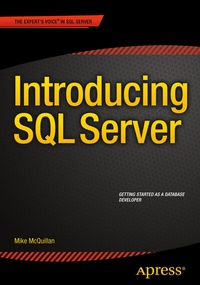
Introducing SQL Server
Description

Do you quake at the sight of a SELECT statement? Start to shiver when people start talking about tables and rows? Fear not, Introducing SQL Server is here to rescue you. The book focuses on the knowledge and skills needed to begin your journey toward becoming a solid and competent SQL Server professional and database programmer. You'll learn the core concepts of SQL Server, from installing the software to executing and profiling queries.
Introducing SQL Server is aimed at SQL Server newcomers as well as at those wanting to improve their database skills. You'll put a comprehensive database together as you work through the book. You will create tablesand learn to use constraints; create reusable functions and stored procedures; and even learn how indexes work and what they bring in terms of increased performance. Introducing SQL Server shows you that databases don't need to be difficult.
Teaches you how to build a SQL Server database from scratch
Takes a tutorial-based approach, with each chapter building on the last
Covers what you need to know for common SQL Server development tasks
More details
Other editions
Additional editions
Person
Mike McQuillan is a software and database specialist who lives with his wife and daughter in the United Kingdom. Mike is a polyglot programmer who began messing around with computers in the 1980s, firstly with an Atari 800XL and then a Sinclair Spectrum. He took up databases in the 1990s, and quickly fell in love with SQL. He's been working with SQL Server since version 7, and is a SQL Server MCSA. When he's not tinkering with computers, Mike enjoys taking the family on walks around Cheshire with the family pups, Dolly and Bertie.
Content
1: What is SQL Server?.-2: Obtaining and Installing SQL Server.-3: Database Basics.-4: Tables.-5: Putting Good Tables Together.-6: Automating Deployment with SQLCMD.-7: NULLs and Table Constraints.-8: Inserts, Updates, and Deletes.-9: Bulk Inserting Data.-10: Creating Data Import Scripts.-11: The SELECT Statement.-12: Joining Tables.-13: Views.-14: Indexes.-15: Transactions.-16: Functions.-17: Table-Valued Functions.-18: Stored Procedures - Part 1.-19: Stored Procedures - Part 2.-20: Bits and Pieces.-Appendix A: SQL Data Types.-Appendix B: Glossary.-
Appendix C: Common SQL Server System Objects.-Appendix D: Exercises