

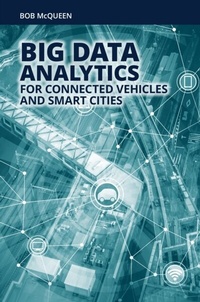
Big Data Analytics for Connected Vehicles and Smart Cities
1st Edition
Published on 1. January 2017
280 pages
978-1-63081-474-8 (ISBN)
Description

This practical new book presents the application of "e;big data"e; analytics to connected vehicles, smart cities, and transportation systems. This book enables transportation professionals to understand how data analytics can and will expand the design and engineering of connected vehicles and smart cities. Readers find extensive case studies and examples that provide a strong framework focusing on practical application of data sciences and analytic tools for actual projects in the field. Both federal and private sector investments have a strong interest in the connected vehicle and this book discusses the impact this has on transportation. This book defines urban analytics and modeling, incentives and governance, mobility networks, energy networks, and other attributes and elements that craft a smart city. Readers learn how smart cities impact the application of advanced technologies in urban areas. This book explains how recently passed transportation legislation for the US has a specific emphasis on the use of data for performance management.
More details
Other editions
Additional editions
Book
08/2017
Artech House Publishers
Unfortunately, price unknown
Available (delivery time upon request)
Content
- Intro
- Big Data Analytics for Connected Vehicles and Smart Cities
- Contents
- Preface
- 1 Introduction
- 1.1 Introduction
- 1.2 Informational Objectives of This Chapter
- 1.3 Word Cloud
- 1.4 Background
- 1.5 Why This Subject and Why Now?
- 1.6 Intended Readership Groups for the Book
- 1.7 Overview of Contents
- References
- 2 What Is Big Data?
- 2.1 Informational Objectives of This Chapter
- 2.2 Chapter Word Cloud
- 2.3 Introduction
- 2.4 Questions Instead of Answers?
- 2.5 Overview of the Questions
- 2.6 Safety-Related Questions
- 2.7 Efficiency-Related Questions
- 2.8 User Experience-Related Questions
- 2.9 What Do We Do with the Questions
- References
- 3 What Is Big Data?
- 3.1 Informational Objectives of This Chapter
- 3.2 Word Cloud
- 3.3 Introduction
- 3.4 How Is Big Data Measured?
- 3.5 What Is Big Data?
- 3.6 Challenges
- 3.7 Big Data in Transportation
- 3.8 Transportation Systems Management and Operations
- References
- 4 Connected and Autonomous Vehicles
- 4.1 Informational Objectives
- 4.2 Word Cloud
- 4.3 Introduction
- 4.4 What Is a Connected Vehicle?
- 4.5 Connected Vehicle Challenges
- 4.6 What Is an Autonomous Vehicle?
- 4.7 Autonomous Vehicle Challenges
- 4.8 Summary of the Differences between Connected and Autonomous Vehicles
- 4.8 Connected and Autonomous Vehicles within a Smart City
- 4.9 The Likely Impact of the Connected and the Autonomous Vehicle on Transportation
- 4.10 Big Data and Connectivity
- 4.11 Connected and Autonomous Vehicles within a Smart City
- 4.12 The Likely Effect of Connected and Autonomous Vehicles on the Automotive Industry
- 4.12 Summary
- References
- 5 Smart Cities
- 5.1 Informational Objectives
- 5.2 Word Cloud
- 5.3 Introduction
- 5.4 What Is a Smart City?
- 5.5 Smart City Objectives
- 5.6 Steps Toward a Smart City
- 5.7 Smart City Frameworks
- 5.8 Evaluating the Effects of Investments
- 5.9 Smart City Challenges
- 5.10 Smart City Opportunities
- 5.11 Lessons Learned from the London Congestion Charge Project
- 5.12 The Sentient City
- 5.13 Summary
- References
- 6 What Are Analytics?
- 6.1 Informational Objectives
- 6.2 Introduction
- 6.3 Word Cloud
- 6.4 What Is an Analytic?
- 6.5 Why Analytics Are Valuable
- 6.6 Smart City Services Analytics
- 6.7 Analytical Performance Management for a Smart City
- 6.8 How Do Analytics and Data Lakes Fit Together?
- 6.9 How to Identify Data Needs Associated with Analytics?
- 6.10 Summary
- References
- 7 The Practical Application of Analytics to Transportation
- 7.1 Informational Objectives of This Chapter
- 7.2 Word Cloud
- 7.3 Introduction
- 7.4 Integrated Payment Systems-What Are They?
- 7.5 Why Does Integrated Payment Make a Good Departure Point for a Smart City?
- 7.6 Integrated Payment System Analytics and Their Practical Application
- 7.7 MaaS-What Is It?
- 7.8 Why Does MaaS Make a Good Departure Point for a Smart City?
- 7.9 MaaS Analytics and Their Practical Application
- 7.10 Traffic Management-What Is It?
- 7.11 Why Does Traffic Management Make a Good Departure Point for a Smart City?
- 7.12 Traffic Management Analytics and Their Practical Application
- 7.13 Transit Management-What Is It?
- 7.14 Why Does Transit Management Make a Good Departure Point for a Smart City?
- 7.15 Transit Management Analytics and Their Practical Application
- 7.16 Performance Management-What Is It?
- 7.17 Why Does Performance Management Make a Good Departure Point for a Smart City?
- 7.18 Performance Management Analytics and Their Practical Application
- 7.19 Summary
- References
- 8 Transportation Use Cases
- 8.1 Informational Objectives of This Chapter
- 8.2 Word Cloud
- 8.3 Introduction
- 8.4 What Is a Use Case?
- 8.5 Smart City Transportation Use Case Examples
- 8.6 Summary
- References
- Appendix A: Smart City Transportation Use Case Examples
- Use Case Example 1: Asset and Maintenance Management
- Use Case Example 2: Connected Vehicle Probe Data
- Use Case Example 3: Connected, Involved Citizens
- Use Case Example 4: Variable Tolling
- Use Case Example 5: Ticketing Strategy and Payment Channel Evaluation
- Use Case Example 6: Intelligent Sensor-Based Infrastructure
- Use Case Example 7: ICT Management
- Use Case Example 8: Electric Fleet Management
- Use Case Example 9: Mobility Hub
- Use Case Example 10: Partnership Management
- Use Case Example 11: Transportation Governance System
- Use Case Example 12: Customer Satisfaction and Travel Response
- Use Case Example 13: Travel Value Analysis
- Use Case Example 14: Accessibility Index
- Use Case Example 15: Urban Automation Analysis
- Use Case Example 16: Freight Performance Management
- Use Case Example 17: MaaS
- 9 Building a Data Lake
- 9.1 Informational Objectives
- 9.2 Word Cloud
- 9.3 Introduction
- 9.4 Definition of a Data Lake
- 9.5 How a Data Lake Works
- 9.6 Value of a Data Lake
- 9.7 Challenges
- 9.8 An Approach to Building a Data Lake
- 9.9 Organizing for Success
- 9.10 Summary
- References
- 10 Practical Applications and Concepts for Transportation Data Analytics
- 10.1 Learning objectives
- 10.2 Word Cloud
- 10.3 Introduction
- 10.4 Concepts
- 10.5 Freeway Speed Variability Analysis
- 10.6 Smart City Accessibility Index
- 10.7 Arterial Performance Management
- 10.8 Decision Support for Bus Acquisition
- 10.9 Thoughts on the Use of Analytics
- References
- 11 Benefit and Cost Estimation For Smart City Transportation Services
- 11.1 Informational Objectives
- 11.2 Word Cloud
- 11.3 Introduction
- 11.4 Overview of the Approach
- 11.5 Assumptions
- 11.6 Smart City Cost and Benefit Estimation
- 11.7 Assumed Configurations for Cost Estimation Purposes
- 11.8 Cost Estimates for Smart City Transportation Services
- 11.9 Smart City Transportation Service Cost Summary
- 11.10 Estimated Benefits for Smart City Transportation Services
- 11.11 Smart City Transportation Services Cost and Benefits Summary
- 11.12 Summary
- References
- 12 Summary
- 12.1 Instructional Objectives
- 12.2 Word Cloud
- 12.3 Introduction
- 12.4 Review of Chapter 1
- 12.5 Review of Chapter 2
- 12.6 Review of Chapter 3
- 12.7 Review of Chapter 4
- 12.8 Review of Chapter 5
- 12.9 Review of Chapter 6
- 12.10 Review of Chapter 7
- 12.11 Review of Chapter 8
- 12.12 Review of Chapter 9
- 12.13 Review of Chapter 10
- 12.14 Review of Chapter 11
- 12.15 Advice for Smart City Transportation Professionals
- 12.16 Conclusion
- 12.17 Further Reading
- References
- About the Author
- Index
