


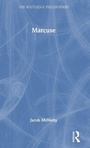
Marcuse
1st Edition
Published on 14. November 2024
284 pages
978-1-040-15084-9 (ISBN)
Description

Herbert Marcuse (1898-1979) is known to many as a leading figure of 1960s counterculture, and a "Guru of the New Left."However, the deeper philosophical background to Marcuse's thought is often forgotten, especially his significant engagement with German idealism, ancient philosophy, and a broad spectrum of problems and issues from the philosophical tradition.
This much-needed book introduces and assesses Marcuse's philosophy and is ideal for those coming to his work for the first time. Jacob McNulty covers the following topics:
Marcuse's life and the background to his thought, including his formative period as a student of Husserl and Heidegger and as a philosopher in Horkheimer's Institute
Marcuse's recasting of metaphysics in light of Marxian and Freudian thought
Marcuse and German idealism, especially the role of Kant and Hegel
Marcuse's philosophy of human nature, his use of the late Freud's ideas of Eros and Thanatos
Marcuse as a critic of state and monopoly capitalism
Meaning, propaganda, and ideology: the political implications of language and also the centrality of free speech
Marcuse's aesthetics
Marcuse's legacy and his relationship to contemporary analytical philosophy (especially "analytic critical theory").
An outstanding and engaging introduction to a central figure in twentieth-century radical thought, Marcuse is essential reading for those in philosophy and related disciplines including political theory, sociology, and media and communication studies.
This much-needed book introduces and assesses Marcuse's philosophy and is ideal for those coming to his work for the first time. Jacob McNulty covers the following topics:
Marcuse's life and the background to his thought, including his formative period as a student of Husserl and Heidegger and as a philosopher in Horkheimer's Institute
Marcuse's recasting of metaphysics in light of Marxian and Freudian thought
Marcuse and German idealism, especially the role of Kant and Hegel
Marcuse's philosophy of human nature, his use of the late Freud's ideas of Eros and Thanatos
Marcuse as a critic of state and monopoly capitalism
Meaning, propaganda, and ideology: the political implications of language and also the centrality of free speech
Marcuse's aesthetics
Marcuse's legacy and his relationship to contemporary analytical philosophy (especially "analytic critical theory").
An outstanding and engaging introduction to a central figure in twentieth-century radical thought, Marcuse is essential reading for those in philosophy and related disciplines including political theory, sociology, and media and communication studies.
Reviews / Votes
"Following in the footsteps of the pathbreaking work on Marcuse's thinking by Douglas Kellner, Andrew Feenberg, and Martin Jay, McNulty (Yale Univ.) succeeds brilliantly in this indispensable reassessment of the conceptual development of Marcuse's contributions to philosophical and cultural theory, from his Heidegger-inspired work on Hegel of the 1920s and 1930s to his unprecedented reconfiguration of aesthetic theory and the analysis of late capitalist mass culture in the 1960s and 1970s. Summing Up: Highly recommended."N. Lukacher, CHOICE"McNulty reestablishes Marcuse's credentials as a first-rate philosopher, while at the same time affirming Marcuse's political commitments to critical Marxism and democratic socialism. With writing that is philosophically sophisticated, accessible and engaging, McNulty elaborates Marcuse's theoretical positions on questions of epistemology, metaphysics, the philosophy of science, aesthetics and philosophical anthropology. Ranging confidently over the entire body of Marcuse's work, McNulty has given us an excellent introduction to Marcuse's critical philosophy." - John Abromeit, State University of New York at Buffalo, USA
"In this lucid and imaginative study, McNulty painstakingly reconstructs the key elements of Marcuse's philosophy and demonstrates its enduring relevance. As the need for exploring new directions in thought and action becomes more pressing than ever, being guided so brilliantly into the heart of Marcuse's engaged thinking could hardly be more valuable." - Espen Hammer, Temple University, USA "Following in the footsteps of the pathbreaking work on Marcuse's thinking by Douglas Kellner, Andrew Feenberg, and Martin Jay, McNulty (Yale Univ.) succeeds brilliantly in this indispensable reassessment of the conceptual development of Marcuse's contributions to philosophical and cultural theory, from his Heidegger-inspired work on Hegel of the 1920s and 1930s to his unprecedented reconfiguration of aesthetic theory and the analysis of late capitalist mass culture in the 1960s and 1970s. Summing Up: Highly recommended."N. Lukacher, CHOICE
"McNulty reestablishes Marcuse's credentials as a first-rate philosopher, while at the same time affirming Marcuse's political commitments to critical Marxism and democratic socialism. With writing that is philosophically sophisticated, accessible and engaging, McNulty elaborates Marcuse's theoretical positions on questions of epistemology, metaphysics, the philosophy of science, aesthetics and philosophical anthropology. Ranging confidently over the entire body of Marcuse's work, McNulty has given us an excellent introduction to Marcuse's critical philosophy." - John Abromeit, State University of New York at Buffalo, USA
"In this lucid and imaginative study, McNulty painstakingly reconstructs the key elements of Marcuse's philosophy and demonstrates its enduring relevance. As the need for exploring new directions in thought and action becomes more pressing than ever, being guided so brilliantly into the heart of Marcuse's engaged thinking could hardly be more valuable." - Espen Hammer, Temple University, USA
More details
Series
Edition
1. Auflage
Language
English
Place of publication
London
United Kingdom
Publishing group
Taylor & Francis Ltd
Target group
College/higher education
ISBN-13
978-1-040-15084-9 (9781040150849)
Copyright in bibliographic data and cover images is held by Nielsen Book Services Limited or by the publishers or by their respective licensors: all rights reserved.
Schweitzer Classification
Other editions

Person
Jacob McNulty is an Assistant Professor of Philosophy at Yale University, USA. He is the author of Hegel's Logic and Metaphysics (2023). His work on Rousseau, Fichte, and others has appeared in the European Journal of Philosophy, Journal of the History of Philosophy, and British Journal for the History of Philosophy.
Content
Preface and Acknowledgments Abbreviations Chronology 1. Life and Thought 2. Epistemology 3. Metaphysics 4. Philosophy of Science 5. Aesthetics 6. Human Nature 7. Politics and Society 8. Marcuse Today. Glossary Bibliography Index
