

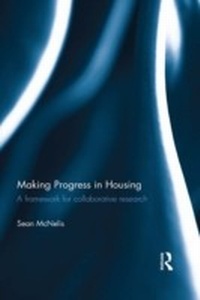
Making Progress in Housing
A Framework for Collaborative Research
1st Edition
Published on 21. January 2014
288 pages
978-1-317-85937-6 (ISBN)
Description

This book presents a new approach to housing research, one that is relevant to all the social sciences.
Housing research is diverse and operates across many disciplines, approaches and methods making collaboration difficult. This book outlines a methodological framework that enables researchers from many different fields to collaborate in solving complex and seemingly intractable housing problems. It shows how we can make progress in housing research and deliver better housing outcomes through an integrated approach.
Drawing on the work of renowned Canadian methodologist, philosopher, theologian and economist, Bernard Lonergan (1904-1984), McNelis outlines a framework for collaborative research: Functional Collaboration. This new form of collaboration divides up the work of housing research into functional specialties. These distinguish eight inter-related questions that arise in the process of moving from the current housing situation through to providing practical advice to decision-makers. To answer each question a different method is required. Making progress in housing is the result of finding new answers to this complete set of eight inter-related questions.
This approach to collaboration opens up a new discourse on method in housing and social research as well as new debates on progress and the nature of science.
Housing research is diverse and operates across many disciplines, approaches and methods making collaboration difficult. This book outlines a methodological framework that enables researchers from many different fields to collaborate in solving complex and seemingly intractable housing problems. It shows how we can make progress in housing research and deliver better housing outcomes through an integrated approach.
Drawing on the work of renowned Canadian methodologist, philosopher, theologian and economist, Bernard Lonergan (1904-1984), McNelis outlines a framework for collaborative research: Functional Collaboration. This new form of collaboration divides up the work of housing research into functional specialties. These distinguish eight inter-related questions that arise in the process of moving from the current housing situation through to providing practical advice to decision-makers. To answer each question a different method is required. Making progress in housing is the result of finding new answers to this complete set of eight inter-related questions.
This approach to collaboration opens up a new discourse on method in housing and social research as well as new debates on progress and the nature of science.
Reviews / Votes
"Given that it is very rare to set out comprehensive methodological critiques in housing studies, the book will interest all housing researchers who take methodology seriously. It will be of value to researchers engaged in national, and particularly international, comparative housing research projects, where research questions demand that new forms of collaboration are an essential prerequisite to meaningful policy analysis and prescription." - Housing Studies, Michael Oxley, University of Cambridge, UKMore details
Series
Language
English
Place of publication
London
United Kingdom
Publishing group
Taylor & Francis Ltd
Target group
College/higher education
Illustrations
2 s/w Tabellen
2 Tables, black and white
File size
4,02 MB
ISBN-13
978-1-317-85937-6 (9781317859376)
Copyright in bibliographic data and cover images is held by Nielsen Book Services Limited or by the publishers or by their respective licensors: all rights reserved.
Schweitzer Classification
Other editions
Additional editions
Book
07/2018
1st Edition
Routledge
€65.60
Shipment within 15-20 days
Book
01/2014
1st Edition
Routledge
€232.00
Shipment within 15-20 days
Person
Sean McNelis has over 30 years' experience in housing management, housing policy and housing research. He is a research fellow at The Swinburne Institute for Social Research, Swinburne University of Technology, Australia.
Content
Introduction PART I: CONTEXT 1. Making Progress in Housing: Problems, Questions and Issues 2. Functional Collaboration: Origins, Initial Description and Searchings 3. Towards a scientific approach to housing research PART II: THE FUNCTIONAL SPECIALTIES 4. Research as the Functional Specialty answering the empirical question 5. Interpretation as the Functional Specialty answering the theoretical question 6. History as the Functional Specialty answering the historical question 7. Dialectic as the Functional Specialty answering the evaluative/critical question 8. The Implementation Functional Specialties PART III: FUNCTION COLLABORATION: A FRAMEWORK FOR COLLABORATIVE HOUSING RESEARCH 9. From Functional Specialties to Functional Collaboration Conclusion
