

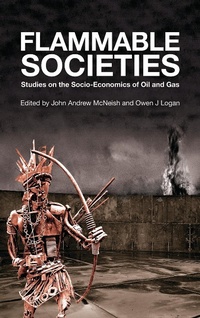
Flammable Societies
Studies on the Socio-economics of Oil and Gas
1st Edition
Published on 6. January 2012
384 pages
978-1-78371-481-0 (ISBN)
Description

The impact of the oil and gas industry - paradoxically seen both as a blessing and a curse on socio-economic development - is a question at the heart of the comparative studies in this volume stretching from Northern Europe to the Caucasus, the Gulf of Guinea to Latin America.
Britain's transformation under Margaret Thatcher into a supposedly post-industrial society orientated towards consumer sovereignty was paid for with revenues from the North Sea oil industry, an industry conveniently out of sight and out of mind for many. Other case studies include resource struggles in Bolivia, oil money in Venezuela and the Azerbaijani oil boom among many others.
Drawing on bottom-up research and theoretical reflection, this book questions the political and scientific basis of current international policy that aims to address the problem of resource management through standard Western models of economic governance, institution building and national sovereignty.
Britain's transformation under Margaret Thatcher into a supposedly post-industrial society orientated towards consumer sovereignty was paid for with revenues from the North Sea oil industry, an industry conveniently out of sight and out of mind for many. Other case studies include resource struggles in Bolivia, oil money in Venezuela and the Azerbaijani oil boom among many others.
Drawing on bottom-up research and theoretical reflection, this book questions the political and scientific basis of current international policy that aims to address the problem of resource management through standard Western models of economic governance, institution building and national sovereignty.
Reviews / Votes
'Unsettles the field of oil studies by fusing visual, textual, historical and ethnographic approaches into a powerful whole. A path-breaking book' -- Michael Watts, Class of 63 Professor, University of California, Berkeley 'Offers fresh insights into the social relations of communities in which oil and gas are produced. It challenges lazy, catch-all concepts about oil-producing economies and raises the standard of academic debate' -- Simon Pirani, Senior Research Fellow at the Oxford Institute for Energy Studies and author of Change in Putin's Russia 'A much-needed and compelling intervention. deftly capturing the complexity of hydrocarbon conflicts' -- Suzana Sawyer, University of California, Davis, author of "Crude Chronicles" (2004) and co-editor of "The Politics of Resource Extraction" (2012)More details
Edition
1. Auflage
Language
English
Place of publication
London
United Kingdom
Target group
Professional and scholarly
Illustrations
4 b&w figures, 19 b&w photographs
File size
2,64 MB
ISBN-13
978-1-78371-481-0 (9781783714810)
Copyright in bibliographic data and cover images is held by Nielsen Book Services Limited or by the publishers or by their respective licensors: all rights reserved.
Schweitzer Classification
Other editions
Additional editions
Book
01/2012
Pluto Press
€63.36
Article exhausted; check different version
Persons
John-Andrew McNeish is Associate Professor at the Norwegian University of Life Sciences and Senior Researcher at the Chr. Michelsens Institute. He is the project leader of the Norwegian Research Council funded project 'Flammable Societies: The Role of the Oil and Gas Industry in the Promotion of Poverty Reduction and Social Volatility' on which the book Flammable Societies is based.
Owen Logan is a photographer and writer and a Research Fellow at the University of Aberdeen where he worked with the Lives in the Oil Industry oral history project. His work has been exhibited and published widely and is in the art collection of the Scottish Parliament. He is a contributing editor to Variant magazine.
Owen Logan is a photographer and writer and a Research Fellow at the University of Aberdeen where he worked with the Lives in the Oil Industry oral history project. His work has been exhibited and published widely and is in the art collection of the Scottish Parliament. He is a contributing editor to Variant magazine.
Content
1. Introduction. Rethinking Responsibility and Governance in Resource Extraction, by Owen Logan & John-Andrew McNeish
Part 1 Resource Sovereignties
2. On Curses and Devils: Resource Wealth and Sovereignty in an Autonomous Tarija, Bolivia, by John-Andrew McNeish
3. A Contribution to the Critique of Post-Imperial British history -
North Sea oil, Scottish Nationalism and Thatcherite Neoliberalism, by Terry Brotherstone
4. Where Pathos Rules: the Resource Curse in Visual Culture, by Owen Logan
Part 2 States of Collective Consumption
5. Development from Below and Oil Money from Above: Popular Organisation in Contemporary Venezuela, by Iselin Asedotter Stronen
6. Living Under the Bullet: Internal Displacement in the Azerbaijani Oil Boom, by Heidi Kjaernet
7. The Socio-Economic Dynamics of Gas in Bolivia, by Fernanda Wanderley, Leila Mokrani, Alice Guimaraes
8. Subsidised Energy and Hesitant Elites in Russia, by Indra Overland and Hilde Kutschera
Part 3. Supply Side Governmentality
9. North Sea Oil, the State and Divergent Development in the UK and Norway, by Andrew Cumbers
10. A Country without a State? Governmentality, Knowledge and Labour in Nigeriam by Femi Folorunso, Philippa Hall, Owen Logan
11. The Race to the Bottom and the Demise of the Landlord: The Struggle over Petroleum Revenues Historically and Comparatively, by Anna Zalik
12. Law's Role in the Tension between Security and Sovereignty in the Field of Energy Resources, by John Paterson
13. Fossil Knowledge: Networks, Industry Strategy, Public Culture, and the Challenge for Critical Research, by Bret Gustafson
14. Conclusion. All Other Things Do Not Remain Equal, by John-Andrew McNeish & Owen Logan
Contributors
Index
Part 1 Resource Sovereignties
2. On Curses and Devils: Resource Wealth and Sovereignty in an Autonomous Tarija, Bolivia, by John-Andrew McNeish
3. A Contribution to the Critique of Post-Imperial British history -
North Sea oil, Scottish Nationalism and Thatcherite Neoliberalism, by Terry Brotherstone
4. Where Pathos Rules: the Resource Curse in Visual Culture, by Owen Logan
Part 2 States of Collective Consumption
5. Development from Below and Oil Money from Above: Popular Organisation in Contemporary Venezuela, by Iselin Asedotter Stronen
6. Living Under the Bullet: Internal Displacement in the Azerbaijani Oil Boom, by Heidi Kjaernet
7. The Socio-Economic Dynamics of Gas in Bolivia, by Fernanda Wanderley, Leila Mokrani, Alice Guimaraes
8. Subsidised Energy and Hesitant Elites in Russia, by Indra Overland and Hilde Kutschera
Part 3. Supply Side Governmentality
9. North Sea Oil, the State and Divergent Development in the UK and Norway, by Andrew Cumbers
10. A Country without a State? Governmentality, Knowledge and Labour in Nigeriam by Femi Folorunso, Philippa Hall, Owen Logan
11. The Race to the Bottom and the Demise of the Landlord: The Struggle over Petroleum Revenues Historically and Comparatively, by Anna Zalik
12. Law's Role in the Tension between Security and Sovereignty in the Field of Energy Resources, by John Paterson
13. Fossil Knowledge: Networks, Industry Strategy, Public Culture, and the Challenge for Critical Research, by Bret Gustafson
14. Conclusion. All Other Things Do Not Remain Equal, by John-Andrew McNeish & Owen Logan
Contributors
Index
