

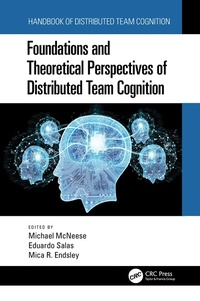
Foundations and Theoretical Perspectives of Distributed Team Cognition
1st Edition
Published on 28. September 2020
245 pages
978-0-429-86178-9 (ISBN)
Description

The background and interwoven streams of team cognition and distributed cognition fermenting together has wielded new nuances of exploration, which continue to be relevant for a theoretical understanding of team phenomena.
Foundations and Theoretical Perspectives of Distributed Teams Cognition looks at fundamentals, theoretical concepts, and how theory informs perspectives of thinking for distributed team cognition. The chapters yield a broad understanding of the nature of diverse thinking and insights into technologies, foundations, and theoretical perspectives of distributed team cognition.
Features
Generates historical patterns and significance that compose developmental trajectories
Explains multiple perspectives that incorporate an interdisciplinary understanding that specifies diverse theories
Identifies and develops particular challenges resident within team simulation studies and then illustrates research frameworks
Highlights and reviews how team simulations are used to produce dynamic experimental results
Investigates and studies research variables within distributed team cognition
Foundations and Theoretical Perspectives of Distributed Teams Cognition looks at fundamentals, theoretical concepts, and how theory informs perspectives of thinking for distributed team cognition. The chapters yield a broad understanding of the nature of diverse thinking and insights into technologies, foundations, and theoretical perspectives of distributed team cognition.
Features
Generates historical patterns and significance that compose developmental trajectories
Explains multiple perspectives that incorporate an interdisciplinary understanding that specifies diverse theories
Identifies and develops particular challenges resident within team simulation studies and then illustrates research frameworks
Highlights and reviews how team simulations are used to produce dynamic experimental results
Investigates and studies research variables within distributed team cognition
More details
Edition
1. Auflage
Language
English
Place of publication
London
United Kingdom
Publishing group
Taylor & Francis Ltd
Target group
Professional and scholarly
Illustrations
6 Tables, black and white; 15 Line drawings, black and white; 15 Illustrations, black and white
ISBN-13
978-0-429-86178-9 (9780429861789)
Copyright in bibliographic data and cover images is held by Nielsen Book Services Limited or by the publishers or by their respective licensors: all rights reserved.
Schweitzer Classification
Other editions
Additional editions
Michael McNeese | Eduardo Salas | Mica R. Endsley
Foundations and Theoretical Perspectives of Distributed Team Cognition
Book
10/2024
1st Edition
CRC Press
€71.20
Shipment within 15-20 days
Michael McNeese | Eduardo Salas | Mica R. Endsley
Foundations and Theoretical Perspectives of Distributed Team Cognition
Book
09/2020
1st Edition
CRC Press
€243.40
Shipment within 10-20 days
Persons
Michael D. McNeese is a Professor (Emeritus) and was the Director of the MINDS Group (Multidisciplinary Initiatives in Naturalistic Decision Systems) at the College of Information Sciences and Technology, The Pennsylvania State University, University Park, PA. Previously, he was the Senior Associate Dean and Professor in Charge at Penn State. He has worked on multiple research projects involving team cognition, artificial intelligence, human factors engineering, crisis management and response, situation awareness, and interactive simulations over the last 35 years. He was a Senior Scientist and Director of Collaborative Design Technology at the USAF Research Laboratory prior to moving to Penn State. Dr. McNeese earned a PhD in cognitive science at Vanderbilt University and an MA in experimental-cognitive psychology at the University of Dayton, was a visiting professor at The Ohio State University, Department of Integrated Systems Engineering.
Eduardo Salas is the Allyn R. and Gladys M. Cline Chair Professor and Chair of the Department of Psychological Sciences at Rice University. He is a past president of the Society for Industrial and Organizational Psychology (SIOP) and the Human Factors and Ergonomics Society (HFES), and a fellow of the American Psychological Association (APA), Association for Psychological Science, and HFES. He is also the recipient of the 2012 Society for Human Resource Management Losey Lifetime Achievement Award, the 2012 Joseph E. McGrath Award for Lifetime Achievement for his work on teams and team training, and the 2016 APA Award for Outstanding Lifetime Contributions to Psychology. He earned a PhD (1984) in industrial/organizational psychology at Old Dominion University.
Mica R. Endsley is the President of SA Technologies, a cognitive engineering firm specializing in the development of operator interfaces for advanced systems, including the next generation of systems for military, aviation, air traffic control, medicine, and power grid operations. Previously she served as Chief Scientist of the U.S. Air Force and was the chief scientific adviser to the Chief of Staff and Secretary of the Air Force. She has also been a visiting associate professor at MIT and an associate professor of industrial engineering at Texas Tech University. She earned a PhD in industrial and systems engineering at the University of Southern California. She is a past president and fellow of the Human Factors and Ergonomics Society and a fellow of the International Ergonomics Association.
Eduardo Salas is the Allyn R. and Gladys M. Cline Chair Professor and Chair of the Department of Psychological Sciences at Rice University. He is a past president of the Society for Industrial and Organizational Psychology (SIOP) and the Human Factors and Ergonomics Society (HFES), and a fellow of the American Psychological Association (APA), Association for Psychological Science, and HFES. He is also the recipient of the 2012 Society for Human Resource Management Losey Lifetime Achievement Award, the 2012 Joseph E. McGrath Award for Lifetime Achievement for his work on teams and team training, and the 2016 APA Award for Outstanding Lifetime Contributions to Psychology. He earned a PhD (1984) in industrial/organizational psychology at Old Dominion University.
Mica R. Endsley is the President of SA Technologies, a cognitive engineering firm specializing in the development of operator interfaces for advanced systems, including the next generation of systems for military, aviation, air traffic control, medicine, and power grid operations. Previously she served as Chief Scientist of the U.S. Air Force and was the chief scientific adviser to the Chief of Staff and Secretary of the Air Force. She has also been a visiting associate professor at MIT and an associate professor of industrial engineering at Texas Tech University. She earned a PhD in industrial and systems engineering at the University of Southern California. She is a past president and fellow of the Human Factors and Ergonomics Society and a fellow of the International Ergonomics Association.
Content
1. Distributed Team Cognition: Integration, Evolution, and Insight 2. Reflections on Team Simulations-Part I: Historical Precedence 3. Reflections on Team Simulations-Part II: Contemporary Progressions 4. Distributed Cognition in Teams Is Influenced by Type of Task and Nature of Member Interactions 5. Bees Do It: Distributed Cognition and Psychophysical Laws 6. Collaborative Action (COACT) Theory: Socially Constructing Shared Knowledge through Mutual Attunement of Shared Affordances 7. Mismatches between Perceiving and Actually Sharing Temporal Mental Models: Implications for Distributed Teams 8. Expertise and Distributed Team Cognition: A Critical Review and Research Agenda 9. Lenses of Diversity in Distributed Teams
