

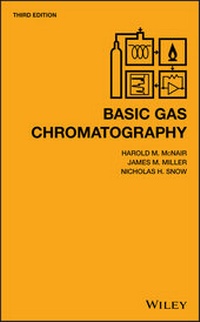
Basic Gas Chromatography
Description

The new edition provides updated chapters that reflect changes in technology and methodology, especially sample preparation, detectors and multidimensional chromatography. The book also covers new detectors recently introduced and sample preparation methods that have become much more easily accessible since the previous edition.
More details
Other editions
Additional editions
Persons
HAROLD M. MCNAIR, PHD, is Professor Emeritus of Chemistry at Virginia Tech, and is known internationally as a leading researcher and educator in the field of gas chromatography.
JAMES M. MILLER, PHD, is Professor Emeritus of Chemistry at Drew University, where he taught for 36 years.
NICHOLAS H. SNOW, PHD, is Professor of Chemistry and Biochemistry at Seton Hall University. He is widely published in gas chromatography and has been teaching GC to new students for over 30 years.
Content
Preface to the Third Edition xi
Preface to the Second Edition xiii
Preface to the First Edition xv
Acknowledgments xvii
1 Introduction 1
A Brief History 1
Definitions 3
Overview: Advantages and Disadvantages 9
Instrumentation and Columns 12
References 14
2 Basic Concepts and Terms 15
Definitions, Terms, and Symbols 15
The Rate Theory 25
The Achievement of Separation 34
References 35
3 Instrument Overview 37
Carrier Gas 38
Flow Control and Measurement 39
Sample Inlets and Sampling Devices 42
Capillary Columns 46
Temperature Zones 47
Detectors 49
Data Systems 50
Reference 50
4 Capillary Columns 51
Types of Capillary Columns 51
Capillary Column Tubing 54
Advantages of Capillary Columns 55
Column Selection 57
Column Quality Testing: The Grob Test Mix 65
Special Troubleshooting Considerations for Capillary Columns 66
Guidelines for Selecting Capillary Columns 67
References 68
5 Stationary Phases 69
Selecting a Column 69
Common and Important Stationary Phases 81
Other Common Stationary Phases 83
References 86
6 Temperature Programming 87
Advantages and Disadvantages of TPGC 89
Requirements for TPGC 90
Example Temperature Programmed Chromatograms 91
Special Topics 96
References 98
7 Inlets 99
Inlet Fundamentals 99
Split Inlet 101
Splitless Inlet 104
On-Column Inlet 106
Programmed Temperature Vaporizer (PTV) 107
Related Topics 108
References 111
8 Classical Detectors: FID, TCD, and ECD 113
Classification of Detectors 115
Common Detector Characteristics 117
Flame Ionization Detector (FID) 124
Thermal Conductivity Detector (TCD) 128
Electron Capture Detector (ECD) 131
Other Detectors 134
References 136
9 Qualitative and Quantitative Analysis 139
Qualitative Analysis 139
Quantitative Analysis 145
Statistics of Quantitative Calculations 145
Quantitative Analysis Methods 148
Summary 154
References 154
10 GC-MS and Spectrometric Detectors 157
Gas Chromatography-Mass Spectrometry (GC-MS) 158
Gas Chromatography-Mass Spectrometry-Mass Spectrometry (GC-MS-MS) 171
Gas Chromatography-Fourier Transform Infrared Spectrometry (GC-FITR) 172
Gas Chromatography-Vacuum Ultraviolet (GC-VUV) Spectrometry 172
References 174
11 Sampling Methods 177
Overview 177
Liquid-Liquid Extraction (LLE) 179
Solid-Liquid Extraction: Soxhlet Extraction and Accelerated Solvent Extraction (ASE) 182
Solid-Phase Extraction 183
Liquid-Vapor or Solid-Vapor Extraction: Headspace Extraction 186
Solid-phase microextraction (SPME) 188
QuEChERS (Quick, Easy Cheap, Effective, Rugged, Safe) 192
Additional Techniques and Summary 193
References 194
12 Multidimensional Gas Chromatography 197
Overview 197
Fundamental Principles of Multidimensional Chromatography 198
Heart Cutting 202
Comprehensive Two-Dimensional GC (GC×GC) 203
LC-GC with Heart Cutting 206
Comprehensive LC×GC 206
References 208
13 Packed Column GC 211
Columns 211
Solid Supports and Stationary Phases 213
Liquid Stationary Phases 214
Solid Stationary Phases 215
Gas Analysis 218
Analysis of Other Inorganics 221
Inlets and Liquid Sampling for Packed Columns 221
Special Columns and Applications 222
References 224
14 Special Topics 225
Fast GC 225
Chiral Analysis by GC 228
Analysis of Nonvolatile Compounds 229
Pyrolysis 233
Inverse GC 233
Additional Theory 234
Activity Coefficients 236
References 238
15 Troubleshooting GC Systems 241
Preventing Problems 241
Troubleshooting Problems 243
Appendix A Acronyms, Symbols and Greek Symbols 251
Appendix B Some Internet Sites for Gas Chromatography 255
Appendix C Other Books On Gas Chromatography 257
Index 259
1
INTRODUCTION
It is hard to imagine an organic analytical laboratory without a gas chromatograph. Gas chromatography (GC) is the premier technique for separation and analysis of volatile compounds. It has been used to analyze gases, liquids, and solids, with the latter usually dissolved in volatile solvents. Both organic and inorganic materials can be analyzed, and molecular weights can range from 2 to over 1000 Da.
Gas chromatographs continue to be the most widely used analytical instruments in the world. Efficient capillary columns provide high resolution, separating more than 450 components in coffee aroma, for example, or the components in a complex natural product like peppermint oil as seen in Figure 1.1. Sensitive detectors like the flame ionization detector can quantitate 50 ppb of organic compounds with a relative standard deviation of about 5%. Automated systems can handle more than 100 samples per day with minimum downtime, and all of this can be accomplished with an investment of about $20,000.
Figure 1.1. Typical gas chromatographic separation showing the high efficiency of this method.
Source: Courtesy of Phenomenex, Inc.
A BRIEF HISTORY
Chromatography began at the turn of the century when Ramsey [1] separated mixtures of gases and vapors on adsorbents like charcoal and Michael Tswett [2] separated plant pigments by liquid chromatography (LC). Tswett is credited as being the "father of chromatography" principally because he coined the term chromatography (literally meaning "color writing") and scientifically described the process. His paper was translated into English and republished [3] because of its importance to the field. Today, of course, most chromatographic analyses are performed on materials that are not colored.
GC is that form of chromatography in which a gas is the moving phase. The important seminal work was first published in 1952 [4] when Martin and James acted on a suggestion made 11 years earlier by Martin himself in a Nobel Prize-winning paper on partition chromatography [5]. It was quickly discovered that GC was simple, fast, and applicable to the separation of many volatile materials, especially petrochemicals, for which distillation was the preferred method of separation at that time. Theories describing the process were readily tested and led to still more advanced theories. Simultaneously the demand for instruments gave rise to a new industry that responded quickly by developing new gas chromatographs with improved capabilities.
The development of chromatography in all of its forms was thoroughly explored by Ettre, who authored nearly 50 publications on chromatographic history. There are three most relevant articles: one focused on the work of Tswett, Martin, Synge, and James [6]; one emphasizing the development of instruments [7]; and a third containing over 200 references on the early development of chromatography [8].
Today GC is a mature technique and a very important one. The worldwide market for GC instruments is estimated to be between $2 and $3 billion or more than 40,000 instruments annually.
DEFINITIONS
In order to define chromatography adequately, a few terms and symbols need to be introduced, but the next chapter is the main source of information on definitions and symbols.
Chromatography
The "official" definitions of the International Union of Pure and Applied Chemistry (IUPAC) are:
Chromatography is a physical method of separation in which the components to be separated are distributed between two phases, one of which is stationary (stationary phase) while the other (the mobile phase) moves in a definite direction. Elution chromatography is a procedure in which the mobile phase is continuously passed through or along the chromatographic bed and the sample is fed into the system as a finite slug [9].
This type of chromatographic process is called elution. The various chromatographic processes are named according to the physical state of the mobile phase. Thus, in GC the mobile phase is a gas, and in LC the mobile phase is a liquid. Figure 1.2 shows a flow chart of the various common gas and liquid chromatographic techniques.
Figure 1.2. Classification of chromatographic methods. (Acronyms and abbreviations are given in Appendix A.)
In GC, the sample is vaporized and carried by the mobile gas phase (the carrier gas) through the column. In most analyses, samples partition (equilibrate) into and out of the stationary liquid phase, based on their solubilities in the stationary phase at the given temperature. The components of the sample (called solutes or analytes) separate from one another based on their relative vapor pressures and affinities for the stationary phase.
Within GC, a subclassification is made according to the state of the stationary phase. If the stationary phase is a solid, the technique is called gas-solid chromatography (GSC); and if it is a liquid, the technique is called gas-liquid chromatography (GLC). Note that the names used to describe open tubular (OT or capillary) GC columns and LC columns include more detail than the simple guidelines just presented. However, all forms of GC are included in the two subdivisions, GLC and GSC. Some of the capillary columns represent GLC, while others represent GSC. Of the two major types, GLC is by far the more widely used; consequently, it receives greater attention in this work.
Obviously, the use of a gas for the mobile phase requires that the system be contained and leak-free, and this is accomplished with a glass or metal tube that is referred to as the column, which contains the stationary phase. Columns are named by specifying the stationary phase. For example, one can speak about a polydimethylsiloxane (PDMS) column, which means that the stationary liquid phase is PDMS. See Chapters 4 and 5 for details on naming columns.
The Chromatographic Process
Figure 1.3 is a schematic representation of the chromatographic process. The horizontal lines represent the column. Each line is like a snapshot of the process at a different time (increasing in time from top to bottom). In the first (top) snapshot, the sample, composed of components A and B, is introduced onto the column in a narrow zone. It is then carried through the column (from left to right) by the mobile phase.
Figure 1.3. Schematic representation of the chromatographic process.
Source: From Miller [10, p. 44]. Reproduced courtesy of John Wiley & Sons, Inc.
Each component partitions between the two phases, as shown by the distributions or peaks above and below the line. Peaks above the line represent the amount of a particular component in the mobile phase, and peaks below the line represent the amount in the stationary phase. Component A has a greater distribution in the mobile phase, and as a consequence it is carried down the column faster than component B, which has a greater distribution in the stationary phase and spends more of its time there. Thus, separation of A from B occurs as they travel through the column. Eventually the components leave the column and pass through the detector as shown. The output signal of the detector gives rise to a chromatogram shown at the right side of Figure 1.3. The schematic in Figure 1.3 is also illustrative of the main process driving separation in GC: phase transfer equilibrium. An analyte partitions between the mobile and stationary phases as it travels along the column. The relative sizes of the peaks above and below the lines in the figure are also indicative of the relative masses of the component in each phase. The ratio of the mass in the stationary phase to the mass in the mobile phase provides the retention factor, "k," one of the most important chromatographic variables. Component A has more of its mass in the mobile phase, so it travels through the column faster. More details about phase equilibrium are provided in Chapter 2.
Note that Figure 1.3 also shows how an individual chromatographic peak widens or broadens as it goes through the chromatographic process. The extent of this broadening, which results from the kinetic processes at work during chromatography, is discussed in Chapter 2.
The tendency of a given component to be attracted to the stationary phase is expressed in chemical terms as an equilibrium constant called the distribution constant, Kc, sometimes also called the partition coefficient. The distribution constant is similar in principle to the partition coefficient that controls a liquid-liquid extraction. In chromatography, the greater the value of the constant, the greater the attraction to the stationary phase.
The distribution constant provides a numerical value for the total sorption by a solute on or in the stationary phase. As such, it expresses the extent of interaction and regulates the movement of solutes through the column. In summary, differences in distribution constants, which are controlled by thermodynamics, effect a chromatographic separation.
Additionally, the attraction can be classified relative to the type of sorption by the solute. Sorption on the surface of the stationary phase is...
