

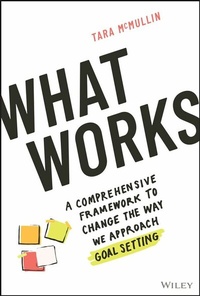
What Works
Description

In What Works: A Comprehensive Framework to Change the Way We Approach Goal Setting, celebrated speaker, coach, and author Tara McMullin shows you how to transform the way you set and achieve your goals to create a gentler and more fulfilling way to work toward what you truly want. In the book, you'll explore what's driving your pursuit of "more" (more money, more things, more prestige, etc.), set commitments to help orient your growth, and organize your actions as part of a holistic learning process.
The author's actionable strategies and tools go beyond mere platitudes about "slowing down" and "appreciating what you have" to a concrete demonstration of how to prioritize practice over achievement. You'll also find:
* An antidote to our culture's relentless pursuit of "more"
* Ways to end the habit of constantly striving for something else at the cost of your own wellbeing
* Strategies for ending your internal monologue of constant comparison to other people
An essential book for the productivity obsessed, unfulfilled career ladder-climbers, and overachievers who are ready to try a new approach to life and work, What Works represents a powerful and exciting new way to tackle life's challenges.
More details
Other editions
Additional editions
Person
Content
Chapter 1 The Validation Spiral 17
Chapter 2 Why Are We So Obsessed with Goals? 33
Chapter 3 Who Am I without the Doing? 47
Chapter 4 The Satisfaction of Practice in an Achievement-Oriented World 63
Chapter 5 Calculating Capacity 77
Chapter 6 Growth without Striving 97
Chapter 7 Choosing Your Destination 111
Chapter 8 Choosing Your Direction 133
Chapter 9 Buying In 145
Chapter 10 Planning Projects 157
Chapter 11 Follow-Through, Self-Sabotage, Margin 169
Conclusion 187
Notes 191
Acknowledgments 199
About the Author 201
Index 203
1
The Validation Spiral
I couldn't shake the feeling of precariousness-that all that I'd worked for could just disappear-or reconcile it with an idea that had surrounded me since I was a child: that if I just worked hard enough, everything would pan out.
-Anne Helen Petersen, Can't Even: How Millennials Became the Burnout Generation7
"BINGO!" I HEARD my classmate call out. I started to feel my eyes well up with tears.
My second-grade teacher noticed. She guided me out of the classroom and into the hall. She gently asked why on earth I was crying over a game of bingo. As only a precocious 8-year-old could, I tried to explain that I hated bingo because it required no skill. It was pure luck. There was no strategy to employ, no natural talent to rely on to win. Either your numbers were called or they weren't. I couldn't extract value out of a win. There was no meaning to victory-although loss still hurt. My teacher gently explained that it was "just a game" and encouraged me to enjoy it. But that's the thing. There has been nothing in my life that has been "just a game." Every win was a small indication that things would work out, that I'd be okay. Every loss was a devastating reminder that I could lose everything-and probably would.
What I couldn't quite explain at the time was that there was no way I could parlay a game of bingo into validation that I was good enough. Today, I know this feeling-this fear-well. It's with me all the time. I'm self-conscious to admit that this continues to be an issue for me. I'm much more aware of it now, and I course correct much more quickly. But in owning the fact that I still struggle, my hope is that this story (and this whole book, really) doesn't get thrown into the mountainous pile of stories of overcoming. I don't believe that we're supposed to transcend all of our challenges-congenital or cultural. I believe that recognizing the persistence of these challenges is key to maintaining our awareness as well as acting to collectively to make change. I constantly seek ways to prove myself good enough and validate my worthiness. I used to worry that I fixated on demonstrating that I was better than others, but I've come to realize that, instead, I'm just trying to prove that I belong. And that it's okay for me to take up space.
I seek validation of my worth, my usefulness, my value in everything. And I'm not alone. Validation-seeking is one of the defining pathologies of our culture. How could it not be? We move through social circles with the brand names we buy. We attempt to one-up each other by what we post on social media. We strive for more and better at work, at home, and at play. We're desperately seeking a way to figure out whether our numbers will get called or whether someone else is going to yell "BINGO!" long before we can cover up the squares.
The Question of Worthiness
Why is validation so elusive? Why do we organize our lives and work to prove to others (and ourselves) that we're worthy of love, respect, and belonging? Because we've been taught to question our worthiness. And while this isn't a new phenomenon, it gained a new flavor over the last century or so.
In 1947, a group of leaders in the fields of economics, sociology, and history gathered at a ski resort on Mont Pelerin in Switzerland. They were there to discuss what they saw as harmful overreach by the governments of Western Europe and the United States. That harmful overreach? It was government programs like Social Security and unemployment insurance as well as regulations on business and industry. Western democracies increasingly leaned toward democratic socialism, and this group was quite concerned. The Mont Pelerin Society, as the group would come to be known, advocates a hands-off approach to economic policy. The group believes that private enterprise and free markets can provide better solutions than governments. Its approach is in direct opposition to Keynesian economics and Marxist philosophy, and its aims would be familiar to anyone who consumes the smallest amount of political news in the United States.8
Friedrich Hayek was one of the organizers of this original conference. Hayek was an advocate for individualism and self-reliance over socialism or collectivism. He believed that free society-and free markets-would create better outcomes than one that was planned or designed for desired outcomes: "If left free, men will often achieve more than individual human reason could design or foresee." Who is going to argue with liberty, am I right? As he started to draw conclusions about how to apply this philosophy, though, things got a little weird. In Individualism and Economic Order, Hayek writes:
.only because men are in fact unequal can we treat them equally. If all men were completely equal in their gifts and inclinations, we should have to treat them differently in order to achieve any sort of social organization. Fortunately, they are not equal; and it is only owing to this that the differentiation of functions need not be determined by the arbitrary decision of some organizing will but that, after creating formal equality of the rules applying in the same manner to all, we can leave each individual to find his own level. There is all the difference in the world between treating people equally and attempting to make them equal.9
What Hayek suggests here is that if everyone were equal, we'd need the state to determine our responsibilities-choose our occupations, determine our wages, maybe even select our homes or families. While dystopian novelists have long envisioned destructive systems in this vein and dictators like Stalin, Mao, and the Kim family put them into practice, it's hardly true of the direction Western democracies took in the early 20th century. Instead, those nations took steps to treat more people equally-white women finally got the right to vote, chattel slavery ended, and workers started to gain some protections and the right to collective bargaining.
Hayek, of course, worked at a time when the illusory veil of a monocultural nation had yet to be lifted. He was "free" to allow his arguments to pertain to the white, educated, property-owning upper class man. He was unburdened by the structural inequities faced by women, workers, former enslaved people, or immigrants. He could easily explain away their poverty, lack of rights, or lack of opportunities as a function of their "gifts and inclinations," rather than a product of a system that favored people like him: ".the relative remunerations the individual can expect from the different uses of his abilities and resources correspond to the relative utility of the result of his efforts to others but also that these remunerations correspond to the objective results of his efforts rather than to their subjective merits." Your economic conditions, then, are the product of your interests, talents, and value to society.
This, then, might be the genesis of our contemporary concern with worthiness and validation. Hayek and his buddies in the Mont Pelerin Society, including economist Milton Friedman, the figurehead of conservative economics in the United States, have had a profound and long-lasting effect on our cultural narrative. The authors of Confidence Culture, Shani Orgad and Rosalind Gill, described the cultural impact of this movement, known today as neoliberalism, as a "hegemonic, quotidian sensibility." They argued that the machine Hayek set in motion transformed us into entrepreneurs-by-necessity, "hailed by rules that emphasize ambition, calculation, competition, self-optimization, and personal responsibility."10
Anything less than the successful organization of your life around those factors is a personal failing, a deficit in your usefulness to society. You see the evidence of this in the hoops someone has to go through to apply for disability or even unemployment assistance. You see it in the "means testing" that gets baked into every piece of legislation designed to help people move out of poverty. It's baked into performance reviews, the gig-ification of the workforce, and stagnant wages. You even see it in the way different fields of study are treated at the college level. The department I graduated from was eliminated a couple of years ago in order to siphon its funding into a multimillion-dollar sports medicine and physical therapy building. The message? Sports medicine practitioners and physical therapists are worth more to society than philosophers and theologians. What's more, if you venture onto any social media platform, you can witness the performance of usefulness and worthiness to rake in those validating likes.
Maybe today, faced with a distinctly multicultural society and hard evidence of how free markets do not create level playing fields for people, Hayek might draw different conclusions. Maybe he would accept that privatization has exacerbated inequality and lack of freedom for many. But his work, along with others', in the first half of the 20th century fomented a whole movement which, in practice, has created a pathological fear of unworthiness aimed to keep us striving, consuming, and climbing over others on the way up the ladder. It's from within this movement that other questions of worthiness arise, most...
