

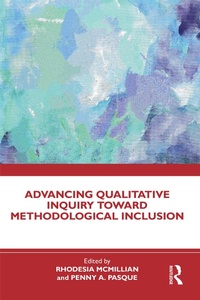
Advancing Qualitative Inquiry Toward Methodological Inclusion
1st Edition
Published on 30. October 2024
230 pages
978-1-040-14937-9 (ISBN)
Description

This fascinating book provides a groundbreaking resource for innovative approaches to qualitative inquiry that address equity and justice and equip readers with tools to enact these approaches in their own work.
Comprising contributions from award-winning qualitative scholars, chapters show how methodologies can be employed to address social issues and problems from the social-political milieu including education, COVID-19, racial inequalities, health inequalities, climate change, and debates around gender diversity amongst others. This book offers the new and innovative paradigms, methodologies, and methods a cutting-edge group of scholars has crafted as well as the 'how to' so readers may employ these approaches in dissertations, grants, and various research team scholarship. Contributors reimagine the next generation of "rigorous" qualitative methodologies by pushing on the boundaries of existing methodological approaches as well as presenting new ways of engaging in research that prioritise innovation, equity and justice.
This unique edited volume is aimed at students and researchers studying or using qualitative methodologies and inquiry who wish to be exposed to emergent conceptualizations and innovations regarding qualitative research methodology and its congruent methods.
Comprising contributions from award-winning qualitative scholars, chapters show how methodologies can be employed to address social issues and problems from the social-political milieu including education, COVID-19, racial inequalities, health inequalities, climate change, and debates around gender diversity amongst others. This book offers the new and innovative paradigms, methodologies, and methods a cutting-edge group of scholars has crafted as well as the 'how to' so readers may employ these approaches in dissertations, grants, and various research team scholarship. Contributors reimagine the next generation of "rigorous" qualitative methodologies by pushing on the boundaries of existing methodological approaches as well as presenting new ways of engaging in research that prioritise innovation, equity and justice.
This unique edited volume is aimed at students and researchers studying or using qualitative methodologies and inquiry who wish to be exposed to emergent conceptualizations and innovations regarding qualitative research methodology and its congruent methods.
Reviews / Votes
'This volume on methodological inclusion provides novel insights and advances the boundaries of methodological "workings" during a time in which the very idea of inclusion is being attacked. This volume highlights just how much it is needed. All the authors deftly deconstruct longstanding methodological knowledges to foster agency, dignity, and inclusion in the research process. This volume is primed to advance the understanding, innovation, and relevance of methodology and methods.'Noelle W. Arnold, PhD, Senior Associate Dean and Professor of Educational Administration, The Ohio State University, USA
Having attended portions of the 2023 Advanced Methods Institute, I wish to vouch for that conference as literally ruffling, oscillating, wobbling, pulsating this edited volume into existence. Rhodesia McMillian and Penny Pasque have skillfully re-assembled an intentionally diverse set of conference presentations, actions and collaboratings that coalesce into fresh challenges and innovative possibilities for the "doings" of (post) qualitative research. Advancing Qualitative Inquiry toward Methodological Innovation is required reading for all those committed to inventive qualitative research that prioritizes justice and equity for all.
Janet L. Miller, Ph.D., Professor Emerita, Teachers College, Columbia University, USA
'Advancing Qualitative Inquiry Toward Methodological Inclusion" is a pivotal resource for scholars and practitioners across disciplines grappling with today's complex, "wicked problems." Through innovative methodologies and a focus on equity and justice, this book equips researchers with the tools to engage deeply with pressing issues. Its collaborative insights from leading scholars pave the way for future research that's not just rigorous but also inclusive and impactful. A must-read for anyone committed to advancing qualitative inquiry with an eye toward methodological renewal and social change.'
David L. Graham, PhD, Assistant Vice Provost for Student Success, The Ohio State University, USA
More details
Edition
1. Auflage
Language
English
Place of publication
London
United Kingdom
Publishing group
Taylor & Francis Ltd
Target group
College/higher education
Professional and scholarly
Illustrations
3 Tables, black and white; 13 Line drawings, black and white; 2 Halftones, black and white; 15 Illustrations, black and white
ISBN-13
978-1-040-14937-9 (9781040149379)
Copyright in bibliographic data and cover images is held by Nielsen Book Services Limited or by the publishers or by their respective licensors: all rights reserved.
Schweitzer Classification
Other editions
Additional editions
Rhodesia McMillian | Penny A. Pasque
Advancing Qualitative Inquiry Toward Methodological Inclusion
Book
10/2024
1st Edition
Routledge
€196.20
Shipment within 10-20 days
Rhodesia McMillian | Penny A. Pasque
Advancing Qualitative Inquiry Toward Methodological Inclusion
Book
10/2024
1st Edition
Routledge
€67.30
Shipment within 10-20 days

Book
10/2024
Taylor & Francis
Unfortunately, price unknown
Available (delivery time upon request)
Persons
Rhodesia McMillian, Ph.D. is an Assistant Professor of Education Policy at The Ohio State University, USA. Dr. McMillian is an interdisciplinary scholar whose research interests and journal publications examine how federal, state, and local education policies impact school governance and education policy and how educational disparities persist in K-12 public education.
Penny A. Pasque (she/her) is Professor of Educational Studies in the Higher Education & Student Affairs program, coordinator of the Qualitative in Education certificate, and affiliate in Philosophy, History, & Policy program at The Ohio State University, USA. In addition, she is the Founding Director of the QualLab methodology center and Director of Qualitative Methods in the Office of Research, Innovation and Collaboration (ORIC), College of Education and Human Ecology.
Penny A. Pasque (she/her) is Professor of Educational Studies in the Higher Education & Student Affairs program, coordinator of the Qualitative in Education certificate, and affiliate in Philosophy, History, & Policy program at The Ohio State University, USA. In addition, she is the Founding Director of the QualLab methodology center and Director of Qualitative Methods in the Office of Research, Innovation and Collaboration (ORIC), College of Education and Human Ecology.
Content
Foreword: Post-Social Justice? Interlude I: Cultivating Qualitative Inquiry Inclusion 1. Introduction: Setting the Context for Advancing Qualitative Inquiry and Methodological Inclusion 2. It turns out 8 is enough: The power of small-scale, qualitative research to transform the field 3. Critical Advocacy Inquiry: The Blending of Critical, Participatory and Transformative Paradigms Interlude II: BordersBodiesBoundaries, Blended 4. "BodyBlending:" Cultivating collectivity in auto/ethnography 5. Theories in the Flesh and Qualitative Methodologies Interlude III: African and Indigenous Qualitative Journeying 6. Discursive Violence Analysis: Journeying Toward Epistemological Advances in Qualitative Research 7. Toward an Indigenous Mixed Method Approach to Research Interlude IV: Intuitive Daughtering as Memory Work 8. Interrupting Epistemic Apartheid & Scientific Racism: The Possibilities of Daughtering and Black Women's Narratives for Collective Epistemic Resistance 9. Sexto Sentido Methodology: Liberating the Inner Self Interlude V: Of Parikrama and Policy 10. Co-constructing social change: Opportunities and considerations in community and policy-based research-practice partnerships 11. Parikrama: A Spirit-Informed Approach to Qualitative Inquiry Interlude VI: three notes on world-ending/bending/building methodologies 12. Grief-as-gateway: Imagining a genealogical approach to ethnographic practice 13. Krik? Krak!, Keti Koti table, groundings, liming and ole talk: Understanding Caribbean decolonial research methodologies Afterword: A Call to Action for Advancing Qualitative Inquiry and Methodological Inclusion
