

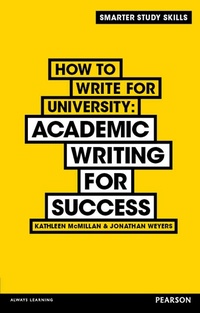
How to Write for University
Description

The full text downloaded to your computer
With eBooks you can:
- search for key concepts, words and phrases
- make highlights and notes as you study
- share your notes with friends
eBooks are downloaded to your computer and accessible either offline through the Bookshelf (available as a free download), available online and also via the iPad and Android apps.
Upon purchase, you'll gain instant access to this eBook.
Time limit
The eBooks products do not have an expiry date. You will continue to access your digital ebook products whilst you have your Bookshelf installed.
Undertaking a writing project for assessment can be a challenging prospect for students of all disciplines and especially those new to academic writing in higher education. The unique 12-step approach in this book leads students through the different stages that apply to any form of academic writing - gathering relevant information, processing that information through effective planning, creating the text and developing writing for future assignments including exam writing. The authors follow their tried-and-tested Smarter Student series approach to deliver timely, practical, hands-on guidance based on real-life experience from teaching and assessing
More details
Other editions
Additional editions
Persons
Jonathan Weyers and Kathleen McMillan both work at the University of Dundee. Both have been teaching and lecturing for over 25 years and latterly have specialised in the transferable skills area. They have a track record of collaborative writing and achievement in this area.
Content
- Introduction
- 1. The importance of writing at university - how your abilities in academic writing contribute to your sucess
- Essentials for getting started - how to gather and record information
- 2. University writing in context - how your academic writing is shaped from the very start of your course
- 3. Lectures, listening and academic writing - how information you hear in lectures contributes to your writing
- 4. Researching information for writing assignments - how to use the library as a source of academic information
- 4. Reading effectively - how understanding the structure of text helps your own writing
- 6. Notes from lectures and reading - how to record information in note-form for use in your writing
- 7. Speaking, thinking and academic writing - how discussing your work contributes to organising and wording your writing
- Understanding the contexts and practices relating to academic writing - how to meet the standards
- 8. Organising yourself for writing - how to use your time effectively to ensure successful completion of assignments
- 9. The format of academic writing - how to structure your text appropriately
- 10. Following the expected academic style in your writing - how to adopt the appropriate language conventions in your task
- 11. Information-processing and critical thinking for writing - how to approach your analysis of source material
- 12. Referring to source material in your writing - how to cite and reference correctly to avoid plagiarism
- 13. Presentation of academic assignments - how to follow the relevant academic conventions in your written work
- 14. What markers look for when assessing written work - how markers grade your academic writing
- Writing technique - how to plan and write for assessment
- 15. Planning writing assignments - how to reflect on and organise your response to the task
- 16. Writing a first draft - how to shape your text using sentences and paragraphs effectively
- 17. Reviewing, editing and proof-reading your writing - how to make sure your writing is concise and correct
- Developing future academic writing - how to build on markers' advice for good results in later writing including exams
- 18. Acting on feedback in your coursework - how to use markers' comments to develop your academic writing
- 19. Academic writing in exams - how to translate the techniques of coursework writing into your exam script
- Appendices
