

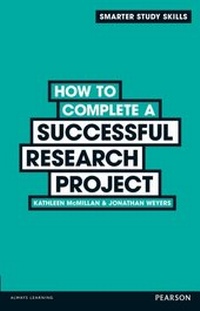
How to Complete a Successful Research Project
1st Edition
Published on 17. October 2014
328 pages
978-1-292-07348-4 (ISBN)
Description

A practical, step-by-step guide to planning, researching and writing a research project for undergraduate students approaching a research project for the first time.
Undertaking a large-scale, original research project can be extremely daunting and challenging to any student. Using the tried-and-tested Smarter Student series approach, style and pedagogy to deliver timely, practical, hands-on guidance based on real-life experience from students and lecturers alike, this book will be an invaluable tutorial and reference for any student approaching an undergraduate or masters research project for the first time.
This book will guide the student through all of the key areas that they will need to deliver a successful research project, providing practical guidance, examples and hints and tips for success on areas such as:
Choosing a theme and topic for your research
Writing the proposal
Working with your supervisor
Planning and managing your time and activity
Analysing and evaluating data
Successful academic writing styles and conventions
Correct citing, referencing and avoiding plagiarism
Ethics in research
Researching and compiling the literature survey
Methods of collecting and analysing data
Writing-up and presenting your findings
An essential guide to academic success!
Undertaking a large-scale, original research project can be extremely daunting and challenging to any student. Using the tried-and-tested Smarter Student series approach, style and pedagogy to deliver timely, practical, hands-on guidance based on real-life experience from students and lecturers alike, this book will be an invaluable tutorial and reference for any student approaching an undergraduate or masters research project for the first time.
This book will guide the student through all of the key areas that they will need to deliver a successful research project, providing practical guidance, examples and hints and tips for success on areas such as:
Choosing a theme and topic for your research
Writing the proposal
Working with your supervisor
Planning and managing your time and activity
Analysing and evaluating data
Successful academic writing styles and conventions
Correct citing, referencing and avoiding plagiarism
Ethics in research
Researching and compiling the literature survey
Methods of collecting and analysing data
Writing-up and presenting your findings
An essential guide to academic success!
All prices
More details
Edition
1. Auflage
Language
English
Place of publication
United Kingdom
Target group
Professional and scholarly
ISBN-13
978-1-292-07348-4 (9781292073484)
Copyright in bibliographic data and cover images is held by Nielsen Book Services Limited or by the publishers or by their respective licensors: all rights reserved.
Schweitzer Classification
Other editions
Additional editions
Kathleen McMillan | Jonathan Weyers
How to Complete a Successful Research Project
Book
06/2014
Pearson Education Limited
€28.46
Shipment within 10-20 days
Persons
Jonathan Weyers and Kathleen McMillan both work at the University of Dundee. Both have been teaching and lecturing for over 25 years and latterly have specialised in the transferable skills area. They have a track record of collaborative writing and achievement in this area.
Content
Introduction
1 Taking on a research investigation - how to approach the challenges of project work
2 Choosing a research topic - how to decide on a theme for your investigation
3 Framing a research question - how to set targets and formulate hypotheses to test
4 Writing a project proposal - how to structure a formal research plan
5 Planning and managing time - how to organise your investigation and submit on time
6 Working successfully with a supervisor - how to make the most of your relationship
7 Finding relevant source material - how to develop your information literacy skills
8 Assessing content in the literature - how to evaluate published information in your field
9 Interpreting published data - how to understand graphs, tables and basic statistics
10 Note-making from research sources - how to record information for use in your investigation
11 Organising your research materials - how to collect and file information and details of references
12 Using quantitative research methods - how to obtain and analyse numerical information
13 Using qualitative research methods - how to obtain and analyse descriptive information
14 Conducting experiments and field studies - how to design and perform lab and field investigations
15 Designing and carrying out surveys and interviews - how to obtain relevant information from research participants
16 Thinking in research contexts - how to apply method to produce valid, original ideas for your investigation
17 Arriving at a position and supporting it - how to sift fact and opinion and express your conclusions
18 Following guidelines on ethics and safety - how to observe good research practice in your investigation
19 Analysing data - how to manipulate and interpret your results with simple, effective techniques
20 Presenting data - how to display information, graphs and tables to academic standard
21 Planning the writing phase - how to organise your work effectively to produce the best-quality product on time
22 Writing up in the approved format - how to report on your research using standard structure and content
23 Writing up in the appropriate style - how to use academic language and well-organised discourse to express your ideas and findings
24 Citing, referencing and avoiding plagiarism - how to refer appropriately to the work and ideas of others
25 Reviewing, editing and proofreading - how to enhance the quality of your write-up
26 Acting on feedback - how to interpret and learn from what your supervisor writes on your drafts
27 Presenting your project for assessment - how to submit your work appropriately
List of references
1 Taking on a research investigation - how to approach the challenges of project work
2 Choosing a research topic - how to decide on a theme for your investigation
3 Framing a research question - how to set targets and formulate hypotheses to test
4 Writing a project proposal - how to structure a formal research plan
5 Planning and managing time - how to organise your investigation and submit on time
6 Working successfully with a supervisor - how to make the most of your relationship
7 Finding relevant source material - how to develop your information literacy skills
8 Assessing content in the literature - how to evaluate published information in your field
9 Interpreting published data - how to understand graphs, tables and basic statistics
10 Note-making from research sources - how to record information for use in your investigation
11 Organising your research materials - how to collect and file information and details of references
12 Using quantitative research methods - how to obtain and analyse numerical information
13 Using qualitative research methods - how to obtain and analyse descriptive information
14 Conducting experiments and field studies - how to design and perform lab and field investigations
15 Designing and carrying out surveys and interviews - how to obtain relevant information from research participants
16 Thinking in research contexts - how to apply method to produce valid, original ideas for your investigation
17 Arriving at a position and supporting it - how to sift fact and opinion and express your conclusions
18 Following guidelines on ethics and safety - how to observe good research practice in your investigation
19 Analysing data - how to manipulate and interpret your results with simple, effective techniques
20 Presenting data - how to display information, graphs and tables to academic standard
21 Planning the writing phase - how to organise your work effectively to produce the best-quality product on time
22 Writing up in the approved format - how to report on your research using standard structure and content
23 Writing up in the appropriate style - how to use academic language and well-organised discourse to express your ideas and findings
24 Citing, referencing and avoiding plagiarism - how to refer appropriately to the work and ideas of others
25 Reviewing, editing and proofreading - how to enhance the quality of your write-up
26 Acting on feedback - how to interpret and learn from what your supervisor writes on your drafts
27 Presenting your project for assessment - how to submit your work appropriately
List of references
