

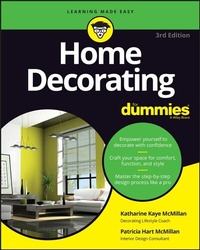
Home Decorating For Dummies
Description

Home Decorating For Dummies packs all the information you need to know about décor into one easy-to-read source. Whether you want to decorate one room or make over the whole house, this book has everything you need to design like a pro. This is the only reference you'll need to transform your home into a space you'll love. Dummies offers no-nonsense help, so you can plan perfect projects and stay within budget. Updated with the latest on smart homes, short-term rentals, DIY décor, and more.
* Learn how to optimize your home's floor plan
* Discover tricks for mixing patterns, colors, and textures successfully
* Refresh your home's style without spending a fortune
* Decorate rental properties with eye-catching, trendy style
* Untangle the terms--mid-century modern, farmhouse, minimalism--and pinpoint your design style
For those seeking ideas, resources, and budget-wise tips to spark their decorating creativity, Home Decorating For Dummies is a must-have.
More details
Other editions
Additional editions
Persons
Content
Part 1: Getting Started with Home Decorating 5
Chapter 1: Bringing Your Vision to Life 7
Chapter 2: Budgeting Your Projects 13
Chapter 3: Evaluating Your Space 23
Chapter 4: Thinking Like a Designer 39
Part 2: Creating Dimensions 53
Chapter 5: Experiencing Color 55
Chapter 6: Playing with Pattern 65
Chapter 7: Toying with Texture 77
Part 3: Perfecting Style 87
Chapter 8: Decorating with Timeless Styles 89
Chapter 9: Designing with Contemporary Styles. 105
Chapter 10: Developing Your Personal Style 113
Chapter 11: Finding Furniture 123
Part 4: Designing Backgrounds 135
Chapter 12: Enhancing Walls 137
Chapter 13: Finding Flooring 149
Chapter 14: Styling Ceilings 163
Chapter 15: Dressing Windows 175
Chapter 16: Livening Up Lighting 189
Part 5: Tackling Kitchens, Baths, Home Offices, and Media Rooms 207
Chapter 17: Cooking Up Dream Kitchens 209
Chapter 18: Beautifying Bathrooms 225
Chapter 19: Setting Up Work from Home 239
Chapter 20: Making the Most of Media Rooms 249
Part 6: Transforming Sleeping, Living, Dining, and Other Spaces 255
Chapter 21: Styling Bedrooms 257
Chapter 22: Enlivening Living Rooms 273
Chapter 23: Designing for Dining 289
Chapter 24: Transforming Bonus Spaces 305
Part 7: Putting on the Final Touches 319
Chapter 25: Arranging Art Artistically 321
Chapter 26: Accessorizing with Flair 335
Part 8: The Part of Tens 351
Chapter 27: Ten Tips for a Luxe Look 353
Chapter 28: Ten Tips for Small Spaces 359
Index 363
Chapter 1
Bringing Your Vision to Life
IN THIS CHAPTER
Making a plan for your home decorating project
Considering color, pattern, and texture
Looking at design styles and finding the style that fits your needs
Focusing on walls, flooring, ceilings, windows, and lighting
Taking your kitchen, bath, home office, or media room to the next level
Making your bedroom, living room, dining room, and other spaces shine
Putting on the finishing touches of art and accessories
You want to be living your best life. And part of living your best life is having a beautifully decorated house - a house that helps you live the way you want to live. No matter how much space you have to decorate, you've picked up this book because you see yourself living a beautiful life in a (potentially) beautiful home.
This chapter introduces you to the home decorating process, walking you through what's involved from beginning to end. After reading this chapter, you'll have the confidence to start your home decorating process.
Planning like a Pro
Professional decorators live by the adage "If you fail to plan, you plan to fail." Decorators are nothing if not planners. So, if you want to decorate your home - whether you're redoing every room in a sprawling house or one room in a small apartment - you need to start with a plan. A happy home happens by design.
To realize your vision, you need a plan and a budget. A plan is a formal document with tasks, timelines, and estimated costs. Budgeting helps you break down a project into smaller steps and manage the money you have to spend. Tracking your time and money goes hand in hand with mapping out a plan. A good plan is clear, easy to understand, comprehensive, and flexible. It should be economical (so you won't run out of money or run up debt), establish your vision standards, be balanced, and be practical. For more on budgeting, turn to Chapter 2.
Space: the final frontier! Well, at least when it comes to decorating, that is. Right now, your space is uncharted. You need to chart your space for size, doors, windows, and key details. Sketch out or digitally draw your space, including the locations of electrical outlets, cables, light switches, and Internet routers.
Using templates or online programs or apps can help you figure out the best placement of furniture and facilitate movement through the space. Turn to Chapter 3 for more on mapping out your space.
Every design problem (like "How should I decorate my bedroom to get high-quality sleep?") has a solution. Maybe you have too many solutions in mind. If so, how will you pick out the best one? The point of thinking like a designer is to be focused on solutions. You need to understand your behaviors, your needs, and your vision. To start thinking like a designer, turn to Chapter 4.
Taking Your Design to the Next Dimension
Whether it's a piece of furniture or a floor or a knick-knack, every object has three visual surface dimensions: color, pattern, and texture.
Color influences mood, cognition, and behavior. In short, it shapes how you experience a space or an object. You can work with color and color palettes to achieve an effect or solve a visual problem (like an oddly shaped space). Turn to Chapter 5 for the basics of color theory and color schemes.
Pattern adds personality and style. Some styles, like boho, call for heavy layering of strong patterns. How do you layer three, four, or more patterns to get the look you want? Never fear! It all comes down to dealing with the dimensions and understanding basic decorating rules. Chapter 6 walks you through how to play with patterns to achieve your desired result.
Texture (and playing textures off one another) is a key part of any style. Shaggy wooly animal hides contrasting with slick glass and chrome defines a '70s look, for example. Chapter 7 shows you how to use sensory aspects of texture to craft your room's story and style.
Considering the Style of Your Designs
Whether you're a purist or an innovator, finding out about the long sweep of style history will give you the basics for determining your decor direction.
Historical styles and periods continue strong in today's decorating. Because these looks are so much a part of the way we live today, we consider them timeless and ever evolving in scale and proportion. Chapter 8 outlines some of history's "top hits" for living in style.
Contemporary style encompasses looks from Modern and Mid-Century Modern to present day. Contemporary styles may draw on many influences over time and across the globe. Chapter 9 hits the highlights of the past few decades of interior design.
Many designers have a signature look. You can be like your favorite designers and decorators when you craft your own look. Chapter 10 takes you through the profiles of some of today's leading trendsetters and guides you on how to discover your own personal style.
Sizing up your options for major furniture types has never been easier. Chapter 11 helps you shop for quality and value while staying in your budget.
Getting Background Information
With all the choices out there, you need a guide to help you decide on major decorating choices for backgrounds - walls, floors, ceilings, windows, and lighting.
Walls bound your space. They also provide tons of opportunities for unleashing style and concealing things like wiring and insulation (never pretty to look at). How can you use paint, wallcoverings, and more to create effects? Discover the options for customizing your look using various materials and options in Chapter 12.
How do you choose the best flooring? Avoid walking on pins and needles when picking flooring. Chapter 13 helps you consider your basic needs for comfort, style, and durability, and provides lots of information on technical aspects of floors.
You may not have given much thought to your ceiling, there are stylish options for making a ceiling look interesting while helping it do its job better (which is to conceal wiring, air conditioning, and structural components). Chapter 14 is a must-read for dealing with the ceiling.
Controlling light, corralling heat loss and gain, and ensuring privacy are key when it comes to dressing up your windows. Chapter 15 looks at the top options for achieving your decorating goals.
Lighting makes or breaks the mood and functioning of a room. What's the right kind of light source? How do you deal with lighting problems like unbalanced sunlight and dark areas? How can you spotlight your favorite objects? Chapter 16 illuminates your options.
Designing Your Kitchen, Bathroom, Home Office, and Media Room
You need decorating know-how to create the four tough rooms: the kitchen, the bathroom, the home office, and the media room. You can add lots of extras to these rooms to make them even more functional and more stylish.
Even if you order takeout five nights a week, your kitchen is the most lived-in room in your house. You use it for everything from cooking to entertaining, which means it has to meet a variety of needs for a variety of users. The hearth of the home truly has very special decorating needs. Turn to Chapter 17 for all things kitchen related.
Just because a room is functional doesn't mean it should be bare-bones basic. The bath - no matter what its size - has morphed into a spa. Whether your bathroom is small or large, turn it into an oasis of comfort with the tips in Chapter 18.
More and more people are working out of our homes these days. Your home office (or library or study) needs professional-level function and style. You need solutions that work for you when you go to work! Turn to Chapter 19 for practice advice you can put to work.
Screening your favorite shows can be more of an experience than ever before. More and more homes are being built with dedicated media rooms with controlled light, sophisticated sound systems, and special layouts. Chapter 20 takes you through some of the key things to know when decorating for viewing.
Making Your Sleeping, Living, Dining, and Other Spaces Work for You
You spend one-third of your life sleeping. Select your bedroom's look while keeping in mind function, fun, and style. You'll make different design choices if you're decorating bedrooms for children and guests. Chapter 21 has all the information you need to decorate any bedroom.
Your living room is a public room that's also very personal. You want your living room to be a comfortable, relaxing room with maximum style. Chapter 22 shows you how to make your living room picture-perfect yet livable.
Entertaining at home is bigger than ever. Having people over for dining, screening your favorite shows, or playing games is the "in" thing. Some people entertain in the kitchen or the living room. No matter what rooms you entertain your friends in, you want a functional and fun look. Chapter 23 covers dining rooms, whether you have a dedicated formal dining room or you're dining in front of the TV.
Do you have plenty of space? Get more use out of it! Decorate bonus spaces - such as entryways, attics,...
