

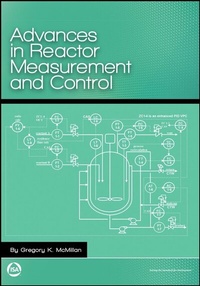
Advances in Reactor Measurement and Control
Description

Advances in Reactor Measurement and Control explains how control system design can address the different process responses and fundamental characteristics of the main reactor types in the process industry. This book helps readers understand the measurements, control strategies, controller features and tuning parameters needed to achieve process goals for a specific types of reactors. It begins with the fundamentals and principles necessary to achieve optimal reactor and control system performance. Additionally, it covers design, implementation and support of straightforward configurations based on the type of process and equipment.
Written from a practical perspective, this book educates readers through the experience and perspective of a practitioner, outlining general concepts and details that span the field, from the control room to the reactor, with a focus on the controlling and optimizing of both batch and continuous reactors.
"Taking a practitioner's approach, I believe, is unique," McMillan says. "The concepts in this book are developed to help the reader understand the fundamental differences in reactor applications and improve the performance of nearly all types of reactors. This book is unique in providing readily configurable, practical solutions for batch and fluidized bed reactors, in addition to the more traditional continuous stirred tank reactors." -Gregory K. McMillan
McMillan goes on to say that the book's practical value is reinforced through its:
- Simple presentation of the characteristics and implications of each of the dynamic responses needed to achieve the necessary efficiency, capacity, quality and safety in operation.
- Clear explanation of the PID features and tuning and control loops needed for addressing the lack of smoothing in dead time dominant processes and the lack of negative feedback in integrating and runaway processes.
More details
Other editions
Additional editions
Person
Gregory K. McMillan, CAP, has more than 50 years of experience in industrial process automation, with an emphasis on the synergy of dynamic modeling and process control. He retired as a Senior Fellow from Solutia and a senior principal software engineer from Emerson Process Systems and Solutions. He was also an adjunct professor in the Washington University Saint Louis Chemical Engineering department from 2001 to 2004. McMillan is the author of numerous ISA books and columns on process control, and he has been the monthly Control Talk columnist for Control magazine since 2002. He started and guided the ISA Standards and Practices committee on ISA-TR5.9-2023, PID Algorithms and Performance Technical Report, and he wrote "Annex A - Valve Response and Control Loop Performance, Sources, Consequences, Fixes, and Specifications" in ISA-TR75.25.02-2000 (R2023), Control Valve Response Measurement from Step Inputs. McMillan's achievements include the ISA Kermit Fischer Environmental Award for pH control in 1991, appointment to ISA Fellow in 1991, the Control magazine Engineer of the Year Award for the Process Industry in 1994, induction into the Control magazine Process Automation Hall of Fame in 2001, selection as one of InTech magazine's 50 Most Influential Innovators in 2003, the ISA Life Achievement Award in 2010, and the ISA Mentoring Excellence award in 2020. He has a BS in engineering physics from Kansas University and an MS in control theory from Missouri University of Science and Technology, both with emphasis on industrial processes.
Content
Preface xi
1 System Dynamics 1
1-1. Sources of Loop Dynamics 4
1.1.1 Dead Times 6
1.1.2 Time Constants 8
1.1.3 Open Loop Gains 12
1-2. Types of Process Dynamics 19
1.2.1 Self-Regulating Processes 19
1.2.2 Integrating Processes 22
1.2.3 Runaway Processes 25
1-3. Controller Tuning 27
1.3.1 Lambda Tuning for Self-Regulating Processes 31
1.3.2 Lambda Tuning for Integrating Processes 33
1.3.3 Lambda Tuning for Runaway Processes 34
1.3.4 Short Cut Method Tuning for Self-Regulating Processes 35
1.3.5 Short Cut Method Tuning for Integrating Processes 36
1.3.6 Short Cut Method Tuning for Runaway Processes 38
1.3.7 Maximizing Absorption of Variability Tuning for Surge Tank Level 39
1.3.8 Window of Allowable Controller Gains 41
1-4. Loop Performance 43
1.4.1 Load Disturbance Accumulated Error 44
1.4.2 Load Disturbance Peak Error 49
1.4.3 Load Disturbance Lag 52
1.4.4 Setpoint Response Rise Time, Overshoot, and Undershoot 55
2 Inferential Measurements 63
2-1. Conversion 66
2-2. Composition 69
2-3. Batch End Point 75
2-4. Multivariate Statistical Models 77
2-5. Step Response Models 81
2-6. First Principle Models 87
3 Reactor Characterization 95
3-1. Classification of Dynamic Responses 98
3-2. Residence Time 102
3-3. Control Loops 105
3-4. Pure Batch versus Fed-Batch versus Continuous 108
4 Reaction Kinetics 113
4-1. Reaction Rate. 115
4.1.1 Temperature Implications 115
4.1.2 Concentration Implications 115
4-2. Reaction Time 118
4.2.1 Batch Operations 119
4.2.2 Continuous Operations 120
4-3. Chemical Reactions 121
4-4. Biological Reactions 124
5 Reactor Control Systems 133
5-1. Single Phase Chemical Reactors 135
5-2. Mixed Phase Chemical Reactors 150
5-3. Acid and Base Chemical Reactors 156
5-4. Yeast Bioreactors (Fermenters) 157
5-5. Fungal Bioreactors 163
5-6. Bacterial Bioreactors 164
5-7. Mammalian Bioreactors 164
5-8. Biological Fed-Batch Profile Control 169
6 Cooling and Heating Control Systems 175
6-1. Jacket and Coil Temperature Control 178
6-2. Process Recirculation Temperature Control 189
Appendix A Top Ten Concepts in Automation System Performance 197
Appendix B Basics of PID Controllers 215
Appendix C Control Loop Performance 227
Appendix D Discussion 243
Appendix E Enhanced PID Analyzer Applications 253
Appendix F First Principle Process Relationships 275
References 297
Index 303
