

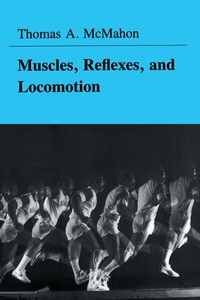
Muscles, Reflexes, and Locomotion
1st Edition
Published on 7. December 2020
354 pages
978-0-691-22154-0 (ISBN)
Description

The description for this book, Muscles, Reflexes, and Locomotion, will be forthcoming.
More details
Other editions
Additional editions
Thomas A. McMahon
Muscles, Reflexes, and Locomotion
Book
04/1984
Princeton University Press
€84.18
Article exhausted; check different version
Thomas A. McMahon
Muscles, Reflexes, and Locomotion
Book
04/1984
Princeton University Press
€81.70
Article not available at the moment
Person
Thomas A. McMahon
Content
- Cover Page
- Half-title Page
- Title Page
- Copyright Page
- Contents
- Preface
- Sources and Acknowledgments
- Chapter 1: Fundamental Muscle Mechanics
- Early Ideas About Muscular Contraction
- Isolated Muscle Preparation
- Mechanical Events: Twitch and Tetanus
- Tension-Length Curves: Passive and Active
- Quick-Release Experiments
- Series Elastic Component
- Force-Velocity Curves
- Active State
- Muscles Active While Lengthening
- Time Course of Active State in a Twitch
- Difficulties with the Active State Concept
- Summary and Conclusions
- Solved Problems
- Problems
- Chapter 2: Muscle Heat and Fuel
- Heat Transients
- Resting heat
- Initial and recovery heat
- Fine Structure of the Initial Heat
- Activation heat
- Shortening heat: The Fenn effect
- Heat Produced by Lengthening Muscles
- Thermoelastic Effects
- What Is the Fuel? The Lactic Acid Era
- High-Energy Phosphates
- Lohmann Reaction
- Isolating the ATP Engine
- Light Exercise
- Aerobic Recovery
- Heavy Exercise
- Anaerobic Recovery
- Lactic Acid Oxygen Debt
- Interval Running
- Alactic Oxygen Debt
- How to Train Without Tiring
- Carbohydrate Loading
- Solved Problems
- Problems
- Chapter 3: The Contractile Proteins
- General Organization of Muscles
- Parallel-Fibered and Pennate Muscles
- Fibers, Fibrils, and Filaments
- Myosin and Its Parts
- Actomyosin Threads
- Glycerinated Fibers
- Synthetic Actomyosin
- The Myosins
- The Actins
- Sliding Filament Model
- Early Evidence for the Sliding Filament Model
- Later Evidence from X-Ray Diffraction in Active Muscle
- Tension-Length Curves in Single Fibers
- Synthesizing the Contractile Apparatus: Polymerized Thick Filaments and Decorated Actin
- Activation of Contraction: the Sarcoplasmic Reticulum
- The On-Off Switch: Troponin and Tropomyosin
- Natural History Aspects: Clues to the Origin of Motility
- Stretch Activation in Insect Muscle
- The Problem of Static Stability in the Sliding Filament Model
- Permanent Extra Tension
- Tension "Creep" in a Fixed-End Tetanus
- Sarcomere Length Nonuniformity as a Unifying Principle
- Review of the Events of a Single Contraction
- Solved Problems
- Problems
- Chapter 4: The Sliding Movement: A. F. Huxley's
- Alternative Mechanisms: A Few Discarded Ideas
- Electrostatic Theories
- Folding Thin Filaments
- Evidence for Independent Force Generators Operating Cyclically
- Points of Muscle Performance a Theoretical Model Should Include or Predict
- Formulation of the Model
- Attachment and Detachment Rate Constants
- Crossbridge Distributions for Isotonic Shortening
- Developed Tension
- Rate of Energy Liberation
- Setting the Constants: Hill's Equations
- Independent Tests of the Model: Isotonic Stretching
- A Subsequent Difficulty: Hill's 1964 Revisions of the Heat Story
- Resolution of the Difficulty: Reversible Detachment
- Solved Problems
- Problems
- Chapter 5: Force Development in the Crossbridge
- Early Transients
- The Difference between the Rapid Elasticity and Hill's Series Elastic Component
- The T2 Transient and Its Time Constant
- A Mathematical Model for the Tension Transients: Two Attached States
- Potential Energy of the S-2 Spring
- Potential Energy of Conformation: The S-1 Link
- Total Potential Energy
- Kinetics of the State Transitions
- The Rate Equation and Its Solution
- Tension
- Fixing the Constants
- Oscillatory Work
- Review and Conclusions
- Solved Problems
- Problems
- Chapter 6: Reflexes and Motor Control
- Organization of the Motor Control System
- Spinal cord
- Brain stem
- Sensorimotor cortex and basal ganglia
- Cerebellum
- Muscle Fiber Types and the Size Principle
- Fiber types
- Motor units and their order of recruitment
- The Muscle Proprioceptors
- Spindle organs
- The Golgi tendon organ
- Afferents and Efferents
- The Stretch Reflex
- Coactivation of a and r Motor Neurons
- Reflex Stiffness
- A Lumped, Linear Model of the Spindle
- How Velocity Sensitivity Acts to Stabilize a Reflex Loop
- Tremor
- How Time Delay in a Negative-Feedback Loop Can Cause Oscillations
- The Role of Loop Gain in Stability
- The Role of Loop Gain in Performance
- Renshaw Cells
- Solved Problems
- Problems
- Chapter 7: Neural Control of Locomotion
- Gait: Comparative Distinctions
- Gait: Classifications
- Bipedal gaits
- Quadrupedal gaits
- Control of a Single Limb: Reciprocal Inhibition
- Placing Reactions and Reflex Reversal
- A Mechanical Oscillator
- Extensor Thrust Reflex
- Spinal Reflexes Involving All Limbs
- Spinal Locomotion on Treadmills: Constancy of the Swing Duration
- Stopped Limb Experiments
- Entrainment
- Superharmonic Entrainment
- The Pattern Generator Could Employ Coupled Oscillators
- Stimulated Locomotion
- De-afferented Spinal Walking
- Feedforward
- Vehicles with Legs
- Solved Problems
- Problems
- Chapter 8: Mechanics of Locomotion
- Force Plates
- Force Plate Records of Walking and Running
- Determinants of Gait
- Compass gait
- Pelvic rotation
- Pelvic tilt
- Stance leg knee flexion
- Plantar flexion of the stance ankle
- Lateral displacement of the pelvis
- Ballistic Walking
- Defining the model
- Results of the ballistic model
- Extensions to include additional gait determinants
- Conclusions from the ballistic walking studies
- Locomotion in Reduced Gravity
- Elastic Storage of Energy
- Energetics of kangaroos
- Maintaining a resonant system in motion
- Cost of Running
- Cost of running formula
- Influence of limbs
- Up and Down Hills: Efficiency of Positive and Negative Work
- Tilting treadmill
- Efficiency
- Running with Weights
- Oxygen consumption and load
- Carrying load is not equivalent to increasing speed
- Enhanced Gravity: Running in Circles
- Utilizing Elastic Rebound: The Tuned Track
- A model of the leg
- Ground contact time
- Step length
- Tuned track prototypes
- Solved Problems
- Problems
- Chapter 9: Effects of Scale
- Dimensional Analysis
- An example: The period of a pendulum
- Fundamental quantities
- Dimensionless variables
- The air resistance of a runner
- The pi-theorem
- Scaling by Geometric Similarity
- Rowing: A comparative analysis based on geometric similarity
- Animal performance: A. V. Hill's scaling rules from geometric similarity
- Some experimental challenges to Hill's arguments
- A conflict within the model
- The Role of Gravity: Variable-Density Scaling
- How Scale-Dependent Distortions in Dimensionless Groups Are Accommodated
- Distortions in Geometry
- Deriving Elastic Similarity
- Buckling
- Bending
- Generality of the rules
- Constant Stress Similarity
- Allometric Rules
- Body Proportions
- Resonant Rebound
- Trunk
- Limbs
- Galloping Frequencies
- Height of Rise of the Center of Mass
- Joint Excursion Angles
- Intrinsic Muscle Velocity
- Phasing of the Limbs
- Metabolic Power for Running
- Blood Pressure and Myocardial Stress
- Basal Metabolic Rate
- Enzymatic Activities
- Surface Area and Cross-Sectional Area
- Physiological Frequencies
- Pulse-Wave Velocity and Blood Velocity
- Aortic Hydraulic Impedance
- Alveolar Diffusion
- Time Constants
- Life Span
- Feeding Gulliver
- Concluding Remarks
- Solved Problems
- Problems
- Answers to Selected Problems
- List of Symbols
- References
- Index
