

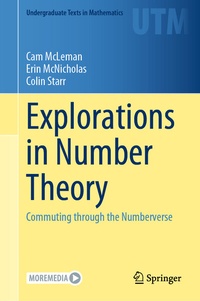
Explorations in Number Theory
Commuting through the Numberverse
Published on 18. December 2022
XIII, 372 pages
978-3-030-98931-6 (ISBN)
Description

This innovative undergraduate textbook approaches number theory through the lens of abstract algebra. Written in an engaging and whimsical style, this text will introduce students to rings, groups, fields, and other algebraic structures as they discover the key concepts of elementary number theory. Inquiry-based learning (IBL) appears throughout the chapters, allowing students to develop insights for upcoming sections while simultaneously strengthening their understanding of previously covered topics. The text is organized around three core themes: the notion of what a "number" is, and the premise that it takes familiarity with a large variety of number systems to fully explore number theory; the use of Diophantine equations as catalysts for introducing and developing structural ideas; and the role of abstract algebra in number theory, in particular the extent to which it provides the Fundamental Theorem of Arithmetic for various new number systems. Other aspects of modern number theory - including the study of elliptic curves, the analogs between integer and polynomial arithmetic,
p
-adic arithmetic, and relationships between the spectra of primes in various rings - are included in smaller but persistent threads woven through chapters and exercise sets.
Each chapter concludes with exercises organized in four categories: Calculations and Informal Proofs, Formal Proofs, Computation and Experimentation, and General Number Theory Awareness. IBL "Exploration" worksheets appear in many sections, some of which involve numerical investigations. To assist students who may not have experience with programming languages, Python worksheets are available on the book's website. The final chapter provides five additional IBL explorations that reinforce and expand what students have learned, and can be used as starting points for independent projects. The topics covered in these explorations are public key cryptography, Lagrange's four-square theorem, units and Pell's Equation, various cases of the solution to Fermat's Last Theorem, and a peek into other deeper mysteries of algebraic number theory.
Students should have a basic familiarity with complex numbers, matrix algebra, vector spaces, and proof techniques, as well as a spirit of adventure to explore the "numberverse."
Each chapter concludes with exercises organized in four categories: Calculations and Informal Proofs, Formal Proofs, Computation and Experimentation, and General Number Theory Awareness. IBL "Exploration" worksheets appear in many sections, some of which involve numerical investigations. To assist students who may not have experience with programming languages, Python worksheets are available on the book's website. The final chapter provides five additional IBL explorations that reinforce and expand what students have learned, and can be used as starting points for independent projects. The topics covered in these explorations are public key cryptography, Lagrange's four-square theorem, units and Pell's Equation, various cases of the solution to Fermat's Last Theorem, and a peek into other deeper mysteries of algebraic number theory.
Students should have a basic familiarity with complex numbers, matrix algebra, vector spaces, and proof techniques, as well as a spirit of adventure to explore the "numberverse."
More details
Series
Language
English
Place of publication
Cham
Switzerland
Publishing group
Springer International Publishing
Product notice
Reflowable
Illustrations
XIII, 372 p. 61 illus., 6 illus. in color.
File size
3,88 MB
ISBN-13
978-3-030-98931-6 (9783030989316)
DOI
10.1007/978-3-030-98931-6
Schweitzer Classification
Other editions
Additional editions
Cam McLeman | Erin McNicholas | Colin Starr
Explorations in Number Theory
Commuting through the Numberverse
Book
12/2022
Springer
€58.84
Shipment within 7-9 days
Persons
Cam McLeman is Associate Professor of Mathematics at the University of Michigan-Flint.
Erin McNicholas is Professor of Mathematics at Willamette University in Salem, Oregon.
Colin Starr is a Professor of Mathematics at Willamette University in Salem, Oregon.
Erin McNicholas is Professor of Mathematics at Willamette University in Salem, Oregon.
Colin Starr is a Professor of Mathematics at Willamette University in Salem, Oregon.
Content
Preface.- What is a Number?- A Quick Survey of the Last Two Millenia.- Number Theory in $\mathcal{Z}$ Beginning.- Number Theory in the Mod-n Era.- Gaussian Number Theory: $\mathcal{Z}[i]$ of the Storm.- Number Theory: From Where We $\mathcal{R}$ to across the $mathcal{C}$.- Cyclotomic Number Theory: Roots and Reciprocity. Number Theory Unleashed: Release $\mathcal{Z}_p$!- The Adventure Continues.- Appendix: Number Systems.
