

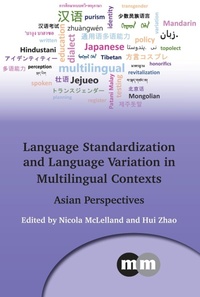
Language Standardization and Language Variation in Multilingual Contexts
Asian Perspectives
Published on 24. November 2021
368 pages
978-1-80041-157-9 (ISBN)
Description

This important contribution to the sociolinguistics of Asian languages breaks new ground in the study of language standards and standardization in two key ways: in its focus on Asia, with particular attention paid to China and its neighbours, and in the attention paid to multilingual contexts. The chapters address various kinds of (sometimes hidden) multilingualism and examine the interactions between multilingualism and language standardization, offering a corrective to earlier work on standardization, which has tended to assume a monolingual nation state and monolingual individuals. Taken together, the chapters in this book thus add to our understanding of the ways in which multilingualism is implicated in language standardization, as well as the impact of language standards on multilingualism.
The introduction, Chapter 6 and Chapter 8 are free to download as open access publications under a CC BY NC licence. You can access them here:
Introduction: https://zenodo.org/record/5749388#.YaiwuNDP3cs
Chapter 6: https://zenodo.org/record/5749522#.Yaiw-9DP3cs
Chapter 8: https://zenodo.org/record/5749586#.Yai0RNDP3cs
The introduction, Chapter 6 and Chapter 8 are free to download as open access publications under a CC BY NC licence. You can access them here:
Introduction: https://zenodo.org/record/5749388#.YaiwuNDP3cs
Chapter 6: https://zenodo.org/record/5749522#.Yaiw-9DP3cs
Chapter 8: https://zenodo.org/record/5749586#.Yai0RNDP3cs
Reviews / Votes
This volume makes an essential contribution to the critical task of decolonizing sociolinguistics, by making the discipline more inclusive and representative. The case studies - drawn from south, southeast, east, and inner Asia - broaden the scope of sociolinguistic knowledge and stimulate important theoretical developments in our understanding of language standardization. * Gerald Roche, La Trobe University, Australia * This valuable book adds depth and breadth to the understanding of language standardization and variation by providing much-needed Asian perspectives. Complex issues such as equity, diversity and cultural revitalisation in the interplay of dominant and minoritized languages are explored in scholarly and accessible chapters that enrich the literature and inform policy. * Bob Adamson, University of Nottingham Ningbo China * This volume situates the study of language standardization and variation firmly in multilingual contexts and provides case studies from both major and minoritized Asian languages. In doing so, it opens up exciting new perspectives on linguistic norms and variation, and tests traditional models and assumptions about standardization, which have hitherto too often been based on monolingual ideologies and European languages. * Wendy Ayres-Bennett, University of Cambridge, UK *More details
Series
Language
English
Place of publication
Bristol
United Kingdom
Target group
College/higher education
Product notice
Reflowable
ISBN-13
978-1-80041-157-9 (9781800411579)
Copyright in bibliographic data and cover images is held by Nielsen Book Services Limited or by the publishers or by their respective licensors: all rights reserved.
Schweitzer Classification
Other editions
Additional editions
Nicola McLelland | Hui Zhao
Language Standardization and Language Variation in Multilingual Contexts
Asian Perspectives
Book
11/2021
Multilingual Matters
€184.90
Shipment within 10-20 days
Persons
Nicola McLelland is Professor in German and History of Linguistics at the University of Nottingham, UK. Her research interests include language standardization, multilingualism, the history of language learning and teaching, and the history of linguistics.
Hui Zhao is an Honorary Research Fellow in the School of Cultures, Languages and Area Studies, University of Nottingham, UK. Her research interests include sociolinguistics, Chinese sociolinguistics, multilingualism and language variation.
Hui Zhao is an Honorary Research Fellow in the School of Cultures, Languages and Area Studies, University of Nottingham, UK. Her research interests include sociolinguistics, Chinese sociolinguistics, multilingualism and language variation.
Content
Contributors
Note on the Use of Original Scripts in This Volume
Nicola McLelland and Hui Zhao: Introduction: Language Standardization and Language Variation in Multilingual Contexts - Asian Perspectives
This chapter is open access under a CC BY NC ND licence and can be downloaded for free at: https://zenodo.org/record/5749388#.YaiwuNDP3cs
Part 1: Histories of Standardization in Multilingual Contexts
Chapter 1. S. Imtiaz Hasnain: Language Codification: Coloniality, Society and History
Chapter 2. Mariarosaria Gianninoto: Linguistic Variation in Late Qing Western Sources: An Analysis of Edkins' Grammar of Shanghainese
Chapter 3. Jiaye (Jenny) Wu: Teaching Mandarin Pronunciation to Mongolian Learners in Early Republican Period China: The Case of the Mongolian Han Original Sounds of the Five Regions Menghan Hebi W?fang Yuanyin, ????????
Part 2: Standardization and Variation in Multilingual China: Implications for Education, Testing, Policy and Practice
Chapter 4. Anwei Feng: Reconciling Multilingualism and Promotion of the Standard Language in Education in China
Chapter 5. Lian Luo: Language Standards in Language Testing: The Case of Variation in Written Chinese Proficiency Tests for Second Language Learners
Chapter 6. Hui Zhao: Social Meaning and Variation in Perception: Beijingers' Attitudes Towards Beijing Mandarin
This chapter is open access under a CC BY NC ND licence and can be downloaded for free at: https://zenodo.org/record/5749522#.Yaiw-9DP3cs
Chapter 7. Wang Xiaomei: Global Chinese and Malaysian Mandarin: Transnational Standards for the Chinese Language
Part 3: Standardization and Minoritized Languages in Multilingual Contexts
Chapter 8. Alexandra Grey: How Standard Zhuang has Met with Market Forces
This chapter is open access under a CC BY NC ND licence and can be downloaded for free at: https://zenodo.org/record/5749586#.Yai0RNDP3cs
Chapter 9. Ying Sargin: Is Sibe a Linguistic Continuation of Manchu?
Chapter 10. Rigdrol Jikar: Language Standardization for Tibetans in the People's Republic of China
Chapter 11. Tsering Samdrup and Hiroyuki Suzuki: Politeness Strategies, Language Standardization and Language Purism in Amdo Tibetan
Chapter 12. Moira Saltzman: Erasure and Revitalization of an Endangered Language: The Case of Jejueo in South Korea
Chapter 13. Suwilai Premsrirat: Standardizing Indigenous Languages in Thailand Through Orthography Development and Mother Tongue-based Multilingual Education: The Case of Patani Malay
Part 4: Negotiating Standards and Variation: Case Studies from Japanese
Chapter 14. Patrick Heinrich: After Language Standardization: Dialect Cosplay in Japan
Chapter 15. Hideko Abe: Negotiating 'Standard' Gendered Speech in Japanese: The Case of Transgender Speakers
Chapter 16. Mie Hiramoto: Changes in Tohoku Dialect as Spoken in Hawai'i
Index
Note on the Use of Original Scripts in This Volume
Nicola McLelland and Hui Zhao: Introduction: Language Standardization and Language Variation in Multilingual Contexts - Asian Perspectives
This chapter is open access under a CC BY NC ND licence and can be downloaded for free at: https://zenodo.org/record/5749388#.YaiwuNDP3cs
Part 1: Histories of Standardization in Multilingual Contexts
Chapter 1. S. Imtiaz Hasnain: Language Codification: Coloniality, Society and History
Chapter 2. Mariarosaria Gianninoto: Linguistic Variation in Late Qing Western Sources: An Analysis of Edkins' Grammar of Shanghainese
Chapter 3. Jiaye (Jenny) Wu: Teaching Mandarin Pronunciation to Mongolian Learners in Early Republican Period China: The Case of the Mongolian Han Original Sounds of the Five Regions Menghan Hebi W?fang Yuanyin, ????????
Part 2: Standardization and Variation in Multilingual China: Implications for Education, Testing, Policy and Practice
Chapter 4. Anwei Feng: Reconciling Multilingualism and Promotion of the Standard Language in Education in China
Chapter 5. Lian Luo: Language Standards in Language Testing: The Case of Variation in Written Chinese Proficiency Tests for Second Language Learners
Chapter 6. Hui Zhao: Social Meaning and Variation in Perception: Beijingers' Attitudes Towards Beijing Mandarin
This chapter is open access under a CC BY NC ND licence and can be downloaded for free at: https://zenodo.org/record/5749522#.Yaiw-9DP3cs
Chapter 7. Wang Xiaomei: Global Chinese and Malaysian Mandarin: Transnational Standards for the Chinese Language
Part 3: Standardization and Minoritized Languages in Multilingual Contexts
Chapter 8. Alexandra Grey: How Standard Zhuang has Met with Market Forces
This chapter is open access under a CC BY NC ND licence and can be downloaded for free at: https://zenodo.org/record/5749586#.Yai0RNDP3cs
Chapter 9. Ying Sargin: Is Sibe a Linguistic Continuation of Manchu?
Chapter 10. Rigdrol Jikar: Language Standardization for Tibetans in the People's Republic of China
Chapter 11. Tsering Samdrup and Hiroyuki Suzuki: Politeness Strategies, Language Standardization and Language Purism in Amdo Tibetan
Chapter 12. Moira Saltzman: Erasure and Revitalization of an Endangered Language: The Case of Jejueo in South Korea
Chapter 13. Suwilai Premsrirat: Standardizing Indigenous Languages in Thailand Through Orthography Development and Mother Tongue-based Multilingual Education: The Case of Patani Malay
Part 4: Negotiating Standards and Variation: Case Studies from Japanese
Chapter 14. Patrick Heinrich: After Language Standardization: Dialect Cosplay in Japan
Chapter 15. Hideko Abe: Negotiating 'Standard' Gendered Speech in Japanese: The Case of Transgender Speakers
Chapter 16. Mie Hiramoto: Changes in Tohoku Dialect as Spoken in Hawai'i
Index
