

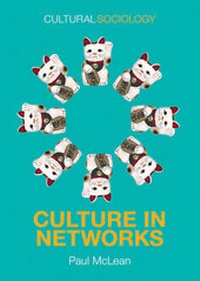
Culture in Networks
Description

Reviews / Votes
?It doesn't get better than this: an accessible treatment of an exciting but often abstruse topic by a leading figure in the field. Further, it organizes a wide range of materials to make a strong and compelling case. A wonderful contribution.? John Levi Martin, University of Chicago ?This is a path-breaking book that brilliantly describes one of the most exciting intellectual developments in the contemporary human sciences ? the melding of network science with the study of culture. McLean tackles this complex topic with clarity and precision, providing both a comprehensive review of the field and a coherent theoretical synthesis.? John Mohr, University of California, Santa BarbaraMore details
Other editions
Additional editions
Person
Content
1. Culture and Social Networks: A Conceptual Framework 1
PART I: Fundamental Concepts
2. The Nuts and Bolts of Networks, through a Cultural Lens 15
3. Basic Culture Concepts, with a Networks Inflection 34
PART II: Linkages of Networks with Culture
4. Culture through Networks: Diffusion, Contagion, Virality, Memes 65
5. Culture from Networks: The Network Genesis of Culture 89
6. Networks from Culture: How Norms and Tastes Shape Networks 111
7. Networks of Culture: Culture as Relational Structures 134
8. Networks as Culture, or Networks and Culture Fused 155
Notes 181
References 198
Index 228
2
The Nuts and Bolts of Networks, through a Cultural Lens
In this chapter, we will cover some of the most important concepts and arguments in the world of social network analysis, so that you can develop familiarity with the basic terminology and core ideas that will help you as you proceed through this book and beyond.1 In the subsequent chapter, I perform not exactly the same exercise, but a similar one, with respect to core ideas in the sociological treatment of culture, focusing especially on those concepts and theories of most relevance to networks research. In both chapters, I aim to discuss these distinctly different sets of fundamental concepts in light of each other. Thus, in this chapter, as I introduce and discuss basic network concepts, I note at each step how cultural themes and issues arise. In a sense, one could see this as problematizing network concepts from a cultural perspective, but I prefer to focus on the positively framed goal of pursuing ideas about how culturally informed thinking can enhance the substantive practice of network analysis, not undermine it. In the next chapter, I pursue the companion goal of exploring how network analytic thinking can enhance the ways cultural sociology may be done, to a significant extent by emphasizing the ways culture is frequently created, transmitted, and altered through concrete instances of social interaction, traceable via social network analysis.
The Most Basic Network Concepts: Nodes/Actors and Edges/Ties
A network is comprised of a set of entities and the connections existing among them. When thinking of social networks in particular, we frequently refer to (and conceive of) the entities as actors; however, nothing requires that they be individual people. They could be collectives, like families, or companies, or organizations, or states. As we will see later, they could also be things like words, or texts, or actions, or emotions, or just about anything existing in some relational nexus that comprises (or impinges upon) social life. Especially when we think of a network in graphic terms, as a set of points with lines connecting them in a web-like pattern, we may refer to the entities as nodes, or vertices, and the ties as edges or arcs. This vocabulary can be quite useful in its abstractness. It gets us away from assuming that the entities in a network are necessarily rational actors, with the specific mental equipment to make rational, self-interested decisions - as if that were the only motive behind social network formation and growth. Refraining from making such an assumption has allowed researchers to focus on structural properties or tendencies within networks, without seeking to explain them in terms of actor rationality. Equally, though, and more important for us, moving away from explaining social network behavior narrowly in terms of rational action provokes us to think about the myriad ways that culture - norms, values, local attitudes and beliefs, cognitive frames, powerful symbols, conversation, and so on - can affect how specific social networks are formed and develop. Taking that step entails adopting a healthy sensitivity to local context and meaning in networks research.
Nodes/actors can be categorized in various different ways. One key structural property of nodes is centrality, and, for the moment, especially degree centrality. This is a measure of the number of connections a given node has to other nodes.2 More central nodes have more ties, and accordingly they are expected to exert a stronger influence on network formation and development. People with many friends are likely to account disproportionately for the spread of tastes and fashions, for example. And a word that appears frequently in a given text - say, the word "security" in a State of the Union address - probably contributes disproportionally to the text's meaning, and influences the meaning of the words adjacent to it.3
It is usually also important to consider substantive attributes of entities in social networks.4 Such attributes may be relatively light on cultural content. Recording actors' physical attributes like height or body mass index or vocal pitch seems pretty devoid of cultural significance - except, say, in the context of speed dating in America (McFarland et al. 2013), where tall men are considered more desirable than short men, heavier women seem to be less choosy about dates, and rising pitch in one's voice is understood to connote engagement in a conversation. You catch my drift here, I hope: these physiological attributes frequently carry culture-specific meanings, and so connection to actors possessing them may be valued or despised accordingly. I don't mean to say these are entirely culturally constituted attributes in the way a preference for country music is, or living in Dumbo, but these meanings are important to consider when we analyze and interpret issues like who is most active or most connected in a network - indeed, who contributes the most to making the network.
While the notion of node is flexible, the notion of tie or edge is even more so. A tie can record almost anything: a kind of social relation (for example, marriage, friendship or admiration), or shared membership in a group, or a flow of resources (trade, gift exchange, migration, favors, advice), or communication (talking together, following on Twitter), or proximity (sharing a neighborhood, words semantically joined in a sentence). Furthermore, while we commonly think of networks as a set of things (actors) tied through connections, as if nodes were subjects and edges were actions or activities predicated of them, we may reverse that: we could think of activities as the nodes and people as the edges connecting them.5 Being a bit imaginative like this allows us, for one thing, to avoid thinking of "physical" networks as primary, and culture, as the thing that flows through them, as secondary, or "added" afterwards. The entities - the actors - may actually be (in fact, almost always are) constituted culturally through flows of activities that generate identities (White 2008). Thus, the "hardware versus software" analogy I posed in chapter 1 can quickly break down!
There are several issues to consider concerning the general properties of ties. First, network analysts typically store information about ties by grouping them into types of tie, or relations. Any given set of nodes may be connected via different relations: for example, a set of college friends may be connected by major, and/or by classes attended together, and/or by shared dorm space, and/or by exercising together, and/or by membership in clubs, and/ or, eventually, by marriage and possibly having kids together! We don't want to jumble up information on these different relations as if they all did the same work and meant the same thing. Because they mean different things, the network patterns we expect for each relation among one set of actors are quite likely to differ, too.
Second, there is the issue of how different relations may relate to each other. Maybe roommates do exercise together; that is an empirical question. But, often enough, not only how specific types of tie go together in actuality, but whether they can or should go together conceptually, is a function of cultural norms and expectations. For instance, in some societies people are expected to go into business with their family members; then, it is not an accidental confluence of relations. Both the roommates example and the business partners example describe overlapping types of tie, which network analysts refer to as multiplexity. However, although both are cases of multiplexity, it should be of special concern to us whether particular instances of multiplexity are culturally mandated (or culturally prohibited), so we can understand better the cultural norms and processes that generate particular network structures.
Consider also that humans are exceptionally adept at stitching different types of ties together, across different domains, to forge connections. For example, I might ask my sister to speak to her neighbor about the neighbor's boss's used car I want to buy. Vedran found a new drummer for his band by talking to a guy on my pick-up basketball team that used to work as a booking agent. Derek chatted with a guy on a train in Europe who went to school with his former girlfriend's dance instructor. And so on. Sometimes those ties are formed for utilitarian reasons; sometimes, as in the last example, they simply support everyday human sociability. Regardless, much of the way our social world works lies in how different relations are utilized skillfully in combination. Note this is not about overlapping relations, but chains of relations. Some combinations are very common. For example, a husband's brother is so commonly turned to for various things that we have a name for that compound relationship: brother-in-law. In patronage-based political systems, some people - bosses - have power precisely because they can connect people they know on one dimension with people they know on another.6 Yet some combinations of relations might be very hard to enact. Again, cultural expectations will shape the possibility of these tie combinations .7
Finally, one of the most important dimensions with which social network analysts have sought to classify ties and...
