

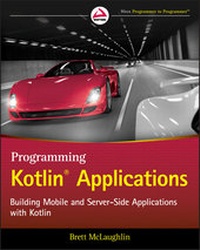
Programming Kotlin Applications
Description

Programming Kotlin Applications: Building Mobile and Server-Side Applications with Kotlin drops readers into the fast lane for learning to develop with the Kotlin programming language. Authored by accomplished cloud consultant and technology professional Brett McLaughlin, Programming Kotlin Applications provides readers with the pragmatic and practical advice they need to build their very first Kotlin applications.
Designed to give readers a thorough understanding of Kotlin that goes beyond mere mobile programming, this book will help you:
* Learn how to develop your first Kotlin project
* Understand how Kotlin securely protects and stores information
* Advocate for using Kotlin in your own professional and personal environments
* Understand Kotlin's goals and how to use it as its best
* Know when to avoid using Kotlin
Programming Kotlin Applications is written in a highly approachable and accessible way without the fluff and unrealistic samples that characterize some of its competitor guides. Perfect for developers familiar with another object-oriented programming language like Java or Ruby, or for people who want to advance their skillset in the Kotlin environment, this book is an indispensable addition to any programmer's library.
More details
Other editions
Additional editions
Person
Brett Mclaughlin has over two decades of experience working and writing in technology. He focuses on cloud and enterprise computing and has become a recognized and trusted name in helping organizations migrate to the cloud, especially with Amazon Web Services. He has led large-scale cloud migrations for NASA's Earth Science program as well as the RockCreek Group's financial platform. He is a sought-after speaker, author, and educator.
Visit us at wrox.com for free code samples.
Content
INTRODUCTION
For decades, the Java programming language has been the dominant force in compiled languages. While there have been plenty of alternatives, it's Java that has remained core to so many applications, from desktop to server-side to mobile. This has become especially true for Android mobile development.
Finally, though, there is a real contender to at least live comfortably beside Java: Kotlin, a modern programming language shepherded by JetBrains (www.jetbrains.com). It is not Java, but is completely interoperable with it. Kotlin feels a lot like Java, and will be easy to learn for developers already familiar with the Java language, but offers several nice improvements.
Further, Kotlin is a full-blown programming language. It's not just for mobile applications, or a visual language that focuses on one specific application. Kotlin supports:
- Inheritance, interfaces, implementations, and class hierarchies
- Control and flow structures, both simple and complex
- Lambdas and scope functions
- Rich support for generics while still preserving strong typing
- Idiomatic approaches to development, giving Kotlin a "feel" all its own
You'll also learn that while Kotlin is a new language, it doesn't feel particularly new. That's largely because it builds upon Java, and doesn't try to reinvent wheels. Rather, Kotlin reflects lessons that thousands of programmers coding in Java (and other languages) employ on a daily basis. Kotlin takes many of those lessons and makes them part of the language, enforcing strong typing and a strict compiler that may take some getting used to, but often produces cleaner and safer code.
There's also an emphasis in Kotlin, and therefore in this book, on understanding inheritance. Whether you're using packages from third parties, working with the standard Kotlin libraries, or building your own programs, you need a solid understanding of how classes interrelate, how subclassing works, and how to use abstract classes along with interfaces to define behavior and ensure that behavior is implemented. By the time you're through with this book, you'll be extremely comfortable with classes, objects, and building inheritance trees.
The Kotlin website (kotlinlang.org) describes Kotlin as "a modern programming language that makes developers happier." With Kotlin and this book, you'll be happier and more productive in your Kotlin programming.
WHAT DOES THIS BOOK COVER?
This book takes a holistic approach to teaching you the Kotlin programming language, from a beginner to a confident, complete Kotlin developer. By the time you're finished, you'll be able to write Kotlin applications in a variety of contexts, from desktop to server-side to mobile.
WILL THIS BOOK TEACH ME TO PROGRAM MOBILE APPLICATIONS IN KOTLIN?
Yes, but you'll need more than just this book to build rich mobile applications in Kotlin. Kotlin is a rich language, and while there are books on all the packages needed to build mobile languages, this is fundamentally a book on learning Kotlin from the ground up. You'll get a handle on how Kotlin deals with generics, inheritance, and lambdas, all critical to mobile programming.
You can then take these concepts and extend them into mobile programming. You can easily add the specifics of Android-related packages to your Kotlin base knowledge, and use those mobile packages far more effectively than if you didn't have the fundamentals down.
If you are anxious to begin your mobile programming journey sooner, consider picking up a book focused on Kotlin mobile programming, and hop back and forth. Read and work through Chapter 1 of this book, and then do the same for the book focused on mobile programming. You'll have to context switch a bit more, but you'll be learning fundamentals alongside specific mobile techniques.
This book covers the following topics:
- Chapter 1: Objects All the Way Down This chapter takes you from getting Kotlin installed to writing your first Kotlin program. You'll learn about functions from the start, and how to interact with the command line through a not-quite "Hello, World!" application. You'll also immediately begin to see the role of objects and classes in Kotlin, and refine your understanding of what a class is, what an object is, and what an object instance is.
- Chapter 2: It's Hard to Break Kotlin This chapter delves into one of the distinguishing features of Kotlin: its rigid stance on type safety. You'll learn about Kotlin's types and begin to grasp choosing the right type for the right task. You'll also get familiar with
valandvarand how Kotlin allows for change. - Chapter 3: Kotlin Is Extremely Classy Like any object-oriented language, much of your work with Kotlin will be writing classes. This chapter digs into classes in Kotlin and looks at the basic building blocks of all Kotlin objects. You'll also override some functions and get deep into some of the most fundamental of Kotlin functions:
equals()andhashCode(). - Chapter 4: Inheritance Matters This chapter begins a multichapter journey into Kotlin inheritance. You'll learn about Kotlin's constructors and the relatively unique concept of secondary constructors. You'll also learn more about the
Anyclass, understand that inheritance is truly essential for all Kotlin programming, and learn why writing good superclasses is one of the most important skills you can develop in all your programming learning. - Chapter 5: Lists and Sets and Maps, Oh My! This chapter moves away (briefly) from classes and inheritance to add Kotlin collections to your arsenal. You'll use these collection classes over and over in your programming, so understanding how a
Setis different from aMap, and how both are different from aList, is essential. You'll also dig further into Kotlin mutability and immutability-when data can and cannot change-as well as a variety of ways to iterate over collections of all types. - Chapter 6: The Future (in Kotlin) Is Generic Generics are a difficult and nuanced topic in most programming languages. They require a deep understanding of how languages are built. This chapter gets into those depths, and provides you more flexibility in building classes that can be used in a variety of contexts than possible without generics. You'll also learn about covariance, contravariance, and invariance. These might not be the hot topics at the water cooler, but they'll be key to building programs that use generics correctly, and also level up your understanding of inheritance and subclassing.
- Chapter 7: Flying through Control Structures Control structures are the bread and butter of most programming languages. This chapter breaks down your options, covering
ifandelse,when,for,while, anddo. Along the way, you'll focus on controlling the flow of an application or set of applications all while getting a handle on the semantics and mechanics of these structures. - Chapter 8: Data Classes This chapter introduces data classes, another very cool Kotlin concept. While not specific to only Kotlin, you'll find that data classes offer you a quick and flexible option for representing data more efficiently than older languages. You'll also really push data classes, going beyond a simple data object and getting into constructors, overriding properties, and both subclassing with and extending from data classes.
- Chapter 9: Enums and Sealed, More Specialty Classes This chapter introduces enums, a far superior approach to
Stringconstants. You'll learn why usingStrings for constant values is a really bad idea, and how enums give you greater flexibility and type safety, as well as making your code easier to write. From enums, you'll move into sealed classes, a particularly cool feature of Kotlin that lets you turbo-charge the concept of enums even further. You'll also dig into companion objects and factories, all of which contribute to a robust type-safe approach to programming where previously onlyStringtypes were used. - Chapter 10: Functions and Functions and Functions It may seem odd to have a chapter this late in the book that purports to focus on functions. However, as with most fundamentals in any discipline, you'll have to revisit the basics over and over again, shoring up weaknesses and adding nuance. This chapter does just that with functions. You'll dig more deeply into just how arguments really work, and how many options Kotlin provides to you in working with data going into and out of your functions.
- Chapter 11: Speaking Idiomatic Kotlin Kotlin, like all programming languages, has certain patterns of usage that seasoned programmers revert to time and time again. This chapter discusses these and some of the idioms of Kotlin. You'll get a jump start on writing Kotlin that looks like Kotlin is "supposed to" all while understanding how you have a tremendous amount of flexibility in choosing how to make your Kotlin programs feel like...
