

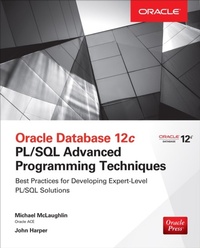
Oracle Database 12c PL/SQL Advanced Programming Techniques
1st Edition
Published on 14. November 2014
511 pages
978-0-07-183515-2 (ISBN)
Available for download
Description

Take Your PL/SQL Programming Skills to the Next Level Build robust database-centric PL/SQL applications quickly and effectively. Oracle Database 12c PL/SQL Advanced Programming Techniques shows you how to write and deploy Java libraries inside Oracle Database 12c, use the utl_file and DBMS_SCHEDULER packages, and create external tables and external procedures. Application security, performance tuning, and Oracle Database In-Memory are also covered in this Oracle Press guide. Configure, deploy, and troubleshoot Java libraries for Oracle object types Use the utl_file package to manage unstructured and structured data Develop and deploy Java I/O libraries and wrap them with PL/SQL Create and use external tables Implement high-speed data transfer Harden database systems and develop secure applications Manage complex schedules and jobs with the DBMS_SCHEDULER package Optimize PL/SQL for use in performance tuning Create and deploy external procedures Implement the Oracle Database In-Memory column store feature
More details
Other editions
Additional editions
Michael McLaughlin | John Harper
Oracle Database 12c PL/SQL Advanced Programming Techniques
Book
12/2014
McGraw-Hill Professional
€84.50
Shipment within 15-20 days
Content
- Cover
- Title Page
- Copyright Page
- Dedication
- About the Authors
- Contents at a Glance
- Contents
- Acknowledgments
- Introduction
- Part I Java in the Database
- 1 Java Functions and Procedures
- Overview
- Oracle Database 12c JVM Features
- Java Architecture in Oracle
- Java Execution Control
- Java Resource Storage
- Java Class Names
- Java Resolvers
- Java Security and Permissions
- Java Threading
- Oracle Java Connection Types
- The Client-Side Driver, or JDBC Thin Driver
- The Oracle Call Interface Driver, or Middle-Tier Thick Driver
- The Oracle Server-Side Internal Driver, or Server-Tier Thick Driver
- Importing Java Class Libraries
- Building a Java File
- Creating a Deterministic Java Library
- Creating a JDBC-Enabled Java Library
- Supporting Scripts
- Summary
- 2 Object Types
- Overview
- Creating a Java Class with SQLData
- Basic Java Class with SQLData
- Object Type Wrapper
- Creating a Java Superclass and Object Types
- Creating the Java Superclass
- Creating the Object Type
- Testing the Java Class File
- Creating a Java Subclass and Object Subtype
- Creating a Java Subclass
- Creating the Object Subtype
- Testing the Java Subclass
- Troubleshooting Java Classes
- Building, Loading, and Dropping Java Class Library Objects
- Using Java Class Library Objects
- Mapping Oracle Types
- Supporting Scripts
- Summary
- Part II File I/O
- 3 utl_file Package
- Overview
- Accessing External Files
- Setting the utl_file_dir Database Parameter
- Using Virtual Directories
- Reading External Files
- Reading Files with the utl_file Package
- Implementing Best Practices
- Copying, Moving, Renaming, and Removing External Files
- Copying External Files
- Renaming or Moving External Files
- Removing External Files
- Creating and Writing to External Files
- Writing Unstructured Data to External Files
- Writing Structured Data to External Files
- Supporting Scripts
- Summary
- 4 Java I/O Libraries
- Overview
- Mapping Virtual Directories to Physical Directories
- Creating a Virtual Directory
- Translating Virtual Names to Paths
- Extracting a File Path and Name
- Setting Java Privileges
- Reading from an External Directory
- Reading from an External File
- Writing to an External File
- Deleting from an External File
- Developing and Deploying Java I/O Libraries
- Reading a Directory
- Reading a File
- Copying a File
- Deleting a File
- Writing a File
- Supporting Scripts
- Summary
- 5 External Tables
- Overview
- Using External Tables
- Creating Virtual Directories and Granting Database Privileges
- Importing a Framework's External Table
- Leveraging the Data Catalog
- Wrapping Access to External Tables
- Cleaning Up the External Table Files
- Supporting Scripts
- Summary
- 6 High-Speed Data Transfer
- Overview
- Importing and Exporting with impdp and expdp
- Exporting Files with expdp
- Importing Files with impdp
- Importing and Exporting with dbms_datapump
- SQL*Loader
- Supporting Scripts
- Summary
- Part III Application Security
- 7 Database Security
- Overview
- LinkedIn Breach
- Key Points of the LinkedIn Breach
- Solutions to Avoid a Similar Breach
- Target Breach
- Key Points of the Target Breach
- Suggested Remediation for the Breach
- NSA Breach
- Key Points of the NSA Breach
- Suggested Remediation for the Breach
- Utah Department of Technology Services Breach
- Key Points of the Utah DTS Breach
- Solutions to Avoid a Similar Breach
- NIST
- SANS
- Planning and Implementing Cybersecurity
- Separation of Duties
- Supporting Scripts
- Summary
- 8 Developing Secure Applications
- Overview
- Programming Patterns
- Auditing with Oracle Audit Vault
- Secure Application Roles
- Proxy Users
- The Database Security Schema
- The utl_sec Package
- Oracle's New Multitenant Architecture
- Sanitizing SQL and PL/SQL
- Bind Variables
- dbms_assert
- Supporting Scripts
- Summary
- Part IV Applied Technologies
- 9 dbms_scheduler Package
- Overview
- Date Intervals
- Immediate Jobs
- Simple Intervals
- Built-in Intervals
- Combined Custom Intervals
- dbms_scheduler View
- *_scheduler_jobs
- *_scheduler_running_jobs
- *_scheduler_job_run_details
- Chained and Clustered Jobs
- Job Management and Security
- Supporting Scripts
- Summary
- 10 Optimizing Using PL/SQL
- Overview
- Current Optimization Platforms
- v$* Views for Performance Tuning
- Gathering Statistics
- Statistics-Gathering Package
- Analyzing a Data Model
- Current Optimization Platforms
- Supporting Scripts
- Summary
- 11 External Procedures
- Overview
- Introducing External Procedures
- Working with External Procedures
- Defining the extproc Architecture
- Defining extproc Oracle Net Services Configuration
- Defining the Multithreaded External Procedure Agent
- Working with a C Shared Library
- Troubleshooting External Procedures
- Configuration of the Listener or Environment
- Configuration of the Shared Library or PL/SQL Library Wrapper
- Supporting Files
- Summary
- 12 In-Memory Column Store
- Overview
- In-Memory Setup and Configuration
- Database Parameter Settings
- Tablespace Settings
- In-Memory Options and Syntax
- Priority
- Distribution
- Compression
- Query Performance
- Compression Stats
- Queries
- DML Performance
- Test Setup
- Supporting Scripts
- Test Results
- Summary
- A Oracle Database Java Primer
- Java and JDBC Architecture
- Configuring the Oracle Java Environment
- Java Programming Language Primer
- Java Basics
- Java Assignment Operators
- Java Conditional and Iterative Structures
- Java Method Definitions
- Java try-catch Blocks
- Testing a Client-Side or Thin-Driver JDBC Connection
- Accessing Scalar Variables
- Writing and Accessing Large Objects
- Writing and Accessing a CLOB Column
- Accessing a BFILE Column
- Supporting Scripts
- Summary
- Index

