

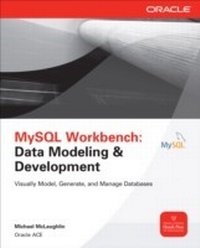
MySQL Workbench
Data Modeling & Development
1st Edition
Published on 21. April 2013
451 pages
978-0-07-179189-2 (ISBN)
Description

The only Oracle Press guide to MySQL Workbench explains how to design and model MySQL databases.MySQL Workbench Data Modeling and Development helps developers learn how to effectively use this powerful product for database modeling, reverse engineering, and interaction with the database without writing SQL statements. MySQL Workbench is a graphical user interface that can be used to create and maintain MySQL databases without coding. The book covers the interface and explains how to accomplish each step by illustrating best practices visually. Clear examples, instructions, and explanations reveal, in a single volume, the art of database modeling. This Oracle Press guide shows you how to get the tool to do what you want. Annotated screen shots demonstrate all interactions with the tool, and text explains the how, what, and why of each step.Complete coverageInstallation and Configuration, Creating and Managing Connections, Data Modeling Concepts, Creating an ERD, Defining the Physical Schemata, Creating and Managing Tables, Creating and Managing Relationships, Creating and Managing Views, Creating and Managing Routines, Creating and Managing Routine Groups, Creating and Managing User & Groups, Creating and Managing SQL Scripts, Generating SQL Scripts, Forward Engineering a Data Model, Synchronize a Model with a Database, Reverse Engineering a Database, Managing Differences in the Data Catalog, Creating and Managing Model Notes, Editing Table Data, Editing Generated Scripts, Creating New Instances, Managing Import and Export, Managing Security, Managing Server Instances
More details
Other editions
Additional editions
Book
05/2013
Osborne/McGraw-Hill
€50.40
Shipment within 15-20 days
Content
- Cover
- About the Author
- Title Page
- Copyright Page
- Contents at a Glance
- Contents
- Acknowledgments
- Introduction
- Part I: Configuration
- Chapter 1: Installing and Configuring
- Fedora Linux
- Install and Configure MySQL Products
- Mac OS X
- Install MySQL Products
- Microsoft Windows
- Pre-install Microsoft Redistributable Libraries
- Install MySQL Products
- Summary
- Mastery Check
- Chapter 2: Creating and Managing Connections
- Fedora
- Mac OS X
- Windows 7
- Configuring MySQL Workbench Connections
- Configuring Server Administration
- Summary
- Mastery Check
- Part II: Data Modeling
- Chapter 3: Data Modeling Concepts
- Data Modeling Theory
- What Is Data Modeling?
- Why Is Data Modeling Important?
- How Do We Accomplish It?
- Data Modeling Systems
- Binary Relationships
- N-ary Relationships
- Notation Sets
- Classic Normalization
- First Normal Form
- Second Normal Form
- Third Normal Form
- Summary
- Mastery Check
- Chapter 4: Creating and Managing Tables and Relations
- Opening and Saving Files
- Creating Tables and Views
- Add Tables
- Add Columns
- Add Indexes
- Add Foreign Keys
- Creating Views
- Creating Routines
- Creating Relationships
- Summary
- Mastery Check
- Chapter 5: Creating and Managing Routines
- Adding a Routine
- Editing a Routine
- Removing a Routine
- Summary
- Mastery Check
- Chapter 6: Reverse Engineering
- Reverse Engineering a Database
- Forward Engineering a Database
- Forward Engineering from an EER Model
- Forward Engineering from a Script
- Summary
- Mastery Check
- Part III: SQL Development
- Chapter 7: Editing Data
- Connecting to Edit Data
- Insert Data
- Update Data
- Delete Data
- Multiple Data Edits
- Summary
- Mastery Check
- Chapter 8: Managing SQL Scripts
- Opening a SQL File
- Running a SQL File
- Summary
- Mastery Check
- Part IV: Server Administration
- Chapter 9: Instances
- Create a Local Instance Manager
- Create a Remote Instance Manager
- Manage an Existing Instance
- Maintain Existing Instance Managers
- Summary
- Mastery Check
- Chapter 10: Creating and Managing Users and Roles
- Adding a User
- Adding Schema Privileges
- Summary
- Mastery Check
- Chapter 11: Imports and Exports
- Exporting a Database
- Importing a Database
- Summary
- Mastery Check
- Chapter 12: Migrating Databases
- Exporting a Database
- Summary
- Mastery Check
- Part V: Appendixes and Glossary
- Appendix A: Mastery Check Answers
- Chapter 1
- Chapter 2
- Chapter 3
- Chapter 4
- Chapter 5
- Chapter 6
- Chapter 7
- Chapter 8
- Chapter 9
- Chapter 10
- Chapter 11
- Chapter 12
- Appendix B: Extending MySQL Workbench
- Scripts
- Modules
- Shell
- Summary
- Appendix C: Setting Up SQL Server
- Installing SQL Server
- Fixing the SQL Server Command-line Interface
- Configuring a User Schemata
- Creating and Seeding a Database
- Summary
- Glossary: Database Modeling Terms
- Index
