

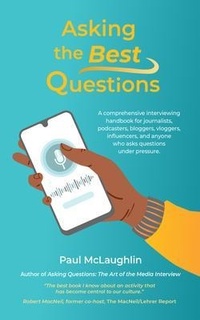
Asking The Best Questions
Description

Interviewing is more complex than just asking questions. A successful interview involves multiple skills, including active listening, commitment to a line of questions, and the ability to adapt to whatever unfolds throughout the process.
Paul McLaughlin has spent decades studying the art of the interview as a working journalist, interviewing coach, and educator. Using personal examples and anecdotes involving other journalists, this comprehensive handbook offers easy-to-read, practical tips for professional questioners in any field - whether in the newsroom, the boardroom, or a podcast studio.
Asking the Best Questions offers insights for every step of the process: researching and securing an interview, building trust and rapport, developing empathy, overcoming your fears, and creating strategies to navigate conversations about complex and traumatic issues. Along the way, McLaughlin shows you how to deal with difficult guests, intimidating topics and unexpected twists and turns.
McLaughlin shares the invaluable tools he carries with him into every interview. And he answers the question everyone wants to know: what to do when the interview doesn't go as planned?
More details
Content
- Intro
- One: The preamble
- The Trump effect
- The war of interviewing
- Interviewing alert
- Not a manual
- Gender-neutral language
- My background
- Some of my best friends
- Two: Educate yourself
- Work on general knowledge and vocabulary
- Advice from a Hall-of-Famer
- Three: Be genuine
- You don't have to act tough
- Emulate Oprah
- Compassion
- Four: Understand the other side
- The microphone as a death ray
- It could damage my reputation or career
- What if I say something stupid?
- Scientists and other professionals
- Oprah, how did I do?
- Possible disconnects
- Don't look me in the eye
- Five: Accept the role
- How to interrupt
- Like paddling a canoe
- Six: Getting the interview
- Don't just email
- Writing an interview request
- Using a third party
- Media and communication departments
- Seven: Location, location, location
- The power of location
- The medicine cabinet ruse
- Be imaginative
- The walking interview
- Background woes
- Eight: What do I have the right to ask?
- The key word is "relevant"
- Nine: Preparation
- What color socks did you wear on your first heist?
- Bone up
- Preparing questions
- The cost of not knowing
- Ten: What are you walking into?
- Four Basic Types of Guests
- Wrong assumptions
- Not as prickly as advertised
- Who is the interviewee talking to?
- Eleven: Role-playing and visualization
- Like chess
- Confrontational and emotionally charged interviews
- Don't be bullied into attacking
- Twelve: Be conversational
- A pas de deux
- We all make mistakes
- Thirteen: It's okay to be shy
- What if I'm young and have a high voice?
- Fourteen: Asking a person's age
- Fifteen: We're not the police
- Give them a reason
- Ambush interviews
- Going undercover and hidden cameras
- Sixteen: Transitioning to performance mode
- Seventeen: Invasive personal questions and sexism
- Should male journalists be allowed to interview female celebrities in glossy magazines?
- Alarm bells should go off
- Flirting
- Interviewing transgender guests
- Mean tweets
- Eighteen: Interviewee demands
- This often works
- I want to see the article or hear the broadcast beforehand
- What do you say when asked to share a draft?
- When might you share?
- An expert on whether journalists should let sources look over stories before publication
- Nineteen: When difficult conditions are imposed
- Off the record
- The post-comment condition
- Twenty: Comfort the afflicted/afflict the comfortable
- Hold their feet to the fire
- We don't do PR
- Walter Cronkite's liberal take
- Noam Chomsky on being embedded
- Objectivity
- It doesn't have to be sweet, Caroline
- Twenty-one: Brain-based interviewing
- Twenty-two: Trust and rapport
- Trust
- Rapport
- Twenty-three: Listening
- Listen up
- A skill to work on
- Avoid distractions
- Our job is to reveal
- We all miss something
- What to listen for
- Why we don't listen
- You easily can miss things
- Listen to Hemingway
- Twenty-four: Silence
- How silence helps an interviewer
- Allow time to recall
- The director's cue
- Twenty-five: Tone
- Why should interviewers care about tone?
- No one likes the sound of their own voice
- Tone and meaning must match
- A killer confesses
- Twenty-six: One question at a time
- Twenty-seven: Open and closed questions
- Twenty-eight: Following up on answers
- Keep asking
- Twenty-nine: Coming up with the next question
- Thirty: D&A, the lifeblood of features
- Details
- Specifics
- Anecdotes
- Look for connections
- Thirty-one: Slow down
- Interviewing elderly people
- The speed of stress
- Thirty-two: Don't answer your own questions
- The right way to do it
- Thirty-three: Interviewee fatigue
- Poetic injustice
- What if you have to ask tired, old questions?
- Thirty-four: The broadcast interview
- Some foundation required
- David Frost on the interview subtext
- The need for a dynamic
- The audience
- Be totally present
- Off-camera interviews
- Thirty-five: The print interview
- Recording the interview
- Zoom interviews
- Lasting longer
- When writing or recording isn't possible
- What they have a right to know
- Thirty-six: Telephone and email interviews
- Don't dial too soon
- The voice can say a lot
- The email interview
- Thirty-seven: Streeters
- Thirty-eight: Difficult interviews
- Quiet resolve
- Dealing with appalling viewpoints
- Find a way in
- If the interview becomes problematic
- Necklace and heels
- One-Minute Answers
- Thirty-nine: Don't apologize for a question
- Forty: What if they question me?
- Forty-one: Interviewing victims
- Respect the victims
- Terminology
- After the interview
- Resources to help
- Many want to talk
- A call for empathy
- Forty-two: Interviewing minors
- Fear not the children
- The CJR's advice
- Forty-three: Long preambles
- Forty-four: Avoid "utmost" questions
- Forty-five: Bad verbal habits
- How do you feel about this question?
- A better feel for the question
- Forty-six: Some people say
- Forty-seven: Reading body language
- What if you're wrong?
- Women's intuition
- Our own body language
- Forty-eight: Manage the interview
- Before the interview
- What if you're attacked prior to an interview?
- During the interview
- Forty-nine: The most important question
- Fifty: The final question
- Acknowledgements
- References
- Index
- Subject Index
- Name Index
- About the Author
